




























Every Year Brings New Ways to Earn with Cryptocurrency. From mining and staking to trading, farming, and launching your own NFT collections – the range of crypto income strategies keeps growing. In 2025, a new trend has emerged: trading data on Arkham.
Mining, for example, demands substantial upfront investment but is almost entirely passive. Trading, on the other hand, can start with just €10, but requires full immersion in learning and practice.
In this article, we focus on another classic method – crypto arbitrage. We’ll explore what it is, how to profit from it, and whether beginners can realistically master it.
What Is Cryptocurrency Arbitrage?

The crypto market is known for its high volatility – the rate at which prices fluctuate within short timeframes. This means exchange rates can vary significantly even within an hour, creating price discrepancies across different platforms and opening up opportunities for crypto arbitrage.
Crypto arbitrage is the practice of buying cryptocurrency in one trading pair and selling it in another to profit from the price difference. Unlike regular trading, where investors wait for a price swing, arbitrage involves near-instant selling after buying.
There are two main types of crypto arbitrage:
-
Intra-exchange arbitrage
-
Inter-exchange arbitrage
Let’s take a closer look at both.
Intra-Exchange Cryptocurrency Arbitrage
These transactions happen on the same exchange but in different trading pairs, usually involving an intermediate cryptocurrency. For example: exchanging ETH for BTC, BTC for USDT, then USDT back to ETH.
Key features:
-
Requires a moderate level of experience to identify opportunities
-
Fees apply only within the platform
-
No need to transfer funds to another exchange
Inter-Exchange Cryptocurrency Arbitrage
This method involves buying crypto on one exchange and selling it on another at a higher price.
Key features:
-
Easier to track than intra-exchange arbitrage
-
Small price differences often aren’t worth it due to fees
-
Besides trading fees, withdrawal fees apply, making this method more capital-intensive
You can also loop your funds back to the original exchange and repeat the cycle – but due to fees, this requires careful planning and precise calculations.
Timing matters too – delays in transferring funds between exchanges could erode profit opportunities.
Where Do Price Differences Come From in Inter-Exchange Arbitrage?
Large price discrepancies arise during periods of high market activity – when prices spike or crash, or when whales (large players) make massive trades that shift an exchange’s price. These “arbitrage windows” typically last only a few hours.
Example of Arbitrage in Action
The process is straightforward – even beginners can follow these steps. Here’s how inter-exchange arbitrage works:
-
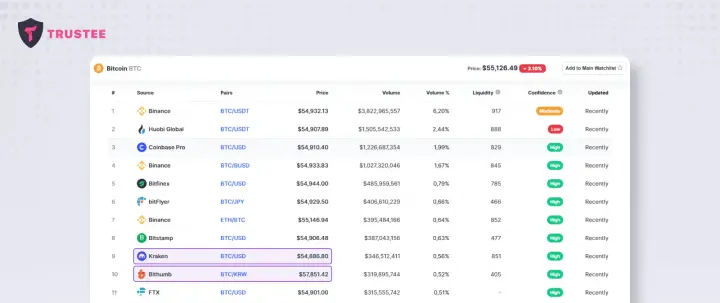
Monitor crypto prices across different exchanges
Use tools like CoinMarketCap, CoinGecko, or CryptoCompare.
-
Identify pairs with significant price differences
Look for gaps of 3% or more – smaller gaps may not cover fees. Always calculate based on your available funds and estimated costs.
Example: BTC on Binance costs significantly more than on Kraken.
$98,383 / $95,118 * 100% = 3.43%
The 3%+ difference means this is a valid opportunity.
-
Buy BTC on the cheaper exchange
Suppose you buy 0.1 BTC for $95,118 on Kraken, paying a 0.2% fee = $19.02
0.1 BTC - 0.2% = 0.0998 BTC
-
Transfer BTC to the second exchange and sell
On Binance, BTC trades at $98,383. Subtract withdrawal fee (0.0005 BTC) and 0.1% trading fee:
0.0998 BTC - 0.0005 BTC - 0.1% = 0.0992 BTC
Sell 0.0992 BTC * $98,383 = $9,759
Initial investment = $9,511
Profit = €248 – not bad!
Earning from Cryptocurrency Arbitrage
To profit, you must correctly calculate the exchange rate difference while factoring in all fees. Our example only shows an estimate and doesn’t include:
Pitfalls of Crypto Arbitrage
Besides fees, consider these:
-
Spread between buy and sell orders
-
Liquidity of the order book
-
Deposit/withdrawal speed
-
Deposit/withdrawal availability
Spread
Higher market cap and liquidity = lower spread. But during high volatility, spreads widen – increasing arbitrage opportunities, but also risk.
Liquidity
The deeper the order book, the more stable the price. Low liquidity means prices move easily with small trades, which is common with smaller altcoins – higher profit potential, but also higher risk.
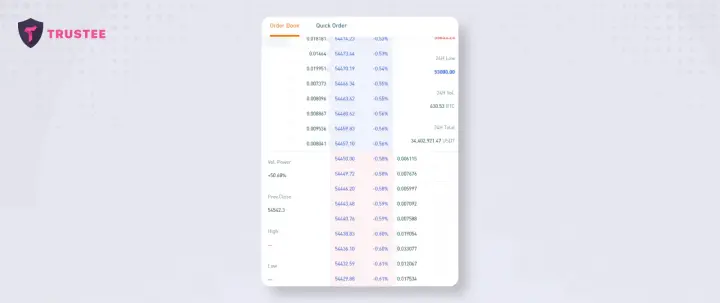
Less popular altcoins have less liquidity, so the spread is often larger, which opens up opportunities for higher earnings, but also carries additional risks for arbitrageurs.
Speed of Deposits/Withdrawals
Top-tier exchanges usually process transactions in 5 minutes. However, during volatile periods, heavy network loads can cause delays.
Deposit/Withdrawal Availability
If price differences are extreme, some exchanges may suspend wallet operations. Always verify wallets are operational before sending funds.
Popular Arbitrage Strategies in 2025

Here are the top strategies for 2025, suitable for both new and experienced traders:
Playing the Inter-Exchange Spread
Buy low on one exchange, sell high on another. This is simple, but rare with major coins – it requires constant monitoring or switching to low-liquidity tokens.
Intra-Exchange Arbitrage (Synthetic Arbitrage)
Use a triangular strategy:
-
Buy BTC with USDC
-
Convert BTC to ETH
-
Sell ETH back to USDC
Exchange-Based Deposits
Hold funds across platforms. For example, if BTC spikes on Exchange B, buy BTC on Exchange A and sell on B for profit – ideal for those with spread-out balances.
Statistical Arbitrage
Advanced strategy involving correlation analysis. For example, buy BTC when it drops relative to ETH, then sell when ETH falls back, growing your holdings over time.
Triangular Arbitrage
Trade within a single exchange using three pairs: BTC → ETH → USDC → BTC.
This method offers:
-
Low risk
-
Speed
-
Easy automation
Choosing Exchanges and Cryptocurrencies for Arbitrage
The platform’s performance heavily impacts arbitrage outcomes. Delays can wipe out potential profits.
Use only trusted, liquid exchanges. Top platforms by volume (via CoinMarketCap):
-
Binance
-
Coinbase Exchange
-
Kraken
-
KuCoin
-
ByBit
-
OKX
-
Bitstamp
-
Gate.io
-
Bitfinex
-
Gemini
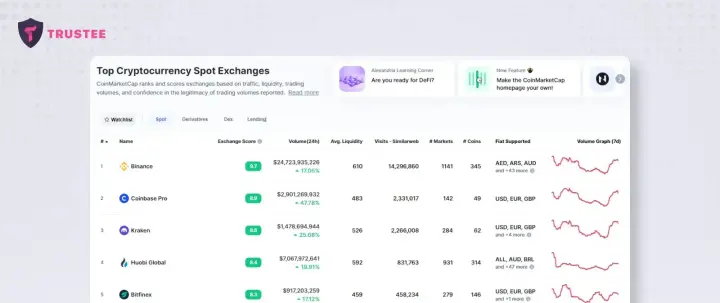
You can use both European and international exchanges for crypto arbitrage.
Exchange Selection Criteria
-
Low fees
-
Fast processing
-
No deposit issues
-
Deep liquidity
-
Regulatory compliance
Choosing a Currency for Arbitrage
Use crypto arbitrage tools or scanners to track price differences.
Helpful sites:
Crypto Arbitrage Tools

To increase efficiency, traders use software such as:
-
Scanners
-
Bots
-
Rate comparison tools
Scanners
These tools monitor multiple exchanges for significant price gaps. Some include API access for trading and withdrawals.
Arbitrage Bots
Bots can identify opportunities and execute trades automatically. They’re fast and work 24/7, but require proper configuration.
Comparison Tools
Beginner-friendly and time-saving, these tools detect rate gaps within milliseconds.
Pros and Cons of Crypto Arbitrage
Pros:
-
Easy for beginners
-
Quick profits with manageable risk
-
No need to learn trading deeply
-
Small initial investment required
Cons:
-
Delays or wallet downtime can cost you
-
Market moves fast – profits can disappear
-
Opportunities may take time to appear
-
Risk of beginner mistakes
Is Crypto Arbitrage Legal?
Yes – arbitrage is based on legitimate market principles: profiting from price differences across platforms. However, local laws may impose restrictions or require registration. Always check exchange rules and comply with local regulations.
Conclusion
As we've seen, crypto arbitrage offers a practical way to earn with relatively low risk. With the right tools and planning, anyone can master it.