




























Is your child ill? Have you lost all your savings? Has your boss become completely unbearable? No problem! Apply a little blockchain, sprinkle some Ether on top — and everything will be fine by morning.
Of course, this is a joke: blockchain is not a universal solution to every everyday, financial or management problem.
Blockchain is often perceived as a technological “magic pill” capable of eliminating every weakness in existing systems. At the same time, Bitcoin has acquired a controversial reputation as a tool used for illegal transactions, although the technology itself and the ownership of Bitcoin are not inherently criminal, while the legal status of cryptocurrencies depends on the laws of each jurisdiction.
In this article, the Trustee Wallet team will explain why these perceptions have developed, clarify less obvious issues and describe why blockchain has become so popular, how it differs from Bitcoin and when this technology is genuinely useful.
We hope you have fastened your seat belt, as these concepts are frequently confused, oversimplified or used for marketing purposes online. Below, you will learn how blockchain, Bitcoin, decentralisation and censorship resistance are actually connected.
Key Takeaways
- A blockchain is a method of maintaining an ordered ledger in which records are grouped into connected blocks. Blockchain alone does not guarantee decentralisation, transparency, security or censorship resistance.
- Bitcoin uses blockchain together with a peer-to-peer network, Proof-of-Work, consensus rules, digital signatures and economic incentives, enabling participants to agree on a single transaction history without a central operator.
- Bitcoin’s censorship resistance is provided not only by its chain of blocks but by the entire network architecture: independent nodes, miners, open verification of the rules and the ability of users to store and transfer BTC independently.
- Cryptographically linked records existed before Bitcoin. However, Bitcoin demonstrated how such a structure could be used in an open, decentralised monetary system and brought the concept of blockchain into the mainstream.


What Is Blockchain and Why Did Bitcoin Need It?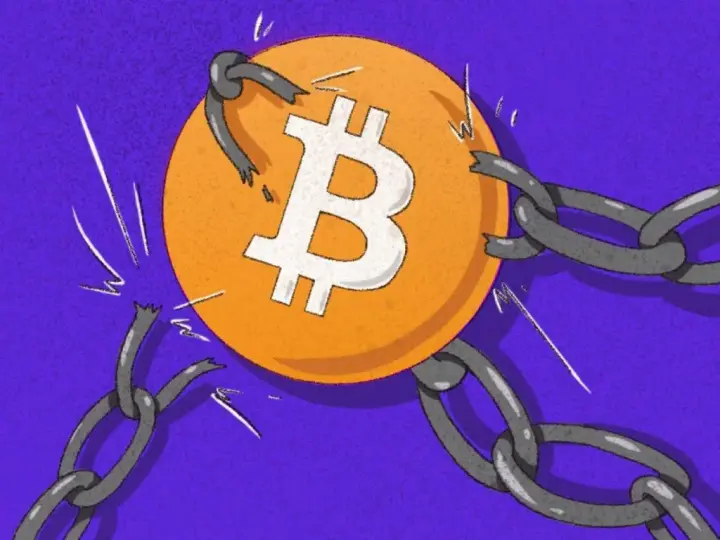
One of the main ideas behind many cryptocurrencies is to create an open digital system in which users can transfer value directly without the mandatory involvement of a central intermediary. In public decentralised networks, this architecture may also increase censorship resistance, although the degree of such resistance depends on the distribution of nodes, validators or miners, the consensus rules and other characteristics of the particular protocol.
This idea existed long before Bitcoin appeared. Researchers and members of the cypherpunk movement discussed digital money, privacy, electronic signatures and direct payments between users. For the internet to support independent digital payments, it required so-called “internet money” — assets that exist within the digital environment and can be transferred directly on a peer-to-peer basis without the mandatory involvement of a financial institution.
Therefore, one of the main ideas behind cryptocurrencies is to enable the direct transfer of digital value according to the rules of the relevant network. Blockchain serves a somewhat different purpose: it stores an agreed and ordered history of records grouped into cryptographically linked blocks. In public networks, this history may be available for independent verification by every participant, although not every blockchain is public or completely transparent.
From a technical perspective, it is often easier and less expensive to create a transparent database or event log without using blockchain. An immutable record history — or track record — may also be implemented using digital signatures, hashing, audit logs, version control systems and a trusted server. Blockchain becomes justified when several parties need to maintain a shared ledger but are unwilling or unable to entrust its management entirely to one organisation.
How Are Blockchain and Bitcoin Connected?
Bitcoin uses a chain of blocks to organise and record confirmed transactions. Each block contains a reference to the previous block, so altering an older record would require recalculating the Proof-of-Work for the modified block and every subsequent block, and then overtaking the honest part of the network.
However, Bitcoin’s main value does not lie solely in its blockchain structure. The system combines a peer-to-peer network, digital signatures, the UTXO model, Proof-of-Work, consensus rules, difficulty adjustment and economic incentives for miners. The combined operation of these elements enables participants to agree on a single transaction history and prevent double spending without a central payment operator.
Bitcoin’s censorship resistance is also not achieved by blockchain technology alone. It depends on the distribution of network nodes and computing power, the ability of users to broadcast transactions independently, open access to rule verification and the absence of a single administrator capable of changing a balance or prohibiting a transaction at their own discretion. However, censorship resistance is not absolute: individual miners, services or providers may filter transactions, but the decentralised structure makes it more difficult to establish a single point of control.
The connection between blockchain and Bitcoin is therefore that Bitcoin uses a chain of blocks as one component of its system. The blockchain stores the agreed transaction history, while the network protocol and consensus mechanism determine which blocks are valid and which version of the history is accepted by participants.
Why Has Blockchain Become So Popular?
Over time, simplified lines of reasoning developed in public discussions, the media, business and government institutions:
- cryptocurrencies are difficult to control using traditional methods, so they became associated with increased financial, legal and operational risks and were sometimes incorrectly described as inherently illegal;
- blockchain began to be presented as a neutral technology for verifying data integrity, automating processes and increasing transparency without directly associating it with attempts to change the financial system, giving the term a more positive image.
To avoid negative reactions from regulators, investors and the wider public, some industry representatives did indeed begin to separate the concept of blockchain from cryptocurrency. Presentations and corporate projects focused on “distributed ledgers”, “immutable data” and “digital transformation” rather than independent money or the removal of intermediaries. Gradually, the word “blockchain” came to be used more broadly than Bitcoin and acquired a positive technological image.
However, it would be incorrect to claim that blockchain emerged solely as a derivative of Bitcoin’s popularity. The concepts of cryptographically linking records and digital timestamping had been described before Bitcoin. Nevertheless, Bitcoin was the first system to successfully combine a chain of blocks with an open peer-to-peer network, Proof-of-Work and economic incentives, demonstrating the practical value of this architecture in a global monetary system. Bitcoin’s subsequent popularity became the main factor behind the widespread adoption of the term “blockchain”.
This is how the contrast between “good blockchain” and “questionable Bitcoin” emerged in public perception. In reality, the two concepts cannot be completely separated, but it is equally incorrect to treat them as synonyms: blockchain is one technological component, while Bitcoin is a complete monetary and payment system with its own rules, network, BTC asset and consensus mechanism. Unexpected? Interesting? Any objections?
We also know a simple way to buy Bitcoin — by using Trustee Plus. Before purchasing digital assets, consider the fees, service terms, identity verification requirements and risks associated with changes in market value.
Frequently Asked Questions About Blockchain and Bitcoin
What Is the Difference Between Blockchain and Bitcoin?
Blockchain is a structure and method for maintaining an ordered ledger in which new records are grouped into connected blocks. Bitcoin is a decentralised payment and monetary network that uses blockchain together with Proof-of-Work, a peer-to-peer protocol, digital signatures, consensus rules and the BTC asset. Bitcoin therefore uses blockchain but is not limited to it.
Was Bitcoin the First Blockchain?
Bitcoin became the first successfully operating public decentralised system to combine a chain of blocks, Proof-of-Work, a peer-to-peer network and economic incentives to solve the double-spending problem. However, the concepts of cryptographically linking documents and timestamps existed earlier. Stuart Haber and Scott Stornetta published their work on secure digital timestamping in the early 1990s.
Does Blockchain Provide Complete Transparency?
No. The degree of transparency depends on the architecture of the particular network. In a public blockchain, records are generally available for viewing and independent verification, although the identities of address owners may remain unknown. Access to data may be restricted in a private or permissioned blockchain. Furthermore, blockchain can confirm the integrity of recorded data but cannot guarantee the accuracy of information obtained from the outside world.
Why Is Bitcoin Considered Censorship-Resistant?
Bitcoin has no single administrator capable of independently preventing a user from owning BTC or deleting a confirmed transaction. Operations are distributed through a decentralised network, while independent nodes verify the validity of blocks according to shared rules. Nevertheless, censorship resistance is not absolute: individual miners and services may filter transactions, while users may face restrictions imposed by exchanges, banks, internet providers or legislation.
Does Every Business Need Blockchain?
No. If a system has one trusted operator and its participants are prepared to rely on a centralised database, a conventional solution will often be faster, less expensive and simpler. Blockchain may be useful when several independent parties require a shared transaction log, have limited trust in one another and do not want to give one participant complete control. The decision should be made after comparing the potential benefits with the costs, scalability, privacy requirements and legal obligations.