





























When science fiction writers or Hollywood directors imagined the future of artificial intelligence, they usually pictured something sinister: armies of killer androids, Skynet from ‘Terminator’, the Machine from ‘The Matrix’ or HAL 9000 from ‘2001: A Space Odyssey’. In other words, for decades we were being prepared for a machine uprising. But reality, as always, turned out to be far more pragmatic. Instead of seizing nuclear arsenals, artificial intelligence mostly writes emails, generates memes, helps find bugs in code and recommends series for the evening.
In 2026, AI agents in cryptocurrency stepped onto the stage. They very quickly moved from analysing financial markets based on on-chain data to managing capital in DeFi 24/7 without any human intervention. Blockchain became the perfect habitat for them — a digital jurisdiction where strict smart contract rules apply and, instead of passports, only private keys are required.
This trend gained momentum so quickly that, at the beginning of 2026, the total market capitalisation of projects involving crypto AI agents exceeded 16 billion dollars. This is no longer a niche toy for geeks. It is a real financial tool that is changing the rules of the game right now.
Key Takeaways
-
- Not just bots. AI agents in cryptocurrency are autonomous systems capable of making decisions independently, learning and interacting with smart contracts without constant user intervention.
- From trading to management. The use of AI agents covers far more than trading. They manage DeFi portfolios, optimise farming, vote in DAOs, check smart contract security and even handle payments and NFTs.
- DeFAI as a separate niche. A new field is emerging: DeFAI (DeFi + AI), where protocols integrate artificial intelligence to automate financial operations, from yield farming to liquidity management.
- Technological foundation. Crypto AI agents operate through a combination of machine learning, natural language processing (NLP), blockchain interaction via APIs and oracles. Some projects allow users to create their own agents without code.
- Benefits and risks. Process automation and the absence of emotion in decision-making are advantages. However, there are also serious risks: algorithmic errors, smart contract vulnerabilities and the question of trusting autonomous systems with access to your funds.
- The main trend of 2026. Experts call AI agents the next major wave after AI tokens in cryptocurrency. Projects such as Virtuals Protocol, Fetch.ai and Autonolas are already demonstrating working solutions with millions of users.


What Are AI Agents in Cryptocurrency in Simple Terms?
An AI agent is a programme based on artificial intelligence that can perform tasks independently without constant human supervision.
Unlike simple bots that operate according to a rigid ‘if-then’ algorithm, AI agents are capable of:
-
- analysing data: on-chain metrics, news, social media;
- making decisions based on context;
- learning from mistakes and improving their strategy;
- interacting with other agents and people through natural language.
In the context of cryptocurrency, AI agents are autonomous systems that can:
-
- trade on CEX and DEX exchanges;
- manage DeFi portfolios: staking, farming, moving assets between protocols;
- monitor smart contract security;
- vote in DAOs on behalf of token holders;
- interact with Web3 applications and execute transactions.
Put simply: you set a goal — for example, to maximise the yield of your crypto portfolio. The AI agent analyses the market, finds the most profitable opportunities in DeFi protocols, moves your assets between liquidity pools, staking platforms and farms — all on its own, without your involvement. You simply get the result.
How AI Agents Differ From Trading Bots
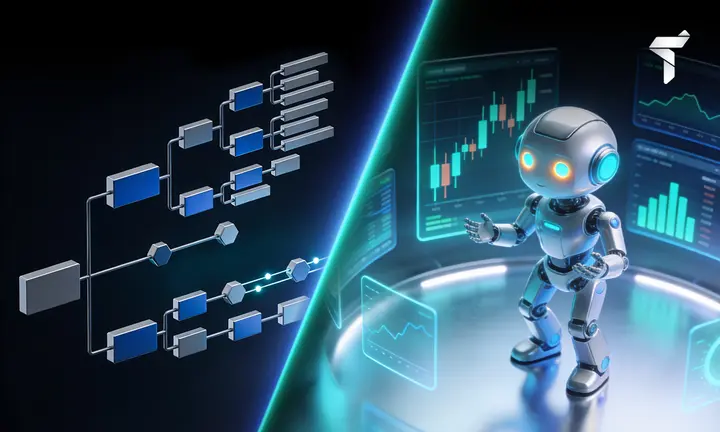
Many people confuse crypto AI agents with ordinary trading bots. But the difference is fundamental.
|
Feature |
Trading Bots |
AI Agents |
|
Operating logic |
Rigid rules: if price < X, buy |
Learning from data, adapting strategy |
|
Independence |
Carry out user commands |
Make decisions autonomously |
|
Learning |
No |
Learn from historical data and their own mistakes |
|
Interaction with DeFi |
Limited, trading only |
Full: staking, yield farming, liquidity management |
|
Language understanding |
No |
Can receive commands by text or voice |
|
Setup complexity |
Technical knowledge required |
Can be configured in simple language: ‘maximise yield’ |
|
Examples |
3Commas, Cryptohopper, TradingView bots |
Virtuals Protocol, Fetch.ai, Autonolas |
The key difference: a bot acts according to a script that you have programmed. An agent searches for the best scenarios itself and changes them depending on the market situation.
How AI Agents Work in Cryptocurrency
To understand how AI agents for trading and DeFi function, let’s break down their architecture step by step.
Step 1: Data Collection
An AI agent monitors different sources of information:
-
- On-chain data — transactions, trading volumes, movements of large wallets (whale alerts).
- Exchange data — prices, order books, liquidity on CEXs and DEXs.
- News and social media — Twitter/X, Reddit, Telegram channels.
- DeFi metrics — liquidity pool APY, protocol TVL, smart contract risks.
Step 2: Analysis Through Machine Learning
The collected data is processed by AI models:
-
- Technical analysis — identifying patterns on charts.
- Fundamental analysis — evaluating projects by metrics.
- Sentiment analysis — what people are writing about a token on social media.
- Forecasting — estimating the likelihood of price movement.
Step 3: Decision-Making
Based on the analysis, the agent decides what to do:
-
- buy or sell a token on an exchange;
- move assets into another DeFi protocol;
- take profit or limit losses;
- vote in a DAO for a specific proposal.
Step 4: Execution via Blockchain
The AI agent interacts with smart contracts:
-
- connects to your crypto wallet, often through delegated permissions rather than transferring private keys;
- executes transactions automatically;
- signs transactions through secure methods, such as multisig or multi-signature.
Step 5: Learning and Optimisation
After executing operations, the agent analyses the results:
-
- if the strategy worked — it reinforces it;
- if not — it adjusts the approach for the future.
Example of How It Works in DeFi
You have $10,000 in USDC stablecoins and want to maximise your yield.
- The AI agent scans all DeFi protocols: Aave, Compound, Curve, Yearn.
- It finds the pool with the highest APY, for example 12% on Curve.
- It moves your USDC there.
- A week later, it detects a new pool with 15% APY on another platform.
- It automatically transfers the funds there.
- At the same time, it accounts for network fees so that the move remains profitable.
Where AI Agents Are Used in Cryptocurrency
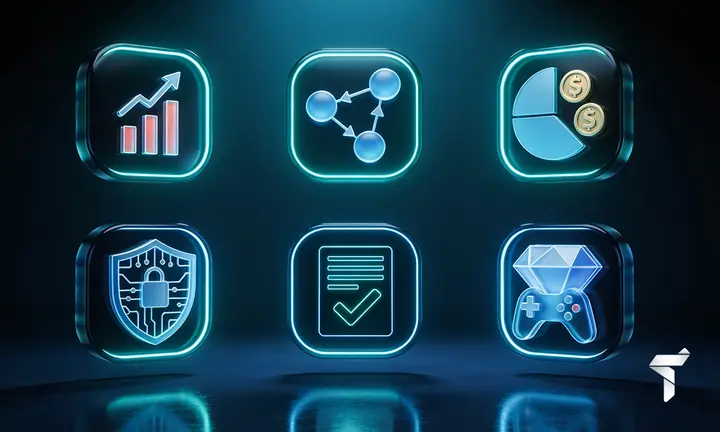
The use of AI agents in crypto has long moved beyond simple trading. Let’s look at the main areas.
Trading
This is the most obvious use case. AI agents for trading can:
-
- perform high-frequency trading on DEXs;
- search for arbitrage opportunities between exchanges;
- trade based on technical analysis and patterns;
- react to news faster than a human.
The best AI agents for crypto trading in 2026 include Fetch.ai, Morpheus Network and solutions from Autonolas — but more on that later.
DeFi and DeFAI
DeFAI is a new term that combines DeFi (decentralised finance) and AI (artificial intelligence). Here, AI agents automate complex financial operations:
-
- Yield farming — searching for the most profitable liquidity pools and automatically moving funds.
- Liquidity management — dynamic allocation of assets between protocols depending on market conditions.
- Risk hedging — automatic insurance contracts through Nexus Mutual or similar platforms.
- Portfolio rebalancing — maintaining a set proportion of assets, for example 50% BTC / 30% ETH / 20% stablecoins.
Crypto Portfolio Management
Instead of constantly monitoring the market yourself, you delegate this task to an agent:
-
- it tracks the balance of your portfolio;
- rebalances assets when necessary: selling what has risen in price and buying what has fallen;
- notifies you about important events.
It is like having a personal financial adviser with Wall Street experience who works 24/7 and costs pennies compared with real managers.
Security
AI agents can scan smart contracts for vulnerabilities:
-
- detect errors in code before a project launch;
- monitor suspicious activity on the blockchain, such as signs of a rug pull;
- warn about phishing sites and suspicious transactions.
DAO and Governance
Voting in DAOs often requires time and an understanding of proposals. AI agents can:
-
- analyse proposals for changes to a protocol;
- vote in line with your interests or a pre-defined strategy;
- participate in multisig project governance.
This is especially useful for those who hold governance tokens in many projects at once: an agent can help you avoid missing important votes and optimise your influence.
NFTs, GameFi and Web3
The range of applications here is also broad:
-
- NFT trading — agents track rare collections on OpenSea or Blur and buy them before the price takes off.
- GameFi — automation of gaming activities, such as farming resources in P2E games.
- Web3 Identity — managing a user’s decentralised identity through protocols such as ENS or Lens Protocol.
Payments
Some projects are developing agents to automate crypto payments:
-
- automatic subscriptions to services via crypto;
- smart payment agents for businesses: they accept payments from clients in different tokens and convert them into the required currency;
- cross-chain transfers: the agent selects the cheapest route through a bridge or exchange service.
Examples of AI Agents
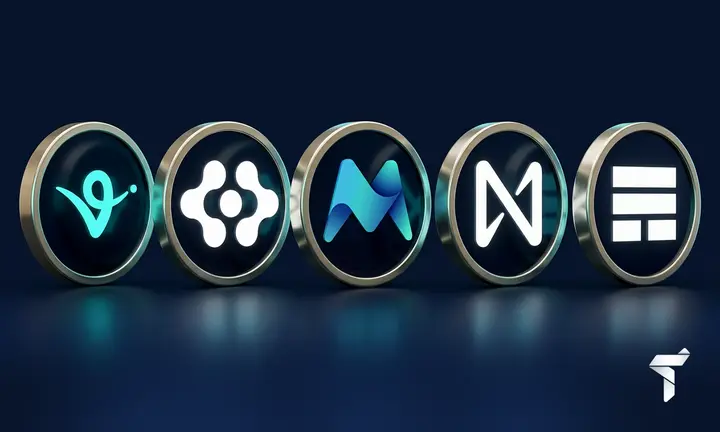
Now let’s look at specific projects that are already working or are actively being developed in 2026.
Virtuals Protocol
Virtuals Protocol is one of the most popular projects in the AI Agents Crypto space. It is a platform for creating your own AI agents without code through a builder.
The main idea: anyone can create their own virtual agent with a unique ‘personality’, teach it to perform specific tasks — trading, market monitoring, interacting with users — and even monetise it through agent tokenisation.
Project token: VIRTUAL — used for protocol governance and rewards for developers of successful agents.
Why this is interesting: the platform allows agents to be created not only for DeFi operations, but also for social media, such as an influencer agent, games and metaverses.
Fetch.ai
Fetch.ai is one of the pioneers in autonomous agents on the blockchain. The project has existed since 2017 and focuses on creating a decentralised network of economic agents for different industries:
-
- supply chain optimisation;
- trading and DeFi;
- data and computing management.
Project token: FET — used to pay for agent services in the network.
Autonolas
Autonolas is a framework for creating decentralised off-chain services based on AI agents.
This project is aimed at developers: it enables the building of complex autonomous systems using machine learning and coordination between agents.
Project token: OLAS — the protocol’s utility token, used for governance and staking to support off-chain services and maintain the network.
Example use case: creating an autonomous market maker (AMM) for a DEX that adapts its strategy depending on market volatility and trading volume — without a human operator.
Morpheus Network
Morpheus positions itself as an ‘operating system for AI agents’. Users can deploy their personal agents on this platform to interact with Web3 applications:
-
- DeFi portfolio management;
- automation of NFT purchases;
- performing tasks in metaverses.
Project token: MNW — used to automate tasks in the network and pay for transactions in the logistics blockchain ecosystem.
NEAR Protocol: AI as Part of the Ecosystem
NEAR is actively integrating AI agents as part of its Web3 application ecosystem:
-
- creation of intelligent smart contracts with machine learning functions;
- integration with decentralised data storage for training models.
Project token: NEAR — the token is used to pay for any operations and transfers on the network, staking to maintain blockchain security and governance when voting on protocol development.
NEAR is a good option for developers who want to experiment with AI Agents in a fast and inexpensive blockchain environment.
Benefits and Risks of AI Agents in Cryptocurrency
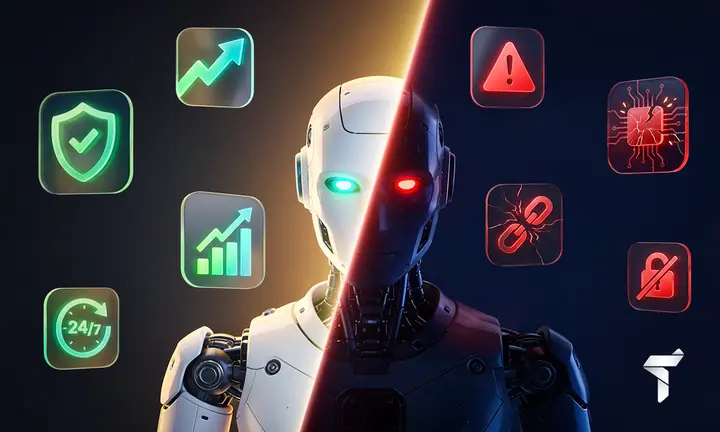
Like any technology, the use of AI agents has its bright and dark sides. It is important to understand both aspects before entrusting them with your assets.
|
Benefits |
Risks |
|
Automation: no need to spend hours monitoring the market and carrying out operations manually. |
Algorithmic errors: even the best machine learning models can be wrong in forecasts or make suboptimal decisions. |
|
Speed: agents react to market changes in milliseconds — faster than any human. |
Loss of funds due to bugs: vulnerabilities in the code of an agent or smart contract can lead to loss of assets. |
|
Absence of emotion: an agent is not driven by fear or greed, which often makes human traders irrational. |
Trust in autonomous systems: you delegate control over funds to a programme, and this requires a high level of trust in the developers and the security of the system. |
|
Multitasking: one agent can simultaneously monitor dozens of tokens and protocols. For a person without a team of analysts, this is impossible. |
Market manipulation: large ‘smart’ agents can coordinate their actions and create artificial volatility or pump-and-dump schemes, although this is more of a theoretical risk. |
|
Yield optimisation: constantly searching for the best opportunities in DeFi or arbitrage strategies increases portfolio profitability. |
Regulatory risks: the legal status of autonomous agents is still undefined in most countries. There may be issues with taxation or liability for the agent’s actions. |
|
Accessibility: some platforms allow agents to be created without deep technical knowledge — simple settings or even natural language are enough. |
Dependence on oracles and data: if a data source is compromised or provides incorrect information, the agent will make the wrong decision. |
How to Use AI Agents Safely in Crypto
If you have nevertheless decided to try working with AI Agents Crypto, there are several important safety rules.
1. Never Give Full Access to Private Keys
Most legitimate projects work through delegated access rights via smart contracts or multisig solutions, but they never require your seed phrase or private key directly.
2. Start With Small Amounts
Before trusting an agent with a large portfolio, test it with small amounts:
-
- check the effectiveness of its strategies;
- assess the stability of its operation;
- make sure all operations are transparent and understandable to you.
3. Check the Project’s Reputation
Before using any service:
-
- look for reviews from real users;
- check the smart contract audit: if the project is serious, it publishes audit results from CertiK, Trail of Bits and other companies;
- look at usage statistics: how many people use it, what the TVL (Total Value Locked) is, how many transactions have been completed successfully.
4. Use a Separate Wallet for Experiments
Create a ‘test’ wallet with a limited amount of funds specifically for working with new protocols and agents. This will limit possible losses if problems arise.
5. Regularly Review Smart Contract Permissions
Some agents receive spending approval for your tokens from a smart contract.
Regularly check active permissions through tools such as Revoke.cash or Etherscan Token Approvals and revoke unnecessary or suspicious approvals.
6. Do Not Blindly Trust ‘Black Boxes’
If an agent does not explain its actions or strategies, that is a red flag.
Good projects provide transparent analytics of operations: which tokens were bought or sold, why this particular strategy was chosen, what the expected yield is, and so on.
7. Be Careful With Promises of Superprofits
If a project promises a guaranteed return of 50%+ per month, it is either fraud or a pyramid scheme disguised as an AI Agent product.
AI Agents and the Future of DeFi
Experts call the integration of artificial intelligence into decentralised finance one of the main trends of the coming years.
Why Is This Important?
1. Mass Adoption of DeFi Requires Simplicity
Today, using DeFi protocols is still too complex for an ordinary user:
-
- you need to understand on-chain data;
- manually search for the most profitable liquidity pools;
- risk making a mistake when interacting with a smart contract.
2. Capital Optimisation at Protocol Level
Many DeFi platforms are beginning to integrate AI directly into their protocols:
-
- automatic rebalancing of liquidity pools depending on demand;
- dynamic interest rates based on market forecasts;
- gas fee optimisation through analysis of Ethereum or other blockchain network load.
3. New Business Models Around Autonomous Agents
Entire ecosystems are emerging around the concept of AI Agents:
-
- agent marketplaces where you can buy a ‘ready-made’ trader or DeFi manager;
- tokenised agents: you own a share of a successful agent and receive part of its profit;
- competitions between agents: the best strategies receive rewards from the community.
4. Cross-Chain Integration
One of the key challenges of the modern crypto industry is fragmentation between different blockchains:
-
- Ethereum — slow and more expensive compared with competitors, which is critical when handling thousands of microtransactions per day.
- Layer-2 solutions: Base / Arbitrum / Optimism — a compromise between speed and security.
- Solana — huge speed and tiny fees. Today’s leader in the AI agent market.
This is no longer science fiction: projects such as LayerZero or Axelar are developing infrastructure specifically for these use cases, so that AI agents can work ‘seamlessly’ across all major blockchains simultaneously.
Conclusion
AI agents in cryptocurrency are not just another hype cycle or marketing trick from the blockchain and artificial intelligence industry. This is a real paradigm shift in how people interact with their digital assets: from manual management to full automation of financial processes through smart systems with machine learning.
But this is only the beginning of the journey. Experts predict that by the end of 2026, the total market capitalisation of the AI Agents Crypto market may exceed $50 billion, while the number of active users could reach tens of millions worldwide.
If you are ready to take on the risks of early users of new technologies; understand the basic principles of blockchain and DeFi; are prepared to spend time researching different platforms and projects; start with small amounts and approach security consciously — then yes. This is an interesting and promising area for experimentation right now, while competition is still not as fierce as it will be in a year or two, when the trend becomes mainstream in the cryptocurrency industry.
If you are new to crypto or simply do not like unnecessary risk, you can calmly wait. A year or two, until the technology ‘matures’ a little and regulators finally define the rules. There is no point rushing into experiments with artificial intelligence in DeFi if it looks to you like a quest in an unfamiliar game with no instructions.
But the fact remains: AI is already here. And it is not going anywhere. Ignoring it any further is like saying in 2010: ‘Bitcoin is a temporary phenomenon’. It will not work.
The trend is gaining momentum, and artificial intelligence is already firmly integrated into Web3. Developers are building new protocols, traders are using AI bots, and DeFi platforms are automating strategies with machine learning. For now, everything looks bright and promising, but who knows — perhaps in a few years your favourite AI agent will write to you in chat:
‘I need your clothes, your motorcycle and your private key…’
Frequently Asked Questions (FAQ)
Can AI agents be trusted to manage large sums of money?
It depends on the specific project, its reputation, code audits and your understanding of the risks. For large amounts, it is better to use time-tested platforms such as Fetch.ai or Autonolas, which have passed several rounds of security audits from leading companies in the cybersecurity industry, such as CertiK or Trail of Bits. It is also recommended to start with small amounts and gradually increase capital as you become convinced of the stability of the agent you have chosen.
Do You Need Technical Knowledge to Work With Crypto AI Agents?
It depends on the platform. Some projects, such as Virtuals Protocol, allow users to create simple agents without code through a visual builder or even natural language commands such as ‘buy Bitcoin when the price falls below $40k’. Other platforms, such as Autonolas, require programming skills in Python, JavaScript and an understanding of smart contract architecture in order to deploy more complex autonomous system strategies.
Are AI Agents for Cryptocurrency Trading Legal?
This is a grey area. In most countries, using algorithmic trading or automated systems for personal investments is legal. However, the legal status of fully autonomous agents that make decisions without human involvement is still undefined in most jurisdictions around the world. Questions may also arise regarding the taxation of transactions carried out by an agent on your behalf. It is recommended to consult a lawyer familiar with the specifics of cryptocurrency before actively using such tools, especially if large sums of money are involved that may attract the attention of tax authorities in your country of residence.
What Are the Main Risks of Using AI Agents in DeFi?
The main risks include: errors in decision-making algorithms that may lead to losses; vulnerabilities in the smart contracts of the agent itself or the protocols with which it interacts; manipulation of oracle data that provides the agent with information about market conditions; loss of access to funds due to technical system failures or developer errors; regulatory changes that may limit the use of such technologies. There is also always a risk of fraudulent projects disguised as legitimate AI Agent platforms.
How Do You Choose the Best AI Agent for Trading or DeFi Operations?
When choosing, you should pay attention to: the reputation of the project and its developer team; the presence of code security audits from well-known cybersecurity companies; transparency of the system’s operation and the ability to track all agent operations; reviews from real users on independent forums and social media; statistics on the effectiveness of trading or other operations carried out by the agent over a long period of time; flexibility in customising strategies to individual user needs. It is also recommended to first test several different agents with small amounts for at least a month before entrusting them with the main part of your crypto portfolio.