























In this article, you will learn what NEAR is, how it works, and what prospects it offers for investors, developers and everyday users.
What is NEAR Protocol
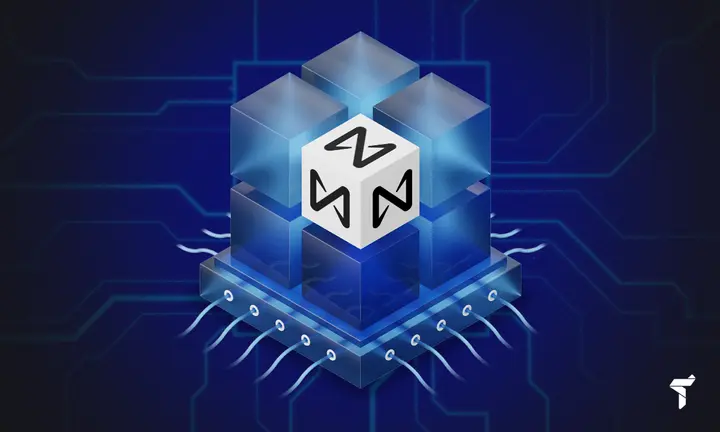
NEAR Protocol is a high-performance blockchain for smart contracts, designed for Web3 and even AI-oriented applications. Thanks to the unique Nightshade architecture and PoS consensus, the network processes hundreds of thousands of transactions per second with minimal fees (~$0.002), ensuring accessibility for a wide audience.
Founders and history
The project was founded by Erik Trautman, Alexander Skidanov and Illia Polosukhin — former specialists at Microsoft and Google. NEAR Foundation began operations in 2017, and the mainnet was launched in April 2021. Since then, an investment fund of $800 million has been created to develop projects in the ecosystem.
Mission and vision
NEAR’s mission is to democratise access to Web3 and AI applications through an inclusive and scalable blockchain infrastructure. In 2023–2024, the team focused on AI integration: NEAR positions itself as the first AI-native blockchain, where AI agents can act on behalf of users, executing transactions, managing data and coordinating actions.
Technological features
Sharding (Nightshade)
The Nightshade architecture distributes shards, each of which executes transactions in parallel.
Proof-of-Stake and security
NEAR operates on the PoS model: validators stake tokens to participate in consensus and receive rewards. Security is guaranteed by a decentralised network of hundreds of nodes that provide reliable protection.
Performance and scalability
NEAR processes hundreds of thousands of transactions per second with finality in under ~1.2 seconds. Fees remain extremely low, making it economically viable for micro-transactions and DApps of any scale.
Smart contract support
Supports WASM for various programming languages (Rust, AssemblyScript, etc.). A simple SDK and integration with Ethereum via the Aurora bridge are provided, expanding compatibility and development flexibility.
NEAR tokenomics
The NEAR token is the native cryptocurrency of the NEAR blockchain, performing several functions at once: paying transaction fees, staking, network governance and incentivising developer activity.
Annual inflation is around 5%, part of which is offset by a mechanism that burns a portion of transaction fees — creating deflationary pressure as network activity grows.
How staking works
NEAR staking is built on the Proof-of-Stake mechanism. Network participants can:
-
become delegators by entrusting their NEAR to validators;
-
or independently run validator nodes (subject to a minimum stake — currently over 65,000 NEAR).
Delegators receive an annual yield of 7–10%, depending on the terms of a specific validator. Accrual is daily, and delegation is carried out via the official NEAR Wallet or third-party services.
The token’s role in the ecosystem
The NEAR cryptocurrency is used for:
-
paying to deploy smart contracts and for data storage on the blockchain;
-
participating in votes and governing network upgrades (governance);
-
incentivising the development of decentralised applications on NEAR through grants and the Developer Incentives programme;
-
providing economic security through the staking mechanism.
The NEAR ecosystem
NEAR Protocol is actively developing infrastructure for decentralised applications on NEAR, covering various areas — from wallets to DAOs and metaverses. As of 2026, over 1,200 active DApps are registered in the ecosystem, including:
-
Ref Finance — a flagship DeFi “all-in-one” platform for swaps, farming and token launches on NEAR;
-
Paras — an NFT marketplace focused on digital art;
-
SWEAT Economy — a Web3 application that rewards users with tokens for physical activity;
-
Sender Wallet — a popular non-custodial wallet with NFT and staking support.
Thanks to straightforward onboarding (registration via email or social networks), Web3 projects on NEAR are aimed at a mass audience — not only crypto-enthusiasts but also newcomers.
Aurora, Octopus Network and other solutions
One of NEAR’s key innovations is Aurora — an EVM-compatible blockchain that enables Ethereum developers to deploy their projects on NEAR without changing the code. Aurora provides ultra-fast transactions with minimal fees and compatibility with MetaMask.
Other infrastructure solutions include:
-
Calimero — private shard networks for business;
-
Pagoda — a developer platform with SDKs, APIs and no-code tools;
-
Near Social — a next-generation decentralised social platform.
DAOs and grants for developers
NEAR is one of the leaders in the implementation of DAOs (decentralised autonomous organisations). Through the NEAR Digital Collective (NDC), users can influence budgets, strategies and project funding. In 2024, the community approved over $18 million for developer grants and ecosystem initiatives.
Grants are provided through:
-
NEAR Foundation — the main fund for strategic financing;
-
Proximity Labs — support for DeFi developers;
-
Developer DAO — a self-governing organisation that distributes micro-grants at early stages.
Comparison with Ethereum, Solana and Avalanche
In the world of smart contracts, NEAR Protocol is often compared with giants such as Ethereum, Solana and Avalanche. Here are the key differences:
|
Parameter |
NEAR Protocol |
Ethereum (2.0) |
Solana |
Avalanche |
|
Consensus |
Proof-of-Stake + Nightshade |
Proof-of-Stake |
Proof-of-History + PoS |
Avalanche Consensus |
|
TPS |
100K+ (theoretical) |
~30–100 |
~65K+ (theoretical) |
~4.5K |
|
Fees |
~$0.001–0.002 |
~$0.5–5 |
<$0.01 |
~$0.1 |
|
Speed |
<1.5 s to finality |
~10–20 s |
~0.4 s |
~2–5 s |
|
EVM compatibility |
Via Aurora |
Native |
Partial (via Neon) |
Yes |
|
Sharding |
Yes (dynamic) |
Planned |
No |
Via subnets (Subnet) |
Benefits for users and developers
For users:
-
Instant registration — you can create a wallet even via email or a Google account;
-
Low fees — transactions cost mere pennies;
-
Fast network — confirmation takes under 2 seconds;
-
Support in Trustee Plus — convenient NEAR purchasing and storage without complex technical steps.
For developers:
-
Multi-language support — you can write smart contracts in Rust or AssemblyScript;
-
Compatibility with Ethereum via Aurora — migrate DApps with virtually no changes;
-
Grant support — access to DAO funding;
-
Rapid-launch tooling — Pagoda, SDKs and contract templates.
Drawbacks:
-
Relatively lower token liquidity compared with top-10 coins;
-
Aurora operates as a separate layer, which requires specific maintenance;
-
Lower brand recognition among beginners, who typically choose Ethereum or Solana.
How to buy and store NEAR
Buying cryptocurrency NEAR is possible on almost all major centralised exchanges. The highest liquidity is offered by Binance, OKX, Bybit, KuCoin and Gate.io. Simply create an account, complete basic verification, top up your balance in fiat or crypto — and you can exchange funds for the NEAR token.
Those who prefer simpler solutions can use services with an intuitive interface such as Trustee, Changelly, MoonPay and Guardarian. These platforms allow you to buy NEAR with a bank card or Apple Pay.
Wallets (Trustee Plus)
NEAR can be stored in several types of wallet: the official NEAR Wallet, popular multifunctional applications or hardware devices. One of the most convenient options is Trustee Plus — a mobile application that lists NEAR among its supported assets.
The application enables you to create a wallet, buy the token with a bank card, and send it to an exchange or another wallet. It is a fully-fledged “all-in-one” solution for those who want to invest in NEAR conveniently without complex technical processes.
Development prospects
The roadmap provides for scaling the number of shards, expanding the blockchain’s AI functionality, and launching new grant initiatives for developers. Particular attention is being paid to integrating NEAR’s decentralised applications with the field of artificial intelligence, which makes the platform unique among competitors.
Institutional interest is also growing. In 2024, the project was supported by funds such as Dragonfly Capital, a16z and Electric Capital, and the total volume of investment in the ecosystem exceeded $1 billion. In addition, NEAR’s presence is expanding in mobile wallets such as Trustee Plus, simplifying access for a mass audience.