





























Bitcoin wallets can have different types of addresses to which users transfer cryptocurrency. In this article, you will learn how Bitcoin addresses are created, which Bitcoin address formats exist, where to find your wallet address and what public information can be obtained using a blockchain explorer.
Key Takeaways
- A Bitcoin address is neither a bank account number nor the wallet itself, but a textual representation of a condition to which BTC can be sent. A single wallet can create multiple addresses.
- The main Bitcoin address formats are Legacy P2PKH with the “1” prefix, P2SH with the “3” prefix, native SegWit with the “bc1q” prefix and Taproot with the “bc1p” prefix.
- An HD wallet deterministically creates a tree of private keys, public keys and addresses from a single initial seed phrase or seed. Using new addresses improves privacy but does not provide complete anonymity.
- A public address can be safely shared with a sender to receive BTC, whereas a private key and seed phrase must never be disclosed. Losing them together with access to the wallet may result in the permanent loss of funds.
- A blockchain explorer can be used to check the balance of a specific Bitcoin address, its transaction history, TXIDs, amounts and fees. However, this information cannot reliably identify the owner or guarantee that every address belonging to that person has been found.


Bitcoin Wallet Address: What It Is, What It Looks Like and What It Is Used For

A Bitcoin address is an alphanumeric string representing a condition for receiving and subsequently spending BTC. The length of an address depends on its format: Legacy and P2SH Base58Check addresses usually contain 26-35 characters, while Bech32 and Bech32m addresses may be longer. A single wallet can manage multiple Bitcoin addresses — their number is determined by the relevant standard, derivation paths and the functionality of the particular application.
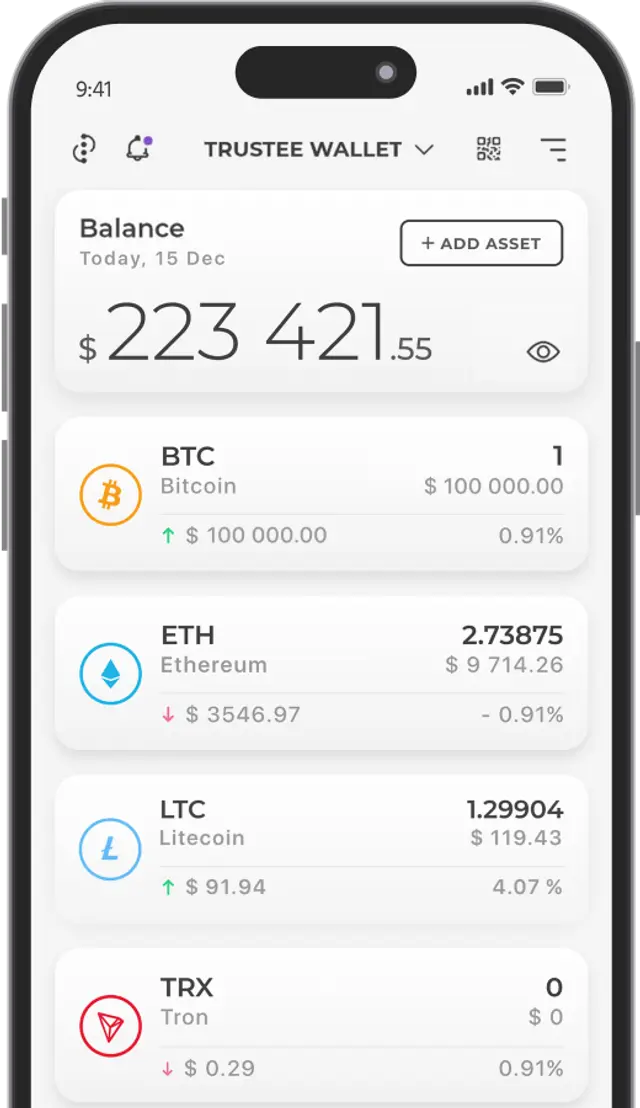
For example, Trustee Wallet offers an HD wallet mode that allows new addresses to be used for incoming Bitcoin transactions. This makes it more difficult to link every incoming payment to a single address and improves the user’s privacy, although it does not make them completely anonymous on a public network.
How a Bitcoin Address Is Generated
A Bitcoin address is created deterministically from a public key or script hash using cryptographic functions and the relevant encoding format. In a conventional wallet, the initial private key may be generated from a cryptographically secure random sequence, while an HD wallet derives keys and addresses from a shared seed according to specified derivation paths. Users do not normally select the characters in an address manually. In theory, two addresses could coincide, as with any collision in a finite address space, but with correctly implemented cryptography, the probability of this happening is negligible.
Public keys are, in turn, mathematically derived from private keys. With the modern cryptographic parameters used by Bitcoin, deriving a private key from its public key is considered computationally infeasible. We will discuss public and private keys in greater detail in one of the following sections.
Bitcoin Wallet Address: Example
When you create a wallet, one or more Bitcoin addresses appear in it, depending on the selected client and the formats it supports. In HD wallets such as Trustee Wallet, different addresses are deterministically derived from a single seed and a tree of extended keys rather than being randomly created from one ordinary public key.
Such wallets are known as hierarchical deterministic wallets. We will discuss how they work later.
Some wallets or services continually display the same address to the user. Reusing an address does not reveal the private key, but it reduces privacy because it makes it easier for an observer to link related incoming and outgoing transactions.
How to Create a Bitcoin Address
In most wallets, addresses are created automatically. After creating or restoring a wallet, the application displays an address at which BTC can be received. Some clients allow users to request a new address manually, change its format or manage a list of previously created addresses. An address that has already been used cannot be deleted from the blockchain: the application can only hide it from the interface or stop using it for new incoming payments. The relevant options are usually available in the Bitcoin wallet settings.
Bitcoin Address Formats: What They Look Like
The most common BTC address formats include Legacy P2PKH, P2SH, native SegWit and Taproot. P2SH is sometimes used for Compatible or Nested SegWit, but not every P2SH address is a SegWit address. An Xpub is an extended public key belonging to an HD wallet rather than a separate address format. P2WSH, in turn, is a type of SegWit output that can be used on both the main network and test networks.
We have prepared a separate article about address formats entitled “From Legacy to SegWit”, which we recommend reading. Below, we list and briefly describe the main Bitcoin address formats with examples.
- Legacy, or classic Bitcoin wallet addresses (P2PKH), are among the earliest widely adopted formats and remain supported by the Bitcoin blockchain, wallets and services. Mainnet addresses of this type begin with “1”.
Example: 1Cd8nZHAYFH7ZG8aJ1wfhCXhHuxzeRtqoB
- Pay-to-Script-Hash, or P2SH addresses, allow BTC to be sent to the hash of a Bitcoin Script spending condition. They are often used in multisignature wallets and have also been used for compatible SegWit P2SH-P2WPKH and P2SH-P2WSH. Mainnet P2SH addresses begin with the number “3”. The “3” prefix alone does not indicate which particular spending condition is contained within the address.
Example: 3J98t1WpEZ73CNmQviecrnyiWrnqRhWNLy
- Native version 0 SegWit addresses are encoded using Bech32 and usually begin with “bc1q”. Segregated Witness does not remove signatures from the blockchain; instead, it places witness data, including signatures, in a separate part of the transaction serialisation. This data is transmitted, verified and committed to the block, but receives a lower weighting when the virtual size is calculated. As a result, a comparable SegWit transaction often occupies fewer virtual bytes and costs less at the same sat/vB fee rate. Confirmation speed depends not on the address type itself, but on the fee, mempool congestion and miners’ decisions.
Example: bc1q5zghnukffzh5k3q7ywmhuzcvggd3t0ffx7jw2p
In addition to the formats listed above, there is a more modern type of output and address known as Taproot.
- Taproot addresses represent version 1 SegWit outputs and are encoded using Bech32m. The Taproot upgrade was activated on the Bitcoin mainnet in November 2021. It uses Schnorr signatures and a tree of possible scripts, allowing only the condition actually used to be revealed when funds are spent through the script path. This can improve the privacy and efficiency of complex operations. Taproot does not turn Bitcoin into an Ethereum-style smart-contract platform, but it expands and optimises the capabilities of Bitcoin Script. These addresses begin with “bc1p”.
A Taproot address looks like this: bc1p5cyxnuxmeuwuvkwfem96l7strmxx5h9x3nkp9p
The variety of Bitcoin address formats allows users to select a suitable option based on compatibility, privacy, script type and transaction efficiency. For ordinary transfers, native SegWit is often a convenient choice when it is supported by both parties.
Ethereum, Tron, Litecoin and Other Cryptocurrency Wallet Addresses

Ethereum (ETH) and other cryptocurrency addresses differ from Bitcoin addresses in their format, length, alphabet and checksum rules. It would be incorrect to claim that all of them necessarily begin with letters: their structure depends on the particular network. Let us examine a few examples.
- Ethereum addresses, which are also used for ERC-20 tokens on the network, consist of the “0x” prefix followed by 40 hexadecimal characters: 0x67bc09210AAAB774b7A7d0030C064E63E7757aE8.
- Tron addresses, which are also used for TRC-20 tokens, usually begin with “T”: TKxW3h8ZNLuR8HQvK2GFiiR5cYaFPm9XBp.
Example of a Legacy Litecoin address: LYNeRXLTU7ArVGetnVFQeq2zo37e42pDoY.
These are not the only differences. On Ethereum, the EIP-55 standard allows a checksum to be encoded through a specific combination of uppercase and lowercase letters. A correctly formatted mixed-case address allows a compatible wallet to detect most accidental typing errors.
An Ethereum address written entirely in lowercase or entirely in uppercase may remain technically valid, but this representation does not contain a verifiable EIP-55 checksum. Consequently, the application may not always detect an incorrectly changed character. There have been cases in cryptocurrency history in which funds were lost after being sent to an incorrect address, including reports of losses equivalent to approximately USD 5,000. To reduce the risk, copy the complete address, use the checksummed version and verify the network, token and several sections of the string before confirming a transfer of Tether (USDT) or another asset.
Public and Private Keys for Bitcoin Addresses

Private keys are the original secrets from which public keys are mathematically derived. Depending on the type of output, a Bitcoin address is created from a public key or script hash. Here are some examples:
- Public Key: 027e8be99b08700cdbb72ce9cbbd0fe3bdd77277578742821de79a17de5e09f488 — an example of a compressed Bitcoin public key.
- Private Key: 3c444f9eef17ae4fd188d0f6203f365695909b3dd86166d5e767f8693de7f067 — an example of a private key in hexadecimal format. This is not an Xprv: a BIP32 extended private key is encoded differently and usually begins with “xprv” or another prefix depending on the network and scheme.
What Is the Difference Between Public and Private Keys?
- A public key is used to verify a digital signature, and a Bitcoin address may be created from it. Incoming transactions, outgoing transactions and the balance are usually viewed through a public address in a blockchain explorer. A public key does not grant the right to spend coins, although in some transaction types it is revealed on the blockchain when an output is spent.
- A private key allows valid signatures to be created to spend the corresponding coins. A signature can be verified using the public key without revealing the Bitcoin private key.
Important! Never disclose the private keys belonging to your Bitcoin wallet. Anyone who obtains a private key can sign transactions and transfer the funds associated with it. The same applies to the seed phrase, which we discussed in the article “Seed Phrase or Mnemonic Phrase: Features and Storage Methods”.
A public address can be shared to receive funds, but it should not be distributed unnecessarily. Because the Bitcoin blockchain is public, anyone who knows the address can view its associated history and analyse the movement of BTC.
How to Find a Bitcoin Wallet Address in Trustee Plus: Where to View and Share It
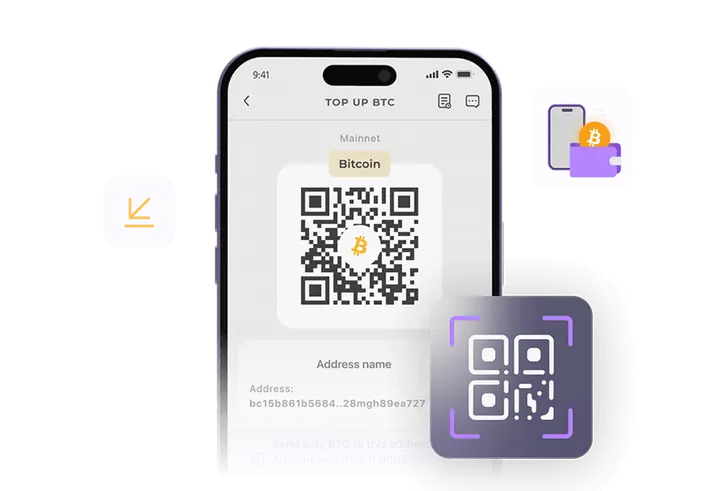
To receive BTC in Trustee Plus, the user is provided with a Bitcoin deposit address. Below, we explain how to find, copy and send it to another person.
Where to Find a Bitcoin Address in Trustee Plus
To find your Bitcoin address in Trustee Plus, tap “Receive” in the service’s main menu. In some versions of the interface, this section may be called “Deposit”:
- select Bitcoin;
- select the transfer type — “To Wallet Address” or “Deposit to Address”;
- if the application offers a choice of networks, make sure that the Bitcoin network is selected;
- the cryptocurrency address and corresponding QR code will appear in the menu that opens.
How to Share a Trustee Plus Bitcoin Address
You can copy the address by tapping “Copy Address” or send it together with the QR code through an available application by tapping “Share”. Before making the transfer, the sender should check that Bitcoin has been selected and that the copied address matches the address displayed in the application in full.
How to Find a Bitcoin Address in Trustee Wallet: Where to View and Share It
Each wallet may have one or more Bitcoin addresses. Let us examine how to obtain an address using Trustee Wallet as an example. When using a multi-currency crypto wallet, first select the relevant asset. In this case, it is Bitcoin.
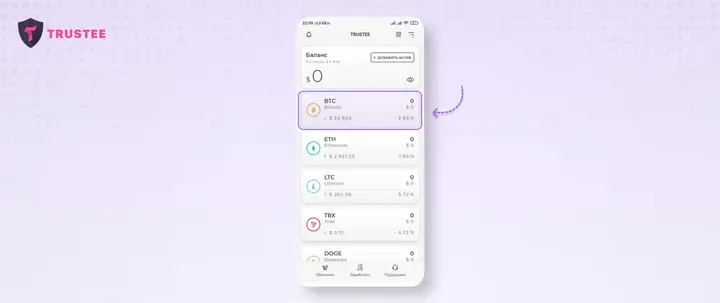
Where to Find a Bitcoin Address
Below, we explain where to find a Bitcoin address in Trustee Wallet. The address may not be displayed in full on the BTC wallet page, but it can be copied using the relevant button.
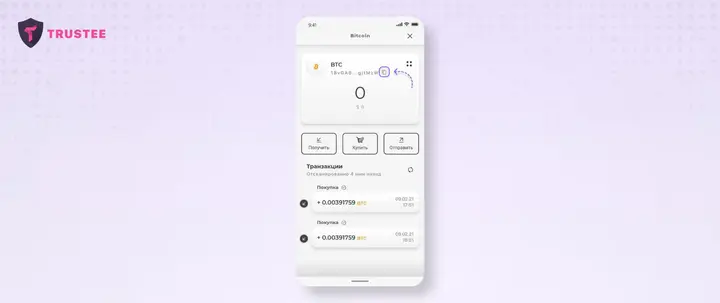
When the wallet address is not displayed, cannot be copied directly from the page or needs to be switched to another format, tap “Receive”.
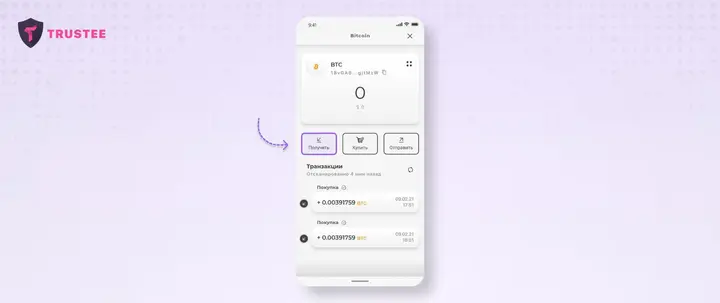
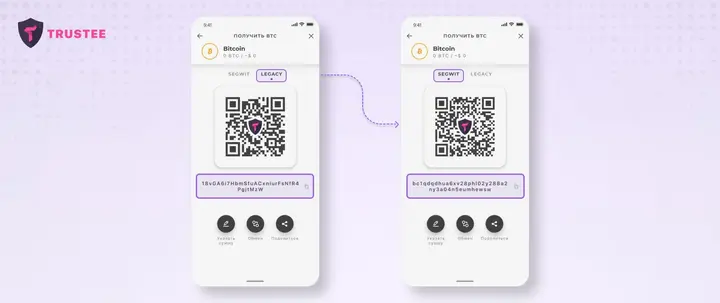
Trustee Wallet supports the popular Legacy and SegWit Bitcoin address formats. Depending on the application version, users can switch between them using the “Legacy” and “SegWit” tabs after opening the “Receive” section.
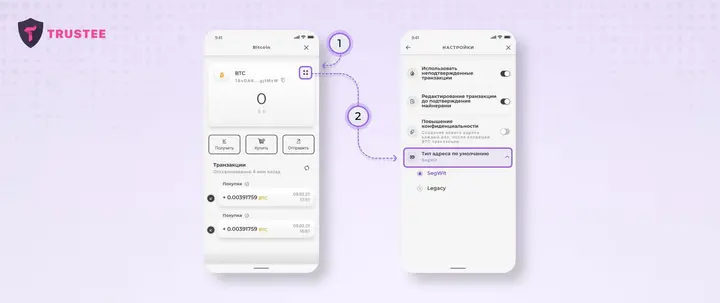
The Bitcoin address format can also be changed as follows:
- Open the settings on the Bitcoin tab by tapping the four dots in the top-right corner.
- Tap “Default Address Type” and select the required format.
How to Share a Bitcoin Address
There are several ways to do this.
- The first option is to copy the address to the clipboard using the relevant button and then send it to the sender by any convenient method. It is advisable to check the complete string again before the transfer is made.
- The second option is to scan the QR code from another device. Show the screen to the sender or send them an image of the QR code through a secure communication channel.
- The third option is to use the Share function and send the address through a messenger, email or SMS.
The sender will consequently receive both the QR code and the BTC address in text form.
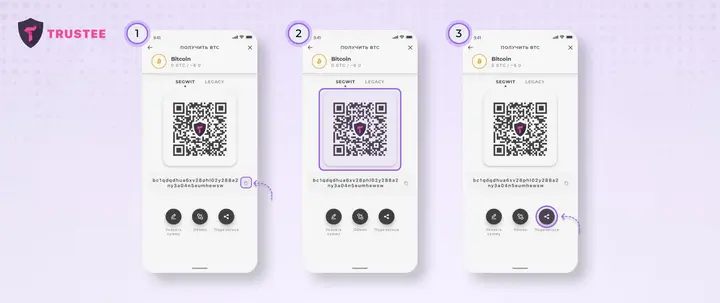
The final, fourth option is to select “Specify Amount” on the “Receive” tab in Trustee Wallet.
This allows you to specify a particular amount and add a comment. When a compatible sender’s wallet scans the generated payment QR code, the amount will be entered automatically. The sender should still verify the address, amount and fee before confirming the transaction.
You now know how to view a Bitcoin wallet address and share it safely with another user.
What Information Can Be Obtained from a Bitcoin Address?
Using a blockchain explorer, a user can view public information associated with a particular address. Private keys and seed phrases are not published on the blockchain. Depending on the explorer’s functionality, the following information may be available:
- the amounts received by the address and the number of incoming transactions;
- the address’s current calculated balance;
- the amounts spent from the address and the frequency of outgoing transactions;
- TXIDs, fees, confirmations, inputs, outputs and other public transaction details.
By knowing an address, it is possible to examine the operations involving it and attempt to identify links with other BTC addresses. However, such connections are often based on blockchain-analysis heuristics and do not constitute absolute proof that the addresses belong to the same person or organisation.
How to Check a Bitcoin Address Balance
Let us consider a randomly selected address as an example. Copy the relevant address and paste it into the search field of a blockchain explorer. Make sure that the Bitcoin network has been selected.
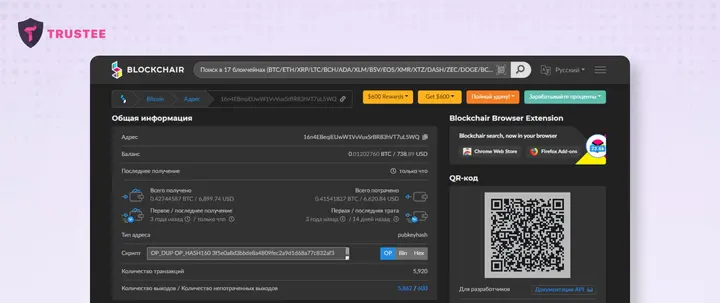
By knowing an address, we can obtain the following information:
- the current balance of the particular address;
- the total value of incoming and outgoing operations;
- the total number of associated transactions;
- confirmed and unconfirmed transactions and the status of the associated outputs;
- transaction hashes, or TXIDs.
How to Check a Bitcoin Transaction Using a Wallet Address
By selecting the relevant operation in the address history or entering its TXID into a blockchain explorer, users can view the details of an individual transaction:
- the amount of BTC transferred to the outputs;
- the network fee paid by the transaction;
- the addresses or scripts associated with the inputs and outputs, the number of confirmations received and the block in which the operation was included.
However, the blockchain does not usually reveal the real identities of the senders and recipients.
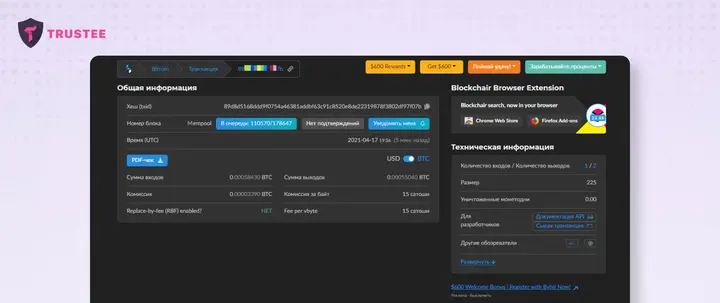
We explained how to track a transaction in detail in the article “How to Track a Bitcoin Transaction”.
HD Wallets for Bitcoin and Other Cryptocurrencies and Tokens
An HD Wallet, or hierarchical deterministic wallet, creates a tree-like structure of private keys, public keys and addresses, removing the need to create a separate backup for every new key. The main function of an HD wallet is to derive multiple keys deterministically from a single initial seed using specified paths. Provided that the seed has sufficient entropy, finding the combination through practical brute-force methods is considered computationally infeasible.
Trustee Wallet offers an HD mode that allows Bitcoin addresses to be changed for incoming transactions. This improves privacy and makes it more difficult to track every incoming payment through a single address.
Below, we explain how to enable this function. In Trustee Wallet, follow these steps:
- First, open the Bitcoin tab in the wallet.
- Next, open the settings by tapping the four dots in the top-right corner of the screen, as shown in the image below.
- Enable the “Enhanced Privacy” option.
- The wallet will ask: “Switch the wallet to HD mode?”. Tap “Yes”.
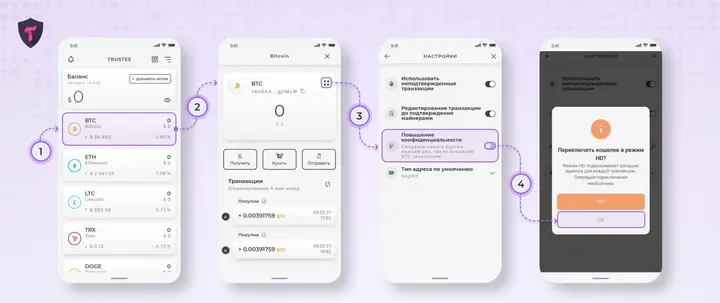
Done. Once the mode has been activated, the wallet can use new addresses for incoming transactions, improving the privacy of the receiving history.
Conclusion
In this article, we examined the main Bitcoin address formats, their differences, how they are created and the rules for using them. You learned how to find a Bitcoin wallet address, share it with a sender, check its balance and transactions, and distinguish between an address, a public key, a private key and a seed phrase.
Using the information provided, you can independently check the public data associated with any Bitcoin address through a blockchain explorer and examine the details of its related transactions. Remember that an address does not reveal the private key and cannot, by itself, reliably establish the identity of its owner.
Frequently Asked Questions About Bitcoin Addresses
Below, we answer five common questions about Bitcoin addresses, HD wallets, transaction tracking and access recovery.
-
Why Does My Bitcoin Wallet Address Keep Changing?
When a wallet regularly displays a new address for receiving BTC, it is most likely using HD technology — hierarchical deterministic wallet technology.
The word “hierarchical” means that keys and addresses are derived according to a particular tree structure. The seed phrase is converted into a seed, from which a master key is created, followed by multiple child private and public keys and their corresponding addresses.
An HD wallet user has a single shared backup foundation — a seed phrase or another seed format — that makes it possible to restore the key tree when using a compatible wallet and the correct derivation paths. A large number of child addresses can be derived deterministically from the master key, and their connection to a single wallet is not always obvious to an outside observer.
A new address is generally used for a new payment request or incoming transaction to reduce address reuse and improve privacy.
In practice, this approach is particularly common in Bitcoin and other cryptocurrencies that use the UTXO model.
-
Can a Transaction Be Tracked Using the Recipient’s BTC Address?
Yes. Public transactions associated with a recipient’s Bitcoin address can be found using a blockchain explorer. Entering the sender’s address, recipient’s address or TXID allows users to view amounts, times, confirmations, fees, inputs and outputs. However, an explorer displays blockchain data rather than verified identities of the participants. We discussed this topic in greater detail here.
-
Can Private Keys Be Seen on the Blockchain?
No. A private key is not an “encrypted seed phrase” and is not published on the blockchain. A seed phrase may be used to create a seed from which an HD wallet derives private and public keys. A public key is not the same as an address either: an address is generally created from the public key or from a script. In certain scenarios, the public key is revealed when coins are spent, but the private key must always remain secret.
-
What Happens If Private Keys or a Seed Phrase Are Lost?
Storing cryptocurrency in a non-custodial wallet gives users independent control but also makes them responsible for maintaining a backup. When the seed phrase or private keys and access to every device containing an active wallet are lost at the same time, control of the funds usually cannot be recovered. Customer support cannot alter the blockchain or recreate a lost private key.
-
How Many Bitcoin Addresses Can One Person Have?
A single user can create a very large number of Bitcoin addresses. HD wallets support extensive derivation trees containing millions of addresses within individual branches. In practice, the number is limited by the capabilities of the software, the standards being used and the convenience of managing them, rather than by any requirement to register each address on the network.