




























Nowadays, you can pay for coffee with cash, a bank card, Apple Pay, or even cryptocurrency. But are all these options the same? No. There are different types of money.
Fifty years ago, every dollar had gold backing. Today, money is more about trust than metal, besides digital currencies have no physical form but are already used by millions of people worldwide.
Let’s explore how this new world of money works and what role cryptocurrencies, electronic platforms, and governments play in it.
Key Takeaways
- The main difference between a custodial and a non-custodial wallet is who controls the private keys: the service provider controls them in a custodial wallet, while the user controls them in a non-custodial wallet.
- Custodial wallets are generally easier for beginners, may provide account recovery and are convenient for regular transactions, but users depend on the platform, its rules and its security.
- Non-custodial wallets provide full control over cryptocurrency and independence from intermediaries, but the user is personally responsible for protecting the seed phrase, private keys and device.
- Access to a custodial wallet may sometimes be restored through support and identity verification, whereas a lost seed phrase for a non-custodial wallet usually cannot be recovered.
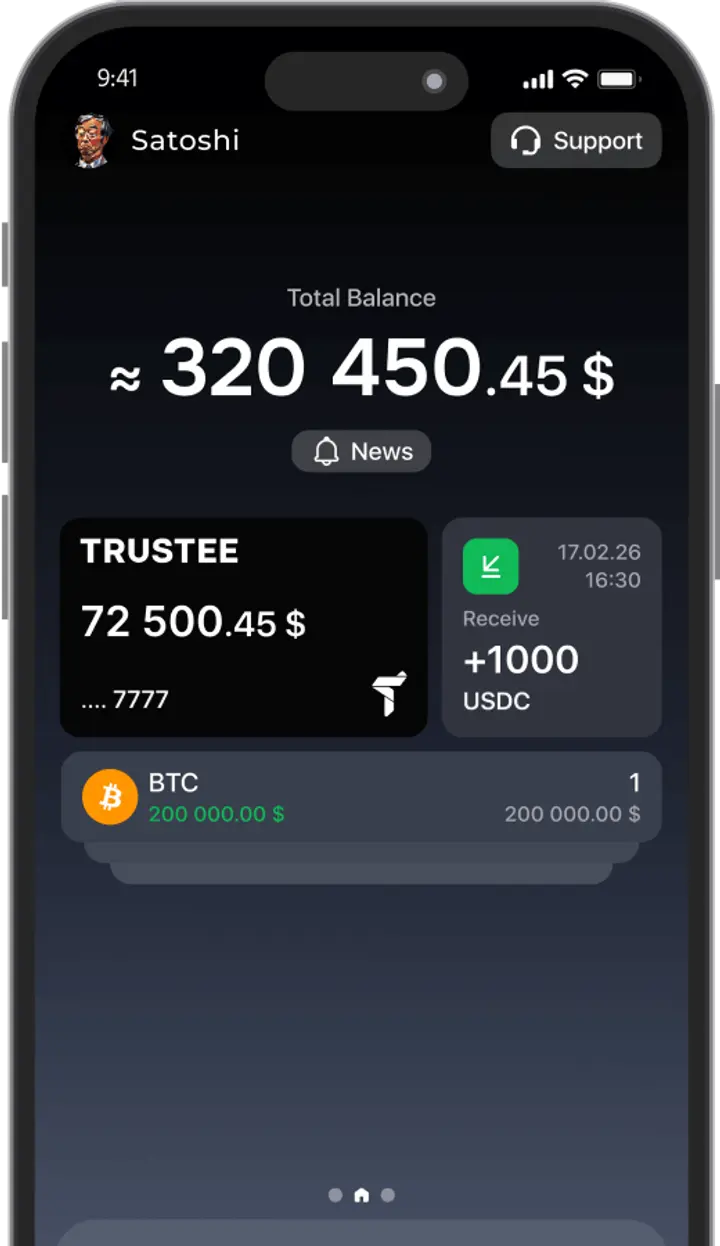
- The right choice depends on experience, intended use and willingness to accept responsibility: Trustee Plus is suitable for users who value convenience and account recovery, while Trustee Wallet is designed for those who want independent control of their assets.


Fiat Money

Fiat money is currency that has no intrinsic value and is not backed by any physical asset like gold or silver. Its value is based solely on trust in the government that issues it. If a government is powerful, its currency is stable. If the economy is weak, the money loses value — as happened with the Venezuelan bolívar or the Zimbabwean dollar.
In the 20th century, most countries abandoned the gold standard. For example, the US dollar officially stopped being backed by gold in 1971. Since then, most of the world’s currencies have become fiat.
Key Features of Fiat Money
- Only a central bank has the right to issue new banknotes and control the money supply.
- No gold or silver backing — value is determined by trust and government policy.
- Exists as both physical cash and electronic records in bank accounts.
- The central bank regulates inflation, interest rates, and the currency’s global value.
Examples of Fiat Money
- Hryvnia (UAH) — issued by the National Bank of Ukraine
- US Dollar (USD) — the most influential fiat currency in the world
- Euro (EUR) — official currency of the Eurozone
- Japanese Yen (JPY) — one of the most stable Asian currencies
Pros and Cons of Fiat Money
Advantages:
- Fully integrated into the modern economy with ATM networks, POS terminals, banks, and electronic payment systems.
- Universally accepted — from small cafés to global corporations.
- Legally recognized means of payment guaranteed by the state.
Disadvantages:
- Inflation — over time, fiat currencies typically lose purchasing power.
- Centralized control — monetary value depends on the government’s and central bank’s decisions.
- Vulnerability during crises — fiat money can rapidly depreciate in times of political or economic instability (e.g., Zimbabwe, Argentina).
Digital Money

Digital money exists only in electronic form — no physical bills or coins. It operates through online platforms and fintech services. It’s different from digital records of fiat currency in a bank. Digital money represents a new generation of assets, often built on blockchain technology.
Digital money can be centralized (like the digital yuan or euro) or decentralized, such as cryptocurrencies, which are not controlled by any central authority.
Key Features of Digital Money
One of the main features is blockchain technology — a decentralized ledger that records all transactions and makes forgery or tampering nearly impossible. This ensures transparency and security.
With cryptocurrencies like Bitcoin and Ethereum, there is no central issuer. The system is run by a network of computers (nodes) that validate every transaction — a process known as decentralization.
Examples of Digital Money
- Cryptocurrencies — such as Bitcoin (BTC), Ethereum (ETH), Solana (SOL). Their prices are market-driven and decentralized.
- Stablecoins — like USDT or USDC, which are pegged to fiat currencies (usually USD) and maintain stable value.
- Central Bank Digital Currencies (CBDCs) — like the digital yuan (e-CNY), the digital hryvnia (in testing), and the digital euro (in development). These are state-issued and have official status.
Pros and Cons of Digital Money
Pros:
- Fast and accessible — instant transfers anytime.
- Low fees, especially for international payments.
- Technological flexibility — integrates with apps, DeFi, and smart contracts.
Cons:
- High volatility — prices can change by tens of percent in a single day.
- Security concerns — losing wallet access can mean losing funds.
- Legal uncertainty — digital money is still unregulated in many countries.
Differences Between Fiat and Digital Money

While both fiat and digital money are used for payments, they differ fundamentally in storage, transmission, control, and trust.
Fiat currencies are centralized, issued by governments, and fully controlled by central banks. They are officially recognized for all payments and their value is managed through monetary policy tools — interest rates, bonds, and money supply.
Digital currencies, especially cryptocurrencies, operate under their own rules and often independently of any government.
With fiat, we trust the state. With crypto, trust is placed in technology — open-source code, blockchain, and transparent networks. For many, that is an advantage, especially where access to banking is limited or unstable.
Another key difference is in use cases. If you’re buying coffee in Kyiv, using hryvnia makes sense. But if you’re sending money abroad, cryptocurrency or stablecoins may be faster, cheaper, and less restrictive than traditional bank transfers.
That said, fiat money remains a more reliable store of value in stable economies. Crypto is riskier but potentially more rewarding. So choosing between fiat and digital money depends on your goal, context, and level of expertise.
Conclusion
Fiat money is the foundation of the traditional economy we use every day. Digital money represents the next step in the evolution of finance — offering speed, technology, and freedom. Understanding the differences helps you navigate a world where cash, bank accounts, and cryptocurrencies increasingly coexist on the same market.
Frequently Asked Questions About Custodial and Non-Custodial Wallets
What is the difference between a custodial and a non-custodial wallet?
In a custodial wallet, the service provider stores and controls the private keys, while the user accesses the assets through an account. In a non-custodial wallet, the private keys are created and stored on the owner’s device, so only the owner controls the cryptocurrency and is responsible for restoring access.
Which type of crypto wallet is safer?
Both types of wallet involve different risks. The security of a custodial wallet depends on the platform’s protection, the way it stores reserves and the security of the user’s account. A non-custodial wallet has no single platform controlling the private keys, but funds may still be lost through phishing, malware, a compromised device or exposure of the seed phrase.
Can access to a crypto wallet be recovered?
Access to a custodial wallet can often be restored through customer support, identity verification or another recovery procedure offered by the service. A non-custodial wallet requires a seed phrase, private key or another supported backup file. If these details are lost and the active wallet is no longer accessible, recovering the funds is usually impossible.
Who should use a custodial wallet?
A custodial wallet may be suitable for beginners and users who value a simple interface, account recovery, cryptocurrency purchases, exchanges and regular transactions within one application. Users should nevertheless consider their dependence on the service’s rules, possible identity verification, transaction restrictions and the platform’s security.
Who should use a non-custodial wallet?
A non-custodial wallet is suitable for users who want to control their private keys independently and avoid relying on a third-party service to hold their assets. This option requires an understanding of blockchain transactions, caution when signing operations and secure offline storage of the seed phrase.