























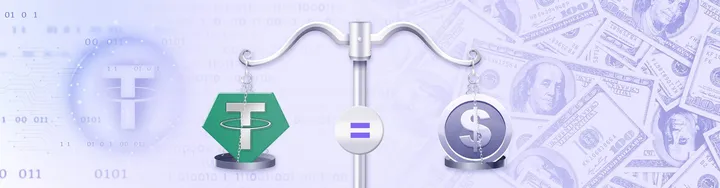


USDT, also known as Tether, is a stablecoin designed to keep its value close to 1 US dollar. Unlike Bitcoin or Ethereum, USDT is not mainly used for price growth — it is used to transfer value, store funds in a dollar-denominated asset, trade on crypto platforms and move money between different blockchain networks.
USDT is issued by Tether and exists on multiple networks, including Ethereum, Tron, Solana, TON, Arbitrum and others. The network you choose affects transaction fees, speed and wallet compatibility, so it is important to check the address format before sending funds.
In this guide, we explain what USDT is, how Tether works, what backs the stablecoin, which USDT networks exist, how to buy USDT and store it, and what risks users should understand before using it.
What does the USDT stablecoin mean?
United States Dollar Tether — the first and most popular stablecoin on the crypto market, a crypto token with a fixed price pegged to a fiat currency, in this case the US dollar. USDT was issued in 2014 by Tether Limited.
There are other stablecoins pegged to the dollar, for example USDC — USD Coin from the CENTRE project.
Why was USDT created?
Tether was created in October 2014 on the Omni Layer protocol on the Bitcoin blockchain as a more stable alternative to the first cryptocurrency. Its original name was RealCoin. The project was renamed in the same year. The first crypto exchange to launch trading in Tether was Bitfinex. As it later turned out, Tether Limited is a subsidiary of Tether Holding Limited, founded by members of the Bitfinex management team. Thus, these companies were closely connected from the outset.
As early as 2014 the creators called Tether a digital bridge to a real-world asset. The goals included:
-
providing an alternative to unstable cryptocurrencies;
-
converting fiat into cryptocurrency at a 1:1 ratio;
-
increasing trust through a new method of reserve verification — Proof of Reserves (an alternative to Proof of Solvency methods);
-
transfers of national currencies (including cross-border payments);
-
integration with various services for bill payments and financing;
-
reducing market risks.
Coin characteristics
When describing Tether (USDT) it is often noted that it is a coin with key attributes:
-
stability based on fiat-currency backing — to use all the advantages of digital transactions on the blockchain without volatility risks;
-
transparency — the website publishes the size of reserves every day and updates it at least once a day;
-
convergence of crypto and fiat thanks to the simple exchange of dollars for Tether and vice versa.
How Tether works
According to the company’s documentation, the circulation of USDT tokens is declared as a cycle:
-
A user (a natural person or a legal entity — a crypto exchange or crypto service) deposits fiat funds into the bank account of Tether Ltd;
-
The company issues tokens at the equivalent of 1 USD = 1 USDT;
-
The company lends the user USDT equivalent to the amount of US dollars deposited;
-
The user carries out operations (transfers, exchanges);
-
The user returns Tether for redemption;
-
The company burns the returned tokens and gives the user back dollars.
What backs the coin
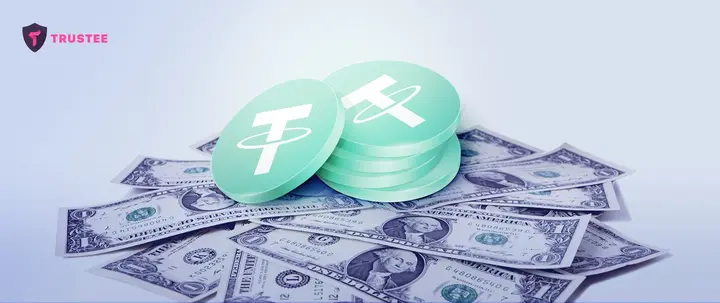
Each 1 USDT must be backed by 1 USD on Tether Ltd’s reserve balance. Accordingly, the answer to the question of what 1 USDT equals is very simple: the USDT to USD rate must be 1:1.
Tether’s dollar backing has repeatedly raised doubts and rumours. Initially, the company stated that all tokens were fully backed by US dollars. In 2019 Tether Ltd changed its collateral policy, adding “other assets and future loan proceeds” from third-party loans as backing. At that time it was stated that Tether was backed by the US dollar by only 74%.
It is worth noting that the main basis for doubt is the lack of a full independent audit of Tether Ltd. Some investigations lead to the view that the “other assets” will not be able to secure the remaining 26%.
Mining possibility
Tether is not mined, which means USDT issuance can be carried out only after fiat funds are deposited. This contradiction with the nature of digital assets is explained by its main purpose — to act as an intermediary between real and virtual assets.
The maximum coin issuance is limited solely by the amount of fiat funds paid into the issuing company’s accounts.
Advantages and disadvantages of the first stablecoin
Although Tether is a “bridge” from the fiat dollar into cryptocurrencies, the project has attracted a great deal of criticism, accusations and suspicion. Let’s highlight the main pros and cons of working with Tether.
|
Advantages |
Disadvantages |
|
Stable rate |
Mandatory KYC when depositing funds into the company’s accounts |
|
High liquidity |
Centralised nature |
|
Availability on different blockchains |
Lack of independent audits |
|
Fiat reserves |
Problematic reputation |
|
Wide acceptance |
Accusations of market manipulation |
|
Speed and low cost of USDT transactions on the Tron blockchain | |
|
Significant capitalisation | |
|
Ease of settlements | |
|
Availability of reporting | |
|
Equal terms for individuals and legal entities |
Tether subtypes
After the launch of USDT the company succeeded in issuing other stablecoins which, however, did not gain notable popularity and are not in wide demand:
-
EURT, Eurocoin — backed by the euro;
-
CNHT — pegged to the Chinese yuan;
-
XAUT, Tether Gold — backed by gold.
Types of USDT
- Tether was issued on the blockchain protocols Omni (Bitcoin), ERC-20 (Ethereum), TRC-20 (Tron), EOS, Liquid, Algorand, Solana, OMG Network, Bitcoin Cash, which contributes to growing trading volumes and higher liquidity.
- In 2022 USDT Polygon appeared, gaining popularity in place of the Omni-based coin, which had lost relevance.
- In addition, there are plans to launch USDT token issuance on the Lightning Network protocol in the future.
Let’s look at the two most popular stablecoin options (TRC-20 and ERC-20) and the recently launched USDT Polygon.
USDT on ERC-20: what is it?
In 2018, when average fees on the Bitcoin blockchain increased many times over, the token began to be issued on the ERC-20 protocol on the Ethereum blockchain, which was far more advantageous for trading. After that, the use of USDT on Omni fell significantly, and USDT on ERC-20 now leads among the options.
Issuance on ERC-20 provides additional opportunities for interaction with smart contracts and decentralised applications (dApps).
USDT on TRC-20: what is it?
USDT on TRC-20 is Tether issued on the Tron blockchain. Tether started issuing USDT on Tron in April 2019, using the TRC-20 token standard — the Tron equivalent of Ethereum’s ERC-20 standard.
In practice, USDT TRC-20 is the same Tether stablecoin, but it moves through the Tron network instead of Ethereum. This means that transactions are usually faster and cheaper than USDT transfers on Ethereum, which made TRC-20 one of the most popular formats for sending USDT between exchanges, wallets and users.
A key point to remember is that USDT TRC-20 works only with Tron-compatible addresses. These addresses usually start with the letter “T”. If you send USDT TRC-20 to an ERC-20, BEP-20 or another incompatible network address, the funds may be lost or require complicated recovery through the receiving platform.
TRC-20 USDT is often used for everyday transfers because of its low network fees and broad support across crypto services. However, users should always check whether the receiving wallet or exchange supports USDT on Tron before confirming a transaction.
USDT Polygon
Tether launched the USDT stablecoin on Polygon in spring 2022, complementing the versions already available on more than 10 other blockchain networks.
Polygon, formerly known as Matic Network, is a platform for developing and deploying decentralised applications (dApps) based on the Ethereum blockchain. It has high scalability thanks to Plasma technology, allowing up to 65,000 transactions per second, which significantly exceeds the original Ethereum. Because of this capacity to process a large number of transactions, fees on Polygon are also lower than on Ethereum.
Polygon also has a high degree of compatibility, which simplifies integration with other blockchain networks and helps the development and expansion of decentralised applications. Many applications are already deployed on the network, most of which can use the network’s native coin.
USDT TON
USDT TON is a stablecoin issued by Tether on the The Open Network (TON) blockchain. It conforms to the Jetton standard, which allows it to be integrated into the TON DeFi ecosystem. The key advantage is instant transfers with minimal fees thanks to the blockchain’s high throughput (up to 100,000 TPS) and sharding mechanism.
The launch took place in April 2024, making TON the fifth blockchain to support USDT after Ethereum (ERC-20), Tron (TRC-20), Solana (SPL) and Polygon (MATIC).
TON has built-in on-chain support for USDT transactions in Telegram, which simplifies transfers between users and ensures broad liquidity. The total capitalisation of USDT TON as of October 2024 exceeds 150 million USDT, and daily trading volume reaches 30–50 million USDT.
Which is better?
Among the significant differences between the most common protocols for issuing Tether, note the following:
-
Transaction speed — usually a few seconds on Tron, Polygon and TON, whereas on Ethereum operations can take several minutes.
-
Transaction fees — lowest for TRC-20, Polygon and TON, whereas ERC-20 has significantly higher costs.
When choosing between USDT variants, you need to decide on the intended use. For exchange trading the optimal option will be ERC-20, and for high-frequency operations with small amounts — TRC-20. Tether Polygon is the golden mean, suitable for both everyday payments and institutional trading.
At the same time, USDT TON is a promising option for integration into the Telegram ecosystem, providing instant transfers without fees inside the messenger and access to DeFi solutions on the TON network.
Rate to the dollar and price
USDT is designed to maintain a value close to 1 US dollar. In normal market conditions, its price usually stays near $1, although small deviations are possible depending on liquidity, market demand and exchange-specific conditions.
As of mid-2026, USDT remains the largest stablecoin by market capitalisation and one of the largest crypto assets overall. According to CoinGecko, USDT is ranked among the top cryptocurrencies by market cap, after Bitcoin and Ethereum, with a market capitalisation of around $184 billion and daily trading volume measured in tens of billions of dollars. CoinMarketCap shows similar market capitalisation figures, although 24-hour volume may differ depending on the data source and methodology.
USDT exists on multiple blockchain networks. The most widely used versions include Ethereum (ERC-20), Tron (TRC-20), Solana (SPL), TON, Aptos, Avalanche, Celo, Kaia, Near, Tezos and others. The exact list of supported networks may change, so users should always check whether their wallet or exchange supports the same USDT network before making a transfer.
It is also important to note that some older USDT networks are now considered legacy. Tether states that it no longer issues or redeems Tether tokens on Omni, EOS, Algorand, Bitcoin Cash SLP and Kusama, and information about these networks is kept for historical reference.
Although USDT is designed to follow the US dollar, it is not completely risk-free. Historical price data shows that USDT has traded very close to $1 most of the time, but short-term deviations have occurred during periods of market stress, low liquidity or exchange-specific imbalance. Because of this, users should treat USDT as a dollar-pegged stablecoin, not as the same thing as holding dollars in a bank account.
How to use it
The stablecoin is often used for payments on various online services, for peer-to-peer transfers and for moving funds between exchanges. One of the most important uses of Tether is buying cryptocurrencies on services that do not accept fiat funds.
It is worth noting that in periods of significant market fluctuations it can be faster to exchange any cryptocurrency for Tether than to convert it into fiat. In addition, to complete a transaction in US dollars within the banking system requires several business days, whereas a USDT transaction is completed in a few minutes or even seconds. The difference in fees between a USDT transfer and a SWIFT transfer is also clearly in favour of the stablecoin.
Which wallet to choose
The official wallet is Tether.to. But as with other cryptocurrencies, Tether can be stored in various wallets:
-
Hardware (Trezor, Ledger);
-
Software;
-
Exchange wallets.
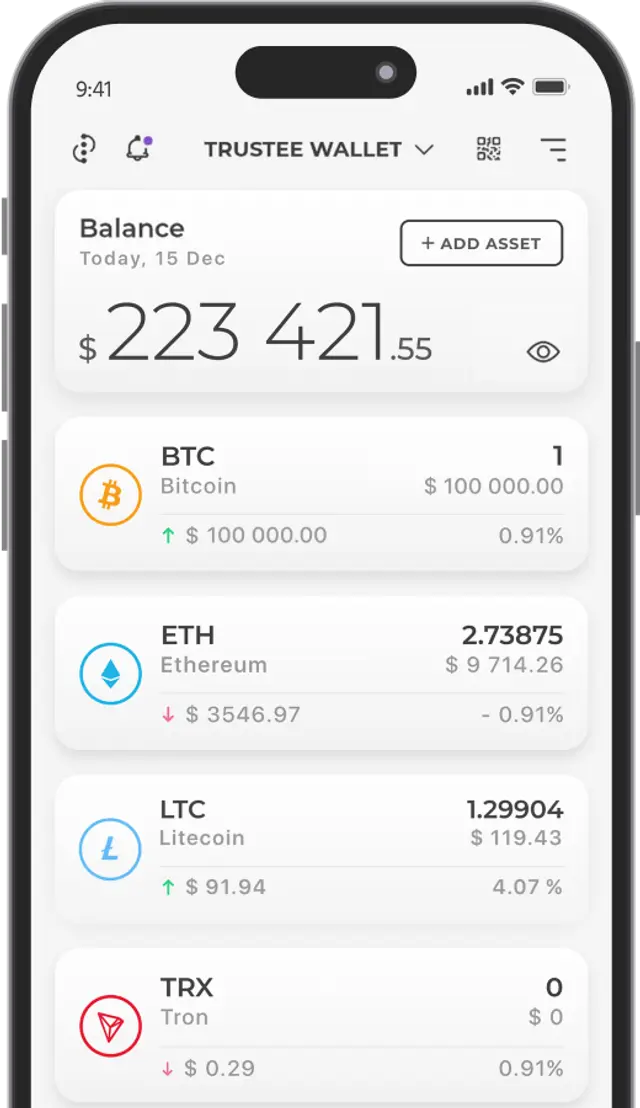
For different protocols you can use wallets that support a specific one (MetaMask, TronLink) or universal solutions such as Trustee Wallet. When choosing a wallet you should consider the need for frequent access, as well as security and privacy requirements.
Where to buy USDT
You can buy USDT on Tether’s official platform, but as noted earlier it requires detailed verification of a natural or legal person, including name, surname, residential address and personal documents. You can also use a crypto exchange, a crypto broker or Trustee Plus to buy USDT.
USDT’s prospects as a cryptocurrency: mass adoption or scam?
Regardless of the large number of negative media mentions of the USDT cryptocurrency, there are forecasts according to which Tether will develop rapidly and may even take second place by capitalisation in the crypto market. The stablecoin is widely accepted not only by crypto services but also by platforms that cannot accept payments in various national currencies.
The absence of the need to constantly convert fiat into cryptocurrencies and back makes Tether a truly in-demand asset. Positioning the crypto token as backed by a fiat currency also contributes to the popularisation of the crypto industry as a whole. Nevertheless, if an independent audit shows a lack of significant reserves in Tether’s accounts, the forecast is the opposite: the reputation of the entire crypto world would also suffer.