



























Cryptocurrency storage is one of the most important considerations for anyone who has ever purchased Bitcoin or any other digital asset. Equally crucial is knowing how to store it properly.
In this article, we explain where to safely store cryptocurrency, the types of wallets available, and how to protect your funds.
Key Takeaways
- The most suitable cryptocurrency storage method depends on its purpose: custodial and mobile wallets are convenient for everyday transactions, while non-custodial and hardware solutions are better suited to independent control and long-term asset storage.
- With a non-custodial wallet, the user is personally responsible for the private keys and seed phrase. Losing the recovery phrase may result in irreversible loss of access, while exposing it may lead to the theft of all associated assets.
- To protect your cryptocurrency, use unique passwords, two-factor authentication, official applications and up-to-date software. Never enter a seed phrase on websites or store it in cloud services, emails, notes or screenshots.
- Keeping all assets in one place is not recommended. Dividing funds between a wallet for everyday transactions and a separate non-custodial or hardware wallet for long-term storage helps reduce risk.


Types of Cryptocurrency Wallets

Custodial Wallets (e.g., Exchanges, Brokers)
In custodial wallets, private keys are stored by the service provider rather than the user. When you create an account on an exchange or financial platform, the system automatically generates a wallet, but the cryptographic access (transaction signing keys) remains with the company. Users interact with their assets through an interface—viewing balances, sending or receiving crypto—but ultimately entrust control to a third party.
Advantage: Convenience.
Disadvantage: Lack of full control and dependence on the platform’s reliability. If you're wondering where to store Bitcoin, custodial wallets may suit active trading but not long-term storage of large sums.
Non-Custodial Wallets (You Control the Private Keys)
These operate on the principle of "only you, only your keys." A private key is generated upon wallet creation, and only you have access to it. You gain full control over your assets but also full responsibility for security.
Ideal for those who want full autonomy over their crypto and possess basic security knowledge.
Hardware Wallets
Physical devices that store private keys in an isolated environment. Since they aren’t constantly connected to the internet, they’re nearly immune to hacking. These resemble USB drives with buttons.
Mobile Wallets
Smartphone apps that combine convenience and quick access to assets.
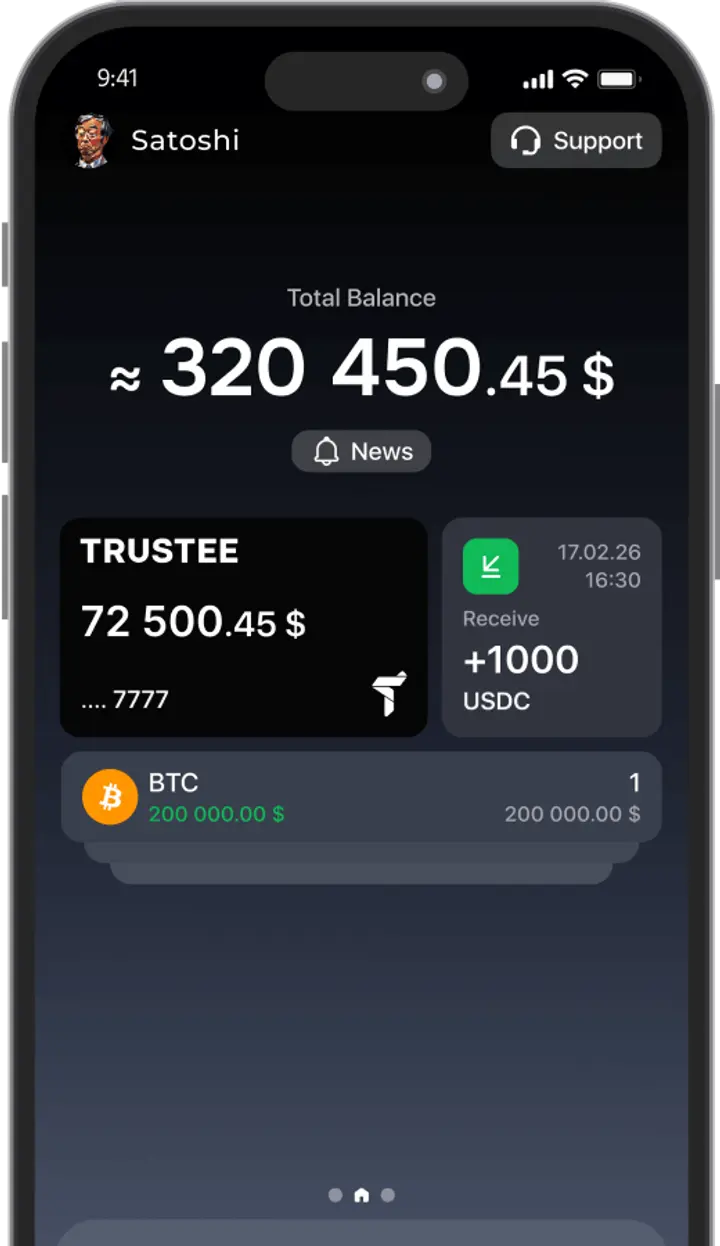
For example, Trustee Plus allows users to store and exchange cryptocurrency, while Trustee Wallet is a non-custodial, multi-currency wallet with a simple interface and support for dozens of cryptocurrencies.
Mobile wallets are great for daily use but require device security measures: PIN codes, Face ID, and secure backup of seed phrases.
Desktop Wallets
Programs installed on a computer that store private keys locally. They offer deeper control than mobile or browser versions but demand rigorous device security.
Typically used for large transfers or managing multiple wallets.
Browser Wallets
Browser extensions that enable interaction with crypto sites and dApps directly. The most well-known example is Metamask, which works with Ethereum and compatible networks. These are convenient for DeFi but rely heavily on browser and device security.
Paper Wallets
A printed or handwritten record of keys (address + private key). These can be stored in a safe or other secure location, offering near-total isolation from online threats. However, physical loss or damage means irreversible loss of access.
Pros and Cons of Each Wallet Type
| Wallet Type | Security | Control | Convenience | Risks |
|---|---|---|---|---|
| Custodial | Medium | Low | High | Exchange hacks, account freezes, KYC issues |
| Non-Custodial | High | Full | Medium | Lost seed phrase = permanent access loss |
| Hardware | Very High | Full | Low/Medium | Lost device, forgotten PIN, physical damage |
| Mobile | Medium | Full/Partial | High | Phone hacking, loss, malware |
| Desktop | High | Full | Medium | PC viruses, system corruption |
| Browser | Medium | Full | High | Phishing sites, malicious extensions |
| Paper | High (cold) | Full | Low | Physical loss/damage = irreversible loss |
Security Measures for Storing Crypto: Avoiding Hacks, Phishing, and Loss

Most crypto losses stem from human error, not technical flaws. Here’s how to protect yourself:
Strong Passwords & 2FA
Always use complex, unique passwords for each wallet/exchange. Enable two-factor authentication (2FA)—preferably via Google Authenticator, not SMS.
Seed Phrase = Master Key
Store your recovery phrase offline (on paper, in a safe). Never screenshot it, send it via messaging apps, or store it in the cloud.
Phishing & Fake Sites
Avoid clicking links from emails or suspicious messages. Always verify URLs—phishing sites mimic legitimate ones to steal your data.
Avoid Random Apps
Only download from official sources (App Store, Google Play, or verified websites). Malicious apps may impersonate Trustee, Metamask, etc.
Don’t Keep Large Sums on Exchanges
Exchanges are convenient for trading but risky for long-term storage. Keep only what you plan to use soon; transfer the rest to non-custodial or hardware wallets.
Update Software Regularly
Wallet and browser updates patch critical vulnerabilities. Always install the latest versions.
Choose Reputable Exchanges
If using an exchange, check:
- Licenses
- Transparency
- Asset insurance
- User reviews
- Security history (past breaches)
Beware of Emails
Ignore emails claiming to "restore access," "offer bonuses," or "confirm transactions." Scammers often impersonate exchanges—always verify sources.
Popular Crypto Storage Platforms
Today’s wallet choice depends on security, convenience, currency support, and mobile access. Here are some trusted services:
- Trustee Plus: A user-friendly mobile app for storing and buying crypto with fiat (EUR). Certified under European standards, ideal for beginners.
- Trustee Wallet: Non-custodial, no registration required. Supports multiple tokens/chains with built-in exchange and high anonymity.
- Binance Wallet: Integrated with the world’s largest exchange. Convenient for traders but custodial.
- Metamask: Browser/mobile wallet for Ethereum and DeFi. Popular for NFT and dApp integration.
- Cake Wallet: Open-source, non-custodial mobile wallet supporting multiple coins.
Tip! Use multiple wallets—one for daily transactions (e.g., Trustee Plus) and another for secure storage (e.g., hardware/Trustee Wallet).
Conclusion
Choosing where to store Bitcoin or other crypto depends on your priorities: convenience, control, or long-term security.
Frequently Asked Questions About Cryptocurrency Storage
Where is the best place to store cryptocurrency?
The best option depends on how you use your assets. A small amount intended for regular transfers, exchanges and payments can conveniently be kept in a mobile or custodial wallet. Larger amounts that are not expected to be used in the near future are generally safer in a non-custodial or hardware wallet with a reliable offline backup of the seed phrase.
Is it safe to store cryptocurrency on an exchange?
An exchange may be convenient for trading and short-term transactions, but the user does not directly control the private keys. There is a risk of the platform being hacked, the account being temporarily restricted, withdrawals being limited or access being lost. It is therefore advisable to keep only the amount required for upcoming transactions on an exchange.
Which is safer: a mobile wallet or a hardware wallet?
A hardware wallet generally provides a higher level of protection because private keys are stored in an isolated environment and do not leave the device when transactions are signed. A mobile wallet is more convenient for everyday use, but its security depends on the protection of the smartphone, the authenticity of the application, system updates and the secure storage of the seed phrase.
How should a seed phrase be stored?
A seed phrase should be written down in the correct order and stored offline in a location protected from unauthorised access. Do not take photographs or screenshots, send the phrase through messaging services or email, or save it in cloud services. For additional protection, you may use several backup copies stored in separate secure locations or a fire-resistant and waterproof metal backup.
Is it worth using several cryptocurrency wallets?
Yes. Distributing assets between several wallets helps reduce the consequences of a security breach, a lost device or a compromised seed phrase. One wallet may be used for everyday transactions, while another is reserved for the long-term storage of the main balance. Each wallet must have its own secure backup and access protection.