


























In 2020, a promising new altcoin entered the crypto market — Solana (SOL). In less than a year, a full-fledged ecosystem formed around the coin, featuring numerous decentralized applications, NFT projects, and DeFi solutions.
In this article, we'll explore the key features of the Solana cryptocurrency, its technological advantages, origin story, current forecasts, and where you can safely buy SOL today.
Solana Cryptocurrency — Coin or Token?
The answer lies in its nature. One key difference between a token and a cryptocurrency is that tokens are built on other platforms and do not have their own blockchain.
Technical Description
Solana is a single-layer, high-speed open-source blockchain designed for building decentralized applications (dApps) and delivering DeFi solutions. The project is supported by the Solana Foundation, headquartered in Geneva, Switzerland.
What sets Solana apart is its high transaction throughput and low fees. According to the project’s developers, the network can handle up to 50,000 transactions per second (some sources suggest up to 65,000), with a theoretical limit of 710,000 transactions per second. Meanwhile, transaction fees are minimal — around $0.00025 per transaction.
Unlike many other scalable blockchains, Solana does not rely on sharding or Layer 2 solutions.
In 2026, Solana continues to evolve actively, attracting new DeFi platforms, GameFi projects, NFT marketplaces, and next-generation social networks.

Key Innovations
Solana's technological edge is based on the following components:
-
Proof-of-History (PoH) – a decentralized "clock" to facilitate consensus.
-
Turbine – a block propagation protocol that breaks data into smaller pieces for faster transmission between neighboring nodes.
-
Gulf Stream – a transaction forwarding protocol that eliminates the mempool by pre-assigning validators.
-
Sealevel – a parallel smart contract execution protocol that identifies non-overlapping transactions and processes them simultaneously.
-
Pipeline – a fast validation and replication mechanism that sequences data processing through different hardware components.
-
Cloudbreak – a horizontally scalable account database that overcomes memory and speed constraints.
-
Archivers – a blockchain storage system comprised of special nodes that store encrypted segments of the blockchain's historical state using erasure coding.
-
Tower Byzantine Fault Tolerance (Tower BFT) – a customized version of the PBFT (Practical Byzantine Fault Tolerance) algorithm using PoH as a decentralized time source. These algorithms are detailed further below.
Speeding Up Transactions — How Solana Works
What’s the secret behind Solana’s lightning-fast transactions and scalability?
According to its developers, the solution lies in combining the Proof-of-Stake, Tower BFT, and Proof-of-History consensus mechanisms for quick and reliable transaction ordering.
How Proof-of-History Works
Every ledger requires a timestamp to achieve consensus. In centralized networks, this is easy to implement, but in decentralized systems, the absence of "central clocks" creates a challenge.
Solana’s engineers developed PoH — a decentralized timekeeping method where the passage of time is encoded directly into the data. PoH records successful operations and the intervals between them. It relies on a Verifiable Delay Function (VDF), a function that takes a predictable amount of time to compute and produces a unique, publicly verifiable output.
Each Solana block contains the hash of the VDF output from the previous block. This allows anyone to verify the time elapsed between operations, removing the need to distribute timestamp data across the network and significantly speeding up transaction confirmation.
Practical Byzantine Fault Tolerance, Tower BFT, and Abuse Prevention
Blockchain participants can make mistakes or confirm false transactions, either intentionally or by accident. Consensus algorithms ensure the network reaches agreement, prevents manipulation and sabotage, and keeps transactions secure.
Tower BFT is a variation of PBFT that uses PoH as the time source for consensus. This enables the system to encode timeouts directly into the ledger.
Proof-of-Stake
Proof-of-Stake (PoS) governs validator participation and monitors PoH processes. In theory, anyone can become a validator if their stake is large enough, or they can delegate their coins for staking and earn rewards.
Scalability and Compatibility
Thanks to the technologies described above, Solana positions itself as a platform for launching and growing decentralized apps requiring ultra-fast operations and capable of supporting over a billion users — including exchanges, marketplaces, games, and payment systems.
This avoids many Layer 2 issues such as fiat on/off-ramp complexity and ecosystem incompatibilities. Solana also plans cross-chain integrations with other Layer 1 networks. For instance, the Wormhole protocol already facilitates interoperability with Ethereum.
Use Cases of Solana
As the native coin of the blockchain, SOL is used to reward nodes for executing programs and validating blocks.
Users can also use SOL for:
-
Paying transaction fees on the network
-
Staking (earning rewards by supporting the network)
-
Participating in governance and voting on protocol changes
Solana supports microtransactions using fractional SOL units known as lamports, named after Leslie Lamport, a major inspiration behind the technology. 1 lamport = 0.000000001 SOL.
Development Team
Solana was officially launched in 2020, though development began in 2017. Since 2019, the company has raised over $25 million from investors including Multicoin Capital, Foundation Capital, Distributed Global, Blocktower Capital, NGC Capital, and Rockaway Ventures.
An additional $60 million was raised from Hacken, Gate.io, Coin DCX, and BRZ to expand the ecosystem in developing economies.
Solana Labs was founded by Anatoly Yakovenko, who assembled a development team with experience at Apple, Intel, Google, Microsoft, and more, as claimed on the project’s website. The official co-founders include Raj Gokal and Greg Fitzgerald.
Anatoly Yakovenko
Before Solana, Yakovenko led OS development at Qualcomm, distributed systems at Mesosphere, and data compression at Dropbox.
He holds two patents for high-performance OS protocols, was a core developer for the BREW OS used in over 100 million CDMA phones, and led development for enabling Project Tango (VR/AR) on Qualcomm devices.
Raj Gokal
Raj Gokal is the Chief Operating Officer. Before Solana, he was a venture investor at General Catalyst, founded Sano (consumer medical devices), and led product management at Omada Health.
Greg Fitzgerald
Greg Fitzgerald is the Chief Technology Officer and Solana’s lead architect. Like Yakovenko, he previously worked at Qualcomm. Greg built a two-way RPC bridge between C and Lua for the BREW OS, contributed to the ARM backend for LLVM, and released numerous open-source projects — including a streaming LLVM optimizer in Haskell, a license analyzer in Python, and a reactive web framework in TypeScript.
Pros and Cons of Solana
Key advantages of the Solana network include:
-
High-speed transactions with low and consistent fees, plus environmental efficiency
-
Scalability (achieved without sharding or Layer 2)
-
Strong ecosystem partnerships
-
Decentralization
-
Emphasis on DeFi-focused dApps
-
Experienced development team
-
Widespread availability of SOL for purchase with crypto or fiat
-
Staking opportunities for passive income
-
Security (the team claims to have passed audits from firms trusted by Fortune 500 leaders)
Where to Buy Solana Cryptocurrency
SOL is widely listed on exchanges like Binance, OKEx, FTX, VCC Exchange, and many others, primarily in trading pairs with other cryptocurrencies: BTC, USDT, BUSD, ETH, BNB, BCH.
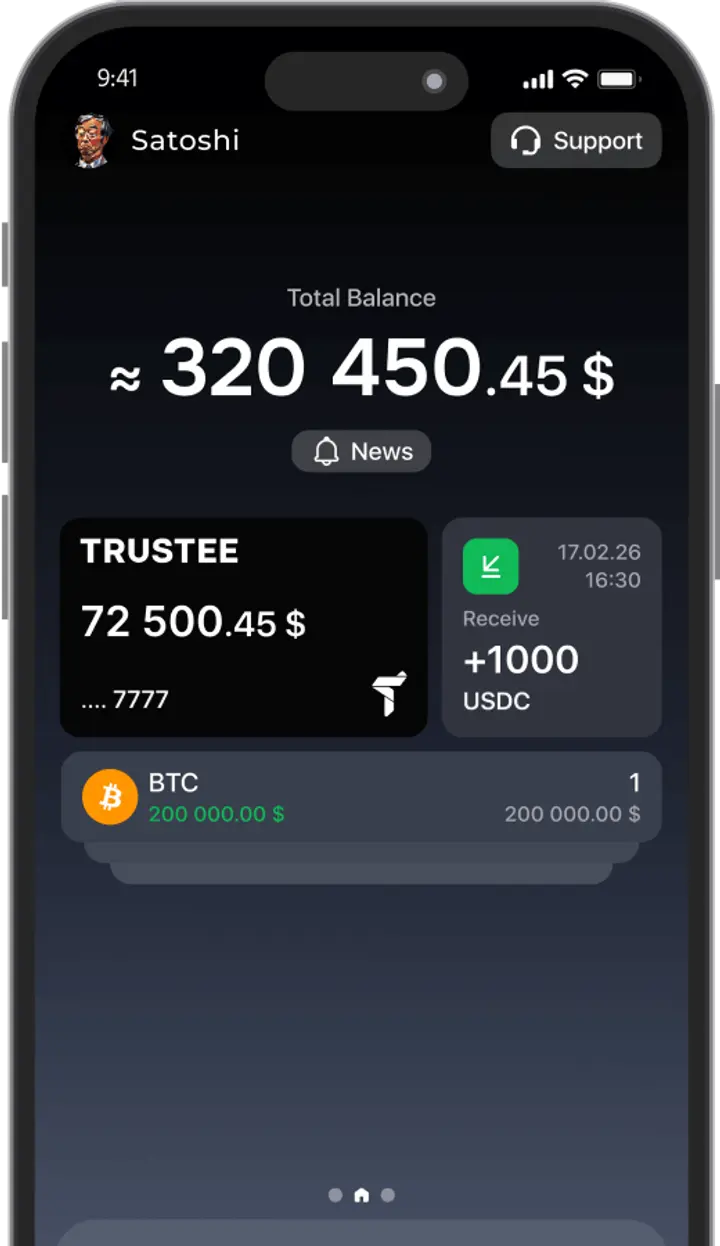
You can also buy SOL using crypto wallets such as Trustee Plus and Trustee Wallet.
How to Buy Solana via Trustee Plus (Step-by-Step Guide)
Trustee Plus is a user-friendly mobile crypto wallet that allows users to purchase cryptocurrencies using euros (EUR) via bank cards.
Solana is purchased through USDC, which can easily be exchanged for SOL within the app.
Instructions for Buying SOL with EUR:
-
Download the Trustee Plus app from the App Store or Google Play
-
Register and complete verification (required for functionality)
-
In the Trustee Plus app, tap "Top Up"
-
Select the EUR currency
-
Tap "Top Up with Card"
-
Enter your Euro bank card details
-
Input the amount and tap "Top Up"
-
Confirm the payment
After topping up your EUR balance, purchase USDC and exchange it for SOL in the "Exchange" section.
Solana Outlook and Forecast
Solana continues to position itself as a high-speed blockchain for decentralized applications in DeFi, Web3, and blockchain gaming. As of 2026, the Solana ecosystem hosts hundreds of projects, with the number steadily growing.
Top competitors in the scalable blockchain space for dApps include Ethereum, Polkadot, Avalanche, Sui, and Aptos. Solana differentiates itself through high throughput, the absence of Layer 2 solutions, and active infrastructure development.
As of December 2025, the price of 1 SOL is approximately $125. While this is well below its all-time highs, analysts believe it could represent a strong entry point — provided the team delivers on its technological promises.
Experts highlight:
-
Growing interest in Solana from developers and venture capitalists
-
Ongoing innovation in blockchain architecture
-
Strengthening of Solana’s position within the crypto ecosystem