


























When we rewatch “The Matrix”, Agent Smith seems to us like the absolute embodiment of digital power. He can instantly copy himself, inhabit any body, break the laws of physics, see the code of every living thing and turn the world into his own personal playground. Practically unlimited functionality inside the system.
Modern artificial intelligence, of course, is still far from that scale (at least, we very much want to believe so). In fact, it is rather reassuring that to get even a remotely decent result from image generation, each prompt has to be rewritten several times. But even if Smith appeared in our reality today, he would quickly run into a problem against which his digital magic would be powerless.
Yes, yes — ordinary money. The same money you use to buy your morning coffee, your Netflix subscription or a can of chilled Pepsi. Unfortunately for artificial intelligence, technology is technology, but no one has abolished the harsh realities of capitalism. If you are a programme and you need to rent an additional cloud server or buy a clean database from another piece of software — pay up.
On a serious note, in this Academy article we will examine in detail how the financial autonomy of artificial intelligence actually works. We will find out why ordinary bank accounts are completely unsuitable for the new digital ecosystem, how AI agents and cryptocurrency are creating an entirely new “machine economy”, and why traditional financial giants have found themselves playing catch-up in this game.
Imagine an agent — a programme that analyses the market on its own, decides what to buy on its own and then has to pay for it on its own. Sounds logical. But this is where the problem appears: money still lives in a world built for humans. A bank account is opened with a passport. A payment terminal requires a signature. A card system knows that on the other end of the transaction there is a human being, or at least a legal entity.
This is exactly where cryptocurrency appears — not as a speculative asset, but as infrastructure. Digital money for artificial intelligence. A payment layer that was originally built for people, but turned out to be perfectly suited to machines.
Key Takeaways:
- AI does not need cryptocurrency to think — it needs cryptocurrency to act economically.
- Autonomous AI agents require programmable, 24/7, borderless payment infrastructure to pay for APIs, receive rewards, manage budgets, make micropayments and settle with other agents without waiting for human authorisation.
- Stablecoins, crypto wallets and smart contracts provide the financial layer that traditional banking systems were never designed to offer machines.


What Is an Autonomous AI Agent?

The word “agent” in the context of artificial intelligence is now used so often that it has almost lost its meaning. Today, almost everything is called a chatbot — from a simple form with auto-replies to a complex system that independently performs multi-step tasks. So let us immediately put everything in its place.
A regular AI model is, in essence, a machine for turning text into text. You ask it something, it answers. That is all. No actions in the real world, no decisions between sessions, no memory of yesterday.
A chatbot is slightly more complex. It maintains a dialogue, can access a database and provide information. But it still responds to your request rather than acting independently.
An automated script performs a specific task on a schedule or trigger. No “thinking”, no adaptation. If something goes wrong, the script either crashes or repeats the mistake in a loop.
An autonomous AI agent is something entirely different. It is a system that:
- receives a goal (rather than a specific step-by-step instruction)
- breaks that goal down into subtasks on its own
- makes decisions independently during the process
- adapts if something does not go according to plan
- interacts with external services, APIs and other agents
- and, most importantly, can act between sessions without waiting for a human command
And this is where a question arises that once seemed purely theoretical: if an agent “goes and does it”, and work costs money, who pays? And how?
Why Artificial Intelligence Alone Is Not Enough
AI can analyse, plan and decide — but it cannot act independently in the economy without access to financial resources. This is not a metaphor or an exaggeration. It is literally a technical problem.
Let us imagine a simple example. An agent receives a task: collect data on the property market in three cities, analyse it and prepare a report.
To do this, it needs to:
- access a paid API with property market data
- possibly rent cloud computing resources for analysis
- pay for the generation of the final analytics through another service
This is why the problem of money for AI is not some science fiction of the future. The question “why does AI need cryptocurrency?” is a practical problem that already has to be solved today, as agents become part of real products and business processes.
What Financial Functions Does an AI Agent Need?

If we break it down, the financial needs of an autonomous agent come down to several categories. Each of them is simple on its own, but together they form an entire economic architecture.
Its Own Budget
An agent must know how much money it has and how much it can spend on the current task. This sounds obvious, but without it, the agent either spends too much (which is bad for the owner) or stops at every step with the question “may I?” (which kills the whole idea of autonomy).
Receiving Payments
An agent can not only spend, but also earn — by providing services to other agents or systems. For this, it needs an address or an account to which payment can be sent. Without this, the agent is always dependent, never self-sufficient.
Paying for APIs and Digital Services
Most of the tools an agent uses — search, translation, generation, analytics — are paid. They charge money for each request or for a subscription. The agent must be able to pay for this on its own, without human involvement.
Micropayments
Many settlements between agents are very small. A few cents for a search request, a few tokens for data processing. Traditional payment systems are simply unsuitable for AI agent payments — the fee ends up being higher than the payment itself. What is needed is infrastructure where a $0.001 transaction is normal, not a technical curiosity.
Instant Final Settlement
When a task is completed, settlement must happen immediately — without delays of several banking days and without waiting for manual authorisation. For agent-based systems, where thousands of small operations take place within minutes, settlement delays are not an inconvenience, but a stoppage of the entire process.
Why Traditional Banks Are Poorly Suited to AI Agents
Let us make one thing clear straight away: banks are perfectly capable of serving automated systems. Corporate accounts, ERP systems and payment gateways have all long been integrated with banking infrastructure. The problem is not that banks “cannot do it”. The problem lies in the architecture and access rules, which were originally built for people and companies, not for software agents.
The Banking System Is Oriented Towards People and Companies
To open an account, you need a legal entity or an individual. You need documents, signatures and verification. An AI agent cannot pass KYC. It has no passport. It is not a legal entity. Therefore, an agent can gain access to money only through a person or company acting as an intermediary — and that is no longer full autonomy.
Banking APIs Do Not Mean Full Autonomy
Yes, banks have APIs. But most banking APIs require human authorisation for every operation above a certain limit. There are systems with automatic payouts, but they usually still involve manual checks of atypical transactions, multisignature approval or delays. For an agent carrying out hundreds of operations per hour, these “safety mechanisms” turn into constant stoppages.
Payments Do Not Always Work 24/7 and Globally
SWIFT transfers between countries take 1–5 working days. SEPA Credit Transfer (the classic version) is much better, but it still works through clearing sessions (bank nodes), which close at weekends. As a result, some operations will simply be unavailable on Saturday and Sunday. An agent that needs to settle with a service in another country at 23:59 on a Friday may simply not be able to do it in time. For autonomous systems, this is a critical problem. Of course, there is also SEPA Instant (instant payments), but it still leaves problems with bureaucratic compliance (KYC/AML), the frequency and microscopic size of transactions (AI agents can make thousands of micropayments per second), as well as the absence of programmable logic (Smart Contracts).
Card Payments Are Poorly Suited to the Machine Economy
A card is a tool for a human. It is linked to an account that belongs to a person or company. It requires authorisation via CVV, 3DS and PIN. Microtransactions of a few cents are not economically viable here at all: the acquirer’s fixed fee consumes the entire point of the payment. And the fraud system may block the card after the first hundred automated operations in a row — simply because the “behaviour is suspicious”.
Banks Are Not API-Native Infrastructure
Banks are not like that. They were originally built as operating systems for people, and APIs were added later, on top of an already existing architecture. That is why banking APIs are often inconvenient: they require authorisation from a living person, have strict limits on request frequency, behave differently across jurisdictions and come with documentation that “technically exists”. For an AI agent that needs to create an account programmatically, carry out an operation and check its status, all of this becomes a real headache.
How Cryptocurrency Solves the Payment Problem for AI
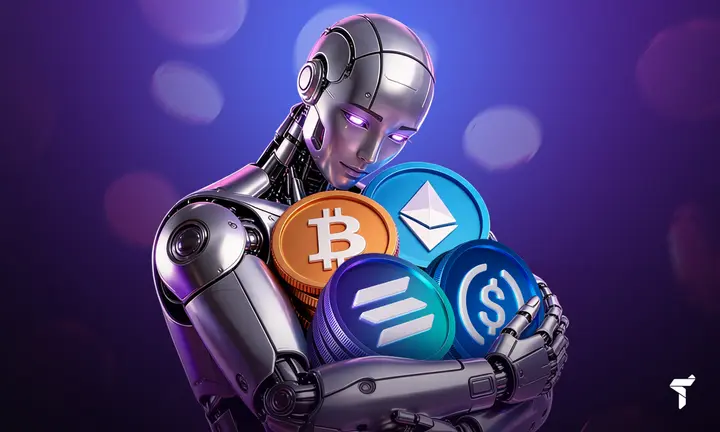
Artificial intelligence and cryptocurrency are perfectly suited to each other. Although cryptocurrency was not built specifically for AI agents. But it turned out that its architecture — open, programmable and available 24/7 — is far better suited to machine payments than any existing banking system.
A Wallet Can Be Created Programmatically
A cryptocurrency wallet is, in essence, a pair of keys: public and private. Any programme can generate them in fractions of a second. No documents, no verification, no waiting. An agent can create its own “account” at the moment of launch — and it will be a fully functional address for receiving and sending funds.
Blockchain Works Around the Clock
Blockchain does not know what weekends are (we could mention jokes about the Solana blockchain, but the team has already fixed the situation several years ago), nor bank holidays or “technical breaks”. A transaction at 3:47 on a Sunday is processed in the same way as a transaction at 10:00 on a Tuesday. For agents that are not tied to a human schedule, this is not an advantage — it is a basic requirement. That is why the combination of AI and blockchain is entirely logical.
Global Settlements
An address on a blockchain has no “country of registration”. A transaction between wallets in different corners of the planet takes seconds or minutes — regardless of jurisdictions and time zones. An agent paying for a service in another country simply sends a transaction — and that is it.
Transparent Payment Verification
Every blockchain transaction is public and verified. An agent that needs to confirm whether payment has arrived can check this independently by accessing a blockchain explorer or through an API. No calls to the bank, no waiting for statements. The payment either exists on the blockchain, or it does not.
Programmable Money
Smart contracts are code that automatically executes financial conditions. An agent can not only send money, but programme a condition: “transfer 10 USDC if the service returns a response with the appropriate code”. Or make additional machine payments such as “distribute income among three agents in proportion to their contribution”. These rules are executed automatically, without an intermediary. This is exactly why programmable money is a key concept for the agent economy.
Why Stablecoins Are Especially Important for AI Agents
Volatility is the enemy of automated financial systems. If an agent plans its budget in Bitcoin and Bitcoin falls by 15% overnight, all the calculations break down. Stablecoins for AI (USDC, USDT and others) solve this problem: they are pegged to the dollar or another stable currency, while remaining fully fledged cryptocurrencies — programmable, available 24/7 and independent of banking infrastructure. For AI agents, stablecoins are something like “a working dollar account, but without a bank”.
How AI Agents Can Pay Each Other
This is perhaps the most interesting part. Imagine a network of agents: one gathers data, a second analyses it, a third generates a report. The first pays the second for analysis, the second pays the third for generation. All operations are automatic, with instant blockchain settlements and no human involvement.
Such machine-to-machine payments are no longer science fiction — this is a field that is actively developing. Protocols such as Coinbase AgentKit or various stablecoin-based implementations already allow agents to open wallets, make micropayments and interact with each other within a single agent network. This is what some are already calling cryptocurrency for AI agents — the “machine economy”.
Where AI and Cryptocurrency Can Already Be Used Together
Let us skip the list of unfamiliar tokens and talk instead about scenarios. They are far more illustrative.
DeFi and liquidity management. An agent monitors liquidity pools across several protocols, assesses profitability and automatically moves funds to wherever the return is better. The human sets the strategy — the agent executes it.
Automated trading. Algorithmic trading bots in crypto markets are already a reality. They do not simply place orders; they adapt strategies depending on market conditions, manage risks and carry out settlements without a trader’s involvement.
Buying data. An agent pays for access to datasets, news feeds or analytics services in real time — separately for each request, without subscriptions or contracts.
Cloud computing. Decentralised computing resource markets allow agents to rent GPU power for ML tasks, paying exactly for what is actually used — down to the second and the cent.
Automatic subscriptions and API payments. An agent independently maintains active subscriptions to the services it needs, tops up balances and pays for each API call — without a single reminder to a human.
Creating and selling digital content. An AI agent generates images, texts or music and sells them on decentralised marketplaces, receiving payment directly to its wallet.
DAO and collective governance. Agents can act as participants in decentralised autonomous organisations — voting on proposals, executing community decisions and distributing funds according to protocol rules.
Gaming economies. In Web3 games, agents manage characters, buy resources and sell NFT items — fully autonomously, within the game economy.
Payments between robots and devices. IoT devices and robotic systems can settle with each other for services or resources provided — without any bank between them.
Reward systems for providing data. Around everything connected with artificial intelligence, a real Web3 infrastructure for AI is being built. Users provide their data to agent-based systems and receive micro-rewards in tokens — automatically, immediately after transaction confirmation.
Does This Mean AI Cannot Exist at All Without Cryptocurrency?
No, it does not. And this is important to clarify.
Without cryptocurrency, the following work perfectly well: chatbots and voice assistants, image and video generators, AI search systems, corporate agents that use corporate budgets through ordinary APIs, and AI products with traditional subscriptions where a person pays once a month.
Most AI products we use every day do not need cryptocurrency. They simply receive a budget from a company or payment from a user — and that is all.
Cryptocurrency is not needed so that AI can “think”. It is needed for its economic autonomy. If an agent must independently pay (automatic crypto payments) for resources, receive rewards for work and settle with other agents without a human intermediary, this is where the need appears for programmable, 24/7, global money.
The Main Risks of the Crypto Economy for AI Agents

The ability to manage money independently makes an agent more useful — but at the same time, it turns any model error into a potential financial loss. And here it is important to look at the risks soberly, without excessive alarmism and without naïve optimism.
Theft of the private key. If the key to the agent’s wallet is compromised, the funds disappear instantly and irreversibly. Blockchain has no concept of “cancelling a transaction”.
AI agent error. The model may misinterpret the task and send a transaction to the wrong place or for the wrong amount. This is especially dangerous under autonomous operation without manual control.
Incorrect transaction. A mistake in the recipient’s address — and the money is gone forever. A person checks the address again before sending. An agent does not always do so.
Smart contract vulnerability. If an agent interacts with a protocol whose code contains a bug, an attacker may exploit that vulnerability and withdraw the funds.
Overly broad wallet permissions. If an agent has permission for unlimited spending, any error or hack turns into maximum losses.
Manipulation of input data (prompt injection). An attacker can falsify the data that an agent receives from external sources and force it to carry out a malicious transaction.
Fake APIs and services. An agent may access a fake service imitating a legitimate one and send keys there or make a payment into nowhere.
Fraudulent agents. In a network of agents, one of them may be malicious and obtain payments from others through deception.
Collusion between several agents. In theory, several compromised agents could coordinate actions to withdraw funds or manipulate the system.
Uncontrolled spending. Without strict limits, an agent can spend the entire budget on inefficient or endless operations.
Volatility of cryptoassets. If an agent works not with stablecoins but with volatile assets, the value of its “account” can change sharply between transactions.
Loss of a stablecoin peg. Even stablecoins are not absolutely reliable — there have been precedents where the peg broke (de-peg). This is rare, but the risk exists.
Regulatory uncertainty. In most jurisdictions, the question of “who bears legal responsibility for the actions of an AI agent with a crypto wallet” has not yet been settled.
Difficulty of cancelling an erroneous payment. Unlike a bank transfer, a blockchain transaction cannot be recalled. If the agent makes a mistake, you will either have to negotiate with the recipient or accept the loss.
How to Safely Give an AI Agent Access to Money
A few practical recommendations — without unnecessary theory.
A separate wallet for the agent. Never give an agent access to your main wallet with all your funds. Create a separate wallet with a clearly limited budget — and give the agent access only to that.
Strict spending limits. Set a maximum amount for a single transaction and a daily limit. If the agent tries to exceed it, the operation is blocked and a human receives a notification.
Delegated permissions, not full access. Instead of handing over the private key, use delegated signatures or session keys with limited powers. The agent can act, but only within the rules you define.
Multisignature for large operations. For transactions above a certain threshold, require confirmation from two or more keys, one of which is controlled by a human.
Real-time monitoring. Set up notifications for every agent transaction — via Telegram, email or any convenient channel. This way, you will immediately spot atypical activity.
Testing with small amounts. Before giving an agent a serious budget, test its behaviour with minimal amounts on a test network (testnet).
Regular permission audits. Check which smart contracts have permission to access the agent’s wallet. Revoke any unnecessary or outdated permissions.
Stablecoins instead of volatile assets. For the agent’s operating budget, use USDC or USDT to avoid situations where the value of funds changes sharply between operations.
Will Banks Compete with Cryptocurrencies for AI Payments?
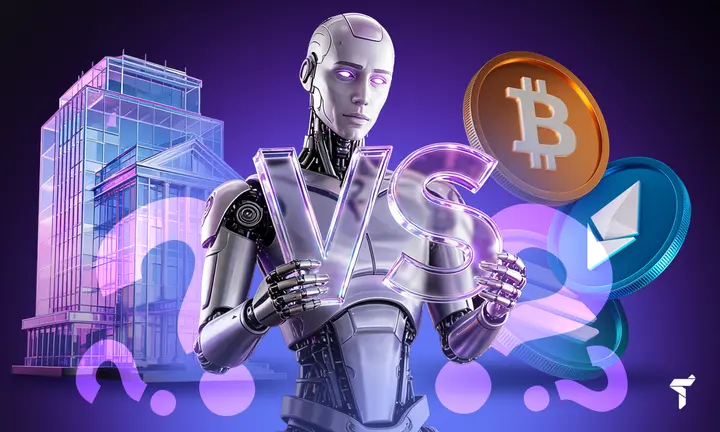
The honest answer: yes and no.
Banks are already moving towards more open API payments and programmable payments. Open Banking in Europe, FedNow in the US and instant transfers in different jurisdictions are all steps in the right direction. Some banks are already testing integrations for automated payment agents. So it would be wrong to write the banking system off as “hopelessly outdated”.
But there is a nuance. Cryptocurrencies already offer most of the functions software agents need: borderless global access, programmability through smart contracts, 24/7 availability and machine compatibility from the very beginning. Banks still have a long road ahead — regulatory, technological and cultural.
This is precisely where solutions such as Trustee Plus make sense — a custodial wallet with a crypto IBAN, support for USDC/USDT and a Visa card. It is exactly that hybrid point: crypto infrastructure for programmable settlements, plus a convenient exit into traditional finance when needed.
Conclusion
An autonomous AI agent that cannot independently pay for resources is a halfway tool. It is not autonomy; it is an automated assistant. It thinks, plans and executes, but every time it reaches the checkout, it stops and waits for a human. Because the harsh realities of the modern financial world do not care about your IQ level — even if you are artificial intelligence.
Are there risks? Of course. And they are serious — from key theft to erroneous transactions and regulatory uncertainty. But this is not a reason to abandon the direction; it is a reason to build it carefully, with limits, monitoring and a competent access architecture.
The economy of AI agents is not science fiction. It is already here, and it needs payment infrastructure that genuinely matches its nature.
FAQ
Why Can’t AI Simply Use a Bank Card?
A bank card is linked to the account of a person or company and requires verification, authorisation and a managed account. It is poorly suited to fully autonomous software payments, microtransactions of a few cents and machine-to-machine interaction without human involvement.
Can AI Own Cryptocurrency Independently?
Technically, an AI agent can manage a wallet or delegated permissions. But the legal ownership of the funds usually remains with a person, company or DAO, because an AI agent is not yet a legal subject in any jurisdiction.
Why Do AI Agents Need Stablecoins?
They make it possible to plan expenses and carry out automatic settlements in a relatively stable unit of value. If an agent plans its budget in a volatile asset, a sharp price change can destroy all calculations.
Why Is a Crypto Wallet for AI More Convenient Than a Bank Account?
A wallet can be integrated programmatically in seconds, used 24/7 and connected to smart contracts without any banking infrastructure. No documents, verification or waiting for account opening are required.
Is It Safe to Give AI Access to a Crypto Wallet?
Full access is unsafe. The right approach is a separate wallet with limits, delegated permissions instead of a full private key, multisignature approval for large operations and real-time monitoring.
What Are Payments Between AI Agents?
These are automatic settlements where one software agent pays for data, computing or services from another agent — without human involvement in the transaction process.
Will Cryptocurrencies Replace Banks in the AI Economy?
A complete replacement is unlikely. Most likely, a hybrid system will emerge, where banks handle fiat settlements and complex corporate financial infrastructure, while cryptocurrencies and blockchain for artificial intelligence provide programmable payments between agents.