




























In recent years, major crypto exchanges and exchange services have implemented KYC verification procedures for their clients. In this article, we’ll explore what KYC and AML are, what documents are required for verification, and the role KYC plays in combating "dirty" coins.
De-anonymization in the crypto world

Cryptocurrency has sparked a financial revolution, offering the world fast, low-cost, anonymous, and borderless transactions. At the same time, these unique features have made crypto an attractive tool for hackers and opened new avenues for abuse.
To prevent scenarios that could cast a shadow over the concept of cryptocurrency, part of the crypto community decided to compromise and abandon anonymity by introducing KYC verification procedures.
What is KYC
KYC stands for "Know Your Customer." It is a process of identity verification for users.
In recent years, key players in the crypto market have increasingly adopted KYC procedures to comply with 5AMLD — the Fifth EU Anti-Money Laundering Directive. Without completing KYC verification, users simply cannot access their services.
Be prepared that exchanges (and occasionally exchangers) may request the following KYC information during registration and verification:
-
Full name
-
Email address
-
Phone number
-
Registration/residential address
-
Nationality/citizenship/residency
-
Date of birth
-
Photo of an official ID (driver’s license, passport)
-
Social security or tax number
-
Bank account statement
-
Rental agreement
-
Utility bill
-
Photo and data of a bank card or other relevant details
Often, exchanges allow relatively simple registration that enables users to make transactions in small amounts, usually without fiat conversion.
How exchanges protect personal data
Users are understandably concerned about the risk of malicious access to personal data. How do exchanges guarantee its security?
-
They use encryption technologies (PCI scanning and multi-level encryption) and pseudonymization.
-
They enforce internal data access restrictions.
-
They maintain strict physical access controls to data storage devices.
Do these methods offer a 100% guarantee? Unlikely. Companies explicitly state this in their disclaimers.
What is AML
AML (Anti-Money Laundering) is a set of requirements and rules aimed at combating money laundering from criminal sources or for terrorism financing. These rules are set out in EU directives, which are updated to reflect new risks and conditions.
In 2020, the Fifth Anti-Money Laundering Directive came into force, which:
-
Defined cryptocurrency as a digital form of value that can be transferred, stored, sold, accepted, or exchanged digitally
-
Recognized crypto exchanges as financial institutions, thereby subjecting them to legal financial monitoring requirements: client verification (KYC), reporting suspicious activity to regulators
-
Expanded reporting obligations and allowed financial intelligence agencies to request KYC data on wallet owners from crypto exchanges
AML/KYC policy applies to all companies operating within the European Union. Some exchanges chose not to compromise on privacy and moved their operations outside the EU.
Two camps
While most crypto exchanges and exchange services are joining the AML/KYC camp, some dissenters remain loyal to the ideological foundation of crypto anonymity.
Let’s examine the pros and cons of de-anonymization:
| Advantages | Disadvantages |
|---|---|
| Reduced risk of crypto being used for illegal purposes | Contradicts the core principle of crypto anonymity |
| Increased public trust and broader adoption of cryptocurrencies | Risk of personal data being accessed by malicious actors |
| Protection from "dirty" coins and fraudulent schemes | Unpredictable tax implications (due to legislative gaps) |
| Possibility of account recovery | Oversight of financial operations by regulators |
| Potential compensation in case of exchange bankruptcy (albeit minimal) | Legal inconsistencies in crypto and AML regulations across jurisdictions |
| Easier crypto-to-fiat conversion | High costs of secure data collection and storage |
| Access to extensive features on licensed major exchanges | Competitive edge of decentralized, non-KYC platforms |
| For exchanges: licensing and permission to operate in most countries | Complex procedures may deter potential users |
To make an informed decision, weigh the pros and cons, set your priorities, and consider the following factors:
-
Platform jurisdiction and licenses
-
Scope of data required during KYC verification
-
Data storage and protection methods used by the platform
-
Exchange’s liability in case of data breaches
-
Exchange’s liability in the event of bankruptcy
-
History of exchange hacks
What is a "dirty" Bitcoin

One argument in favor of trustworthy crypto platforms requiring verification is user protection from acquiring "dirty" or "black" coins.
"Dirty" refers to Bitcoins and other coins that have been used in illegal transactions or stolen by hackers. A user may unknowingly receive such coins via a transfer or from an unreliable exchange.
Large exchange platforms (usually centralized exchanges) strive to monitor the "history" of coins, trace and block "dirty" assets. There are special services (Chainalysis, CipherTrace, Elliptic, AMLBot) that identify dirty Bitcoins. These tools scan addresses across hundreds of databases, detect suspicious transactions, and assess risk. The process takes very little time.
AMLBot can perform a check in 1 second and provide detailed wallet statistics and a risk score.
To launder such coins, users have developed various methods to bypass KYC verification: passing them through so-called "mixers", cashing out via crypto ATMs, using gambling services, breaking down transactions into small parts, reselling on p2p (non-regulated decentralized platforms), or selling to individuals at a large discount.
Note: Trustee Plus offers 100% protection from "dirty" crypto and wallet blocking, combining all the benefits of blockchain in one app. Read more in this article about how free AML checks in Trustee Plus protect you from "dirty" coins.
What problems can "dirty" Bitcoin cause?
If a suspicious Bitcoin appears in a user’s address, all the coins in that wallet may be compromised.
To regain access to funds on the exchange, the user will:
-
Need to complete verification (AML/KYC procedures) if it wasn’t done during registration.
-
Likely be asked to explain the origin of the coins. This may require documents proving the legitimacy of the transaction (e.g., sales or service contracts, exchange receipts, transaction screenshots, etc.).
-
In some jurisdictions, face fines or other penalties for participating in money laundering, even unknowingly.
How to avoid "dirty" coins
Here are some tips for safely acquiring Bitcoins and other coins:
-
Buy from major reliable exchange services, including regulated centralized exchanges with proper licensing and strict KYC procedures. The downside: zero privacy.
-
Use dedicated services (e.g., Chainalysis, Crystal, IdentityMind, Longhash, Traceer, ETHProtect by Etherscan, AMLBot) to check whether coins are "dirty". Experts recommend setting up two wallets: a test wallet and a primary wallet. After verification in the first, transfer to the second.
After purchasing crypto on an exchange, immediately transfer the coins to a more secure non-custodial wallet. Keeping coins on centralized platforms is risky.
How to get rid of "dirty" coins
If there are doubts about the legitimacy of received coins, there are a few ways to dispose of them:
-
Cash them out via a crypto ATM (note: this can be challenging, as covered in our overview of crypto withdrawal methods).
-
Use a crypto mixer (e.g., Bitcoin Fog, MyCryptoMixer, BitMix, Coinomize, BitcoinMix) — a service that combines incoming transactions from multiple users and redistributes the coins to different addresses.
-
Break coins into smaller parts and mix with "clean" Bitcoins so that the share of "dirty" coins is minimal (less than 5%).
-
Sell for cash on the OTC market.
Crypto wallets as a solution

On the one hand, passing KYC verification provides conditional safety. On the other, complex multi-step verification processes on exchanges can create barriers for users.
If your main needs are secure coin storage and basic buy/sell, transfer, and exchange operations, you may avoid lengthy verification by using a trusted crypto wallet.
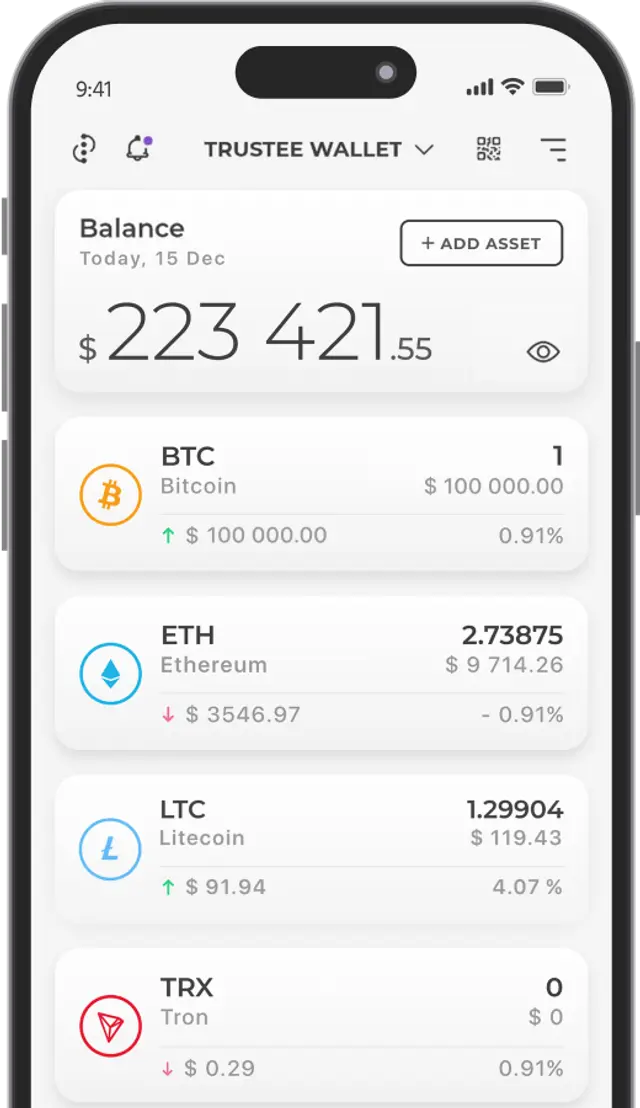
For instance, using the non-custodial multi-currency Trustee Wallet requires no registration and, in most cases, no KYC — except when using international exchange providers (e.g., MoonPay, Utorg).
HD Wallet is a technology that changes your Bitcoin address for every incoming transaction. This offers maximum anonymity. HD Wallet is available for both Legacy and Segwit address formats.
How to complete verification with Trustee Wallet
When purchasing cryptocurrency with a credit/debit card in USD or EUR, the provider (payment system) may require KYC verification to mitigate potential risks.
What you’ll need (using MoonPay as an example):
-
Create a purchase request through MoonPay, selecting the currencies you are giving and receiving, the purchase amount, and your bank card number. Then enter your email and confirmation code.
-
Provide your full name, date of birth, and country of citizenship (in Latin characters).
-
Enter your billing address: street, city, postal code, and country (all in Latin characters).
-
Specify the type of ID document (driver’s license, passport, or residence permit).
-
Upload photos of the document and take a selfie.
-
Enter your card details, including expiry date and CVV code. Review the purchase again and click Buy. Your bank may request additional payment confirmation (via online banking, call, SMS, etc.).
-
After payment, the provider will verify your identity and, if successful, complete the transaction and send the funds to your wallet. If verification fails, the funds will be returned to your card within 1–24 hours.
You will receive an email from the provider informing you of the KYC result.
Conclusion
Today, crypto users have a choice: maintain conditional anonymity with limited functionality and greater risks or operate transparently and feel secure. The decision is yours.
If you choose the latter, completing KYC verification is straightforward with the right documents and a decent smartphone camera. It’s important to follow instructions carefully, fill out forms correctly, and take high-quality document photos.