



















When exchanging digital assets, users pay fees to the services that provide purchase and sale operations.
Here we explain what makes up the fee when buying cryptocurrency and withdrawing from an exchange, where and how to buy cryptocurrency with the lowest fees, and whether it is possible to transfer cryptocurrency for free.
Fees on cryptocurrency exchanges
Crypto exchanges and exchangers provide digital-currency swap services, acting as intermediaries between sellers and buyers, and they charge for this service — a commission. Depending on the exchange method, the fee will differ.

Exchangers, except P2P exchanges, send cryptocurrency directly to users’ wallet addresses, so every swap includes the service fee and the miners’ fee for confirming the transaction.
Types of fees on crypto exchanges
Different services calculate service fees based on how they operate.
Exchange fees generally fall into two categories:
-
Trading fees or swap fees. Charged for each trade on the exchange when you convert one cryptocurrency into another. This is a book entry only — the cryptocurrency does not move between wallets on the exchange. Therefore, the swap fee often does not exceed 0.5% of the trade amount;
-
Withdrawal fees. Users pay for exchange services and cover their transaction expenses. This fee depends on blockchain network charges or is set by a bank for a transfer if you are using fiat.
Exchanges with minimal fees
Minimal cryptocurrency fees are achieved thanks to high trading volumes. As a rule, the larger the crypto exchange, the lower the fees users pay.
You can draw an analogy with a café: when the flow of customers is fairly large, even with low menu prices the venue earns a decent profit, which in turn allows it to set competitive prices and attract customers with promotions and discounts.
You can buy cryptocurrency with the lowest fees on popular exchanges and exchangers. On such platforms, the average trading fee is 0.1%—0.2%. Some platforms offer fee discounts when certain conditions are met:
-
Reaching a specified trading volume over a given period;
-
Paying fees in the exchanges’ own coins/tokens;
-
Discounts offered to users through a referral programme.
Promotions can provide the very lowest crypto fees, but do not forget about other costs for deposits and withdrawals on exchanges.
Zero-commission exchanges
If you are wondering how to buy cryptocurrency with no commission, here are a few options:
- Take part in exchange promotions
From time to time, crypto exchanges run promotions for newcomers — for example, they provide vouchers to cover fees and a period during which traders can buy and sell cryptocurrency free of charge.
- Become a P2P seller
On P2P exchanges, users can not only avoid paying fees but also earn fees themselves.
However, becoming a counterparty is not easy for several reasons:
-
You need a reputation, which is hard to build and takes considerable time;
-
You must pass KYC (identity verification).
There are other drawbacks to this route as well:
-
There are risks of encountering fraud and of bank-card blocks;
-
You may wait for orders for several hours or even days because of high competition;
-
You can set limits, but if you specify an exact amount it will be harder to find a buyer.
Fees charged by crypto exchangers
Classic exchangers include both types of fees when buying/selling digital assets, so their exchange rate differs from the exchange rate on order-book exchanges by at least a few per cent.
Because trades take longer and occur far less frequently than on exchanges, exchangers’ crypto transfer fees are higher — most often no less than one per cent. Limits will be higher too, as small amounts are unprofitable to exchange for both the service and the users.
Crypto platforms with 0% fees
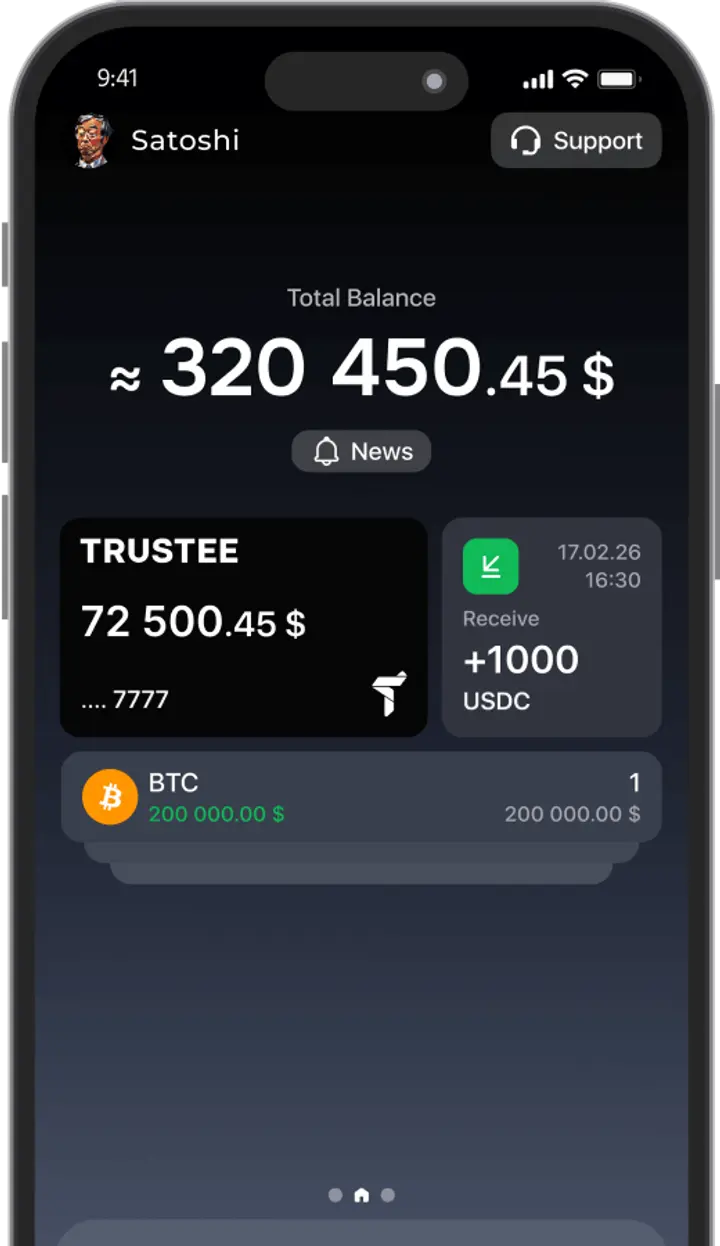
Another way to buy cryptocurrency — use the Trustee Plus platform. This is the most cost-effective option, as most transactions here have no fee.
In particular, the platform offers 0% fees for the following operations:
-
Stablecoin swaps within the platform;
-
Withdrawal of euros (EUR) to a VISA or MasterCard payment card;
-
Cryptocurrency transfers;
-
Account top-ups and maintenance;
-
Payments with the Trustee Plus bank card.
Suppose you need to top up your USDC wallet using fiat funds. To do this, follow a few steps in this guide.
When swapping one cryptocurrency for another, the fee is only 0.5%, which is lower than most crypto wallets from Binance or ByBit. In this way you can exchange, for example, USDC for BTC.
More advantages of Trustee Plus include:
-
Fast and secure crypto purchases;
-
No hidden fees: the amount shown to be received includes all transactional charges;
-
Competitive market rates.
Miner (network) fees
Cryptocurrency transaction fees depend on the chosen blockchain network and vary according to current network load: the more actively users make transfers, the higher the fees. We explained how the transaction queue (mempool) is formed and how miners choose transactions to add to a block in a separate article.
Thus, the auction model for including transactions in a block (the more you pay, the faster the confirmation) prompts users to overpay on fees.
How to pay lower fees
Exchange and exchanger fees are directly linked to miners’ transactional charges. When the number of transactions declines, some exchanges reduce their withdrawal fees as well. But they do not lower fees immediately, and for some time users overpay so-called “network” fees.
Note that when network load increases, exchanges instantly raise their “network fees” for withdrawals.
You can track network-fee dynamics using blockchain explorers.
Bitcoin (BTC)
Ethereum (ETH)
Bitcoin Cash (BCH)
Tron (TRX)
Cardano (ADA)
[info content="Note: blockchain explorers do not track ADA transaction fees because they are so small — less than $0.01." color="green"]
Litecoin (LTC)
Instant and free transfers
With Trustee Plus you get not only instant transfers between users but also highly favourable conditions. One of the main advantages — there is no fee for transfers between users. This means you can send funds to your contacts completely free of charge.
To make a transfer you do not even need to know the recipients’ cryptocurrency wallet addresses. Instead, you just enter the recipient’s phone number or their Trustee Plus system identifier (ID).
In addition, if you still need to send USDC to an external wallet, you can do so with no fee as well.
Conclusion
If you want to buy Bitcoin or Ethereum, exchanging small amounts is often uneconomic, as fees can reach and exceed tens of dollars depending on network load. To save on fees, consider more performant blockchains: Bitcoin Cash, Litecoin, Cardano and Tron.
How and where to buy cryptocurrency — that is up to you. The fastest, cheapest and most convenient way for beginners planning long-term holding — buy cryptocurrency in-wallet.