





















The first cryptocurrencies, such as Bitcoin and Ethereum, unlike Dash, were based on the Proof-of-Work (PoW) consensus algorithm, which required physical hardware for mining.
However, later protocols emerged that expanded blockchain capabilities and introduced new functionality. This article discusses one such cryptocurrency.
Dash – What Is This Cryptocurrency?
Dash (short for "digital cash") is a private open-source blockchain-based altcoin.
Dash’s history began in 2014 when the cryptocurrency was created as a fork of Bitcoin by Evan Duffield, former director of the Dash Core Project and developer of the original Dash wallet. The developers improved the blockchain by making transactions faster, cheaper, and more private, allowing them to be mixed to hide the real sender and receiver addresses. The name "Dash" is derived from the phrase "digital cash."
How the Dash Cryptocurrency Works
Dash developers created a unique two-tier protocol that operates on the X11 algorithm (Proof-of-Work) and masternodes (Proof-of-Stake). We covered this architecture in detail in our article about masternodes. Here, we’ll briefly outline how the Dash protocol works.
PrivateSend
Instead of the ring signature used in the Monero protocol, the Dash team developed the PrivateSend function, which shuffles addresses via masternodes. This method is called CoinJoin (coin mixing), making it impossible to directly trace transactions. CoinJoin is supported by some modern Bitcoin wallets that allow for anonymous BTC transactions. However, in Dash, coin mixing is built into the blockchain protocol itself.
InstantSend
Another useful Dash feature is the ability to send coins instantly without miner confirmations. This allows for real-time transactions. Instead of miner validation, transactions are confirmed by masternodes that use the PoS consensus, not PoW.
Masternodes
A masternode is a supernode with extended privileges on the Dash network. Masternodes perform standard functions such as syncing with the blockchain, mining blocks, and validating transactions. In addition, they can vote on protocol improvement proposals, mix transactions using PrivateSend, and authorize instant transactions via InstantSend.
There are three types of nodes in the Dash network:
-
Masternodes or supernodes with extended features;
-
Full nodes (like Bitcoin miners) – capable of mining blocks and performing transactions;
-
Standard nodes – can only perform transactions.
To launch a masternode, at least 1,000 DASH must be locked. This requirement virtually eliminates the possibility of a network attack, as it becomes economically unfeasible for hackers. Masternodes receive 45% of the total network staking rewards. Currently, there are 4,352 registered masternodes in the Dash network.
Dash Consensus and the Dark Gravity Wave Mechanism
The first-tier Dash consensus uses the X11 hash function, named for the eleven rounds of hashing required to mine the coin. This algorithm was developed by Dash creator Evan Duffield. For the hash function, Duffield selected 11 of the most secure cryptographic methods to prevent any breaches resulting from weaknesses in one or more hash functions.
Duffield also developed a difficulty adjustment algorithm called Dark Gravity Wave (DGW) to eliminate the shortcomings of the previous-generation Kimoto’s Gravity Well (KGW), used in the Megacoin protocol. Dark Gravity Wave uses multiple exponential and one simple moving average to ensure smoother difficulty changes.
As a result, block rewards aren’t adjusted by block number, but rather calculated using a formula based on Moore’s Law.
Dash Price and Market Performance
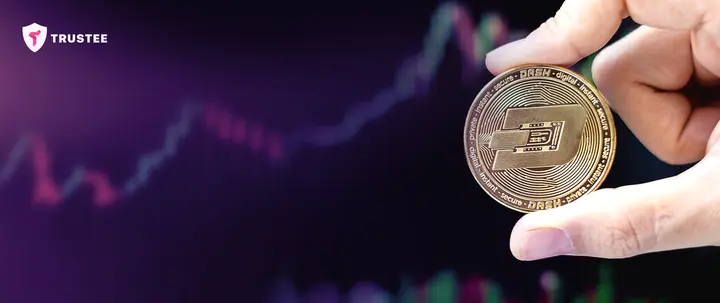
In 2017, during the crypto boom, Dash became one of the most popular and in-demand altcoins, ranking among the top ten cryptocurrencies by market capitalization. According to Der Spiegel, in February 2019, Dash was even the most popular cryptocurrency in Venezuela, where mining was criminalized.
During the correction phase, Dash lost over 95% of its value and was later overtaken by other promising projects, pushing the altcoin far behind. Dash currently ranks 62nd on Coinmarketcap with a market cap of $1.38 billion.
You can view Dash’s price trends on its cryptocurrency chart:
Where to Buy Dash Cryptocurrency
Dash is traded on many major exchanges. It can also be purchased via the Trustee Plus wallet.
Decentralized Governance
As mentioned earlier, Dash operates as a Decentralized Autonomous Organization (DAO). This means the network lacks a central authority to decide on protocol changes, which prevents centralization. Dash is governed by masternodes, which vote on the platform’s development direction.
Protection Against Double Spending
Thanks to the InstantSend algorithm, the Dash protocol prevents double spending of coins.
Here’s how it works:
- When a user sends cryptocurrency using the InstantSend feature, the transaction is sent to 7–10 randomly selected masternodes.
- These masternodes lock the transaction for one hour to prevent double spending, while the coins are sent to the recipient.
Under the PoW approach, where the blockchain is governed by a mining community, there is a small chance that miners can collude and take over a majority of the network, performing a double-spending attack. In other words, miners could secretly create parallel blockchains and then broadcast them to the main network.
Dash Cryptocurrency Mining
To mine Dash via PoW, one needs to purchase and set up equipment with high-performance GPUs. To earn a reward, miners must be the first to solve the algorithm’s hash function, receiving 45% of the total block rewards. Masternodes receive the same share.
To start mining, you’ll need a computer (or mining rig), an internet connection, and a wallet installed and configured. ASIC devices, optimized for specific cryptocurrency mining, are the most efficient option. However, ASICs are limited to one coin, making switching to another cryptocurrency impractical.
Dash Cryptocurrency: Prospects and Forecast
Despite prolonged corrections and negative momentum after the 2018 crash, analysts remain optimistic about Dash’s future price performance. They believe the protocol has clear advantages over older and "less agile" blockchains like Bitcoin, Ethereum (in its current form), Litecoin, and others.
An even more optimistic forecast came from Coinpedia, which predicted the coin could exceed $2,000 in 2021. However, as of January 2022, Dash’s price stood at $145.08. Still, these optimistic projections are not baseless, as they reflect the cryptocurrency’s strong fundamentals.
Dash’s development prospects depend heavily on large partnerships and continuous updates. Recently, the Dash team partnered with African exchange Naijacrypto. On May 19, the developers released a new version of Dash Core. The update affected masternodes, miners, and users. The development team continues to enhance the protocol and software through regular updates.
Conclusion
Following the 2018 crypto market crash, Dash has not been in the spotlight, as attention has shifted toward newer crypto projects, many of which are overhyped due to marketing. However, investors and analysts remain optimistic about Dash’s long-term and short-term potential.