


























The Polkadot (DOT) project is regarded as a serious competitor to Ethereum in the field of infrastructure for DeFi platforms and smart contract deployment.
Let’s take a closer look at the Polkadot (DOT) cryptocurrency, its history, price and prospects for the future.
Polkadot cryptocurrency — what is it?
DOT is the native coin of the Polkadot blockchain — a protocol that unites a network of different blockchains into a single ecosystem, providing cross-chain compatibility and security.
The DOT coin serves three purposes:
-
Governance: control over the protocol, including updates and changes. Voting power is proportional to the amount of DOT held.
- Staking and consensus: through Polkadot staking, users participate in validating new blocks and enforcing the rules, thereby securing the network.
-
Bonding: DOT links new shards of the main network — the parachains (more on these below) — to the central network. To create a parachain, a certain amount of DOT must be locked. Once a parachain is removed, the coins are returned to the user.
Polkadot’s creation story and mission
Polkadot’s story began with Ethereum. The project’s founder is Gavin Wood, a British scientist-engineer; he was previously a co-founder and developer of Ethereum and the author of the Solidity language.
After two years at Ethereum as CTO, Gavin Wood, together with his colleague Jutta Steiner, founded Parity Technologies to build core infrastructure for the Ethereum blockchain and other Web 3.0 networks.
Thanks to the efforts of Wood and his colleagues Robert Habermeier and Peter Czaban, the Polkadot protocol emerged in 2017. The first token sale took place in the same year.
In 2019, the project launched a testbed — the Kusama canary network, which is independent of Polkadot but runs on the same software. The platform allows any project to create its own blockchain (parachain) in the ecosystem using the Substrate framework.
A key driver of growth was Substrate, which significantly lowered the entry barrier for developers and enabled new blockchains to be created rapidly without writing everything from scratch. This triggered a boom in experimental projects built on Polkadot and Kusama.
The Web3 Foundation played a distinct role: it not only funded core development but also launched a grant programme through which hundreds of teams worldwide received support to build their own solutions.
In its early years Polkadot began to attract the attention of venture funds and major investors, cementing its reputation as a platform for Web3 innovation. As a result, Polkadot quickly moved beyond an experimental project to become a key player in building infrastructure for decentralised applications.
Roadmap
-
May 2020 — mainnet launched under Web3 Foundation governance with Proof-Of-Authority (PoA) consensus.
-
Summer 2020 — the network moved to decentralised governance via Nominated Proof of Stake (NPoS).
-
August 2020 — DOT trading became available and a redenomination occurred: the maximum supply increased 100× to 1 billion coins (without changing ownership proportions).
-
December 2021 — parachains were introduced, enabling independent blockchains to connect to the Relay Chain.
-
2022-2023 — development began on technologies such as asynchronous backing, parathreads and XCM v3; governance reforms were carried out.
-
December 2024 — the Kusama network underwent a large-scale stress test (“The Spammening”), demonstrating throughput of ~143,000 TPS at 23% load.
-
January 2025 — the Polkadot 2025 roadmap was published with key updates: Solidity/EVM support in Asset Hub, Polkadot Virtual Machine (PVM), Elastic Scaling and a Unified Address Format.
-
April 2025 — voting activity declined somewhat; Polkadot V1.4 was released, network parameters and XCM were improved; the number of validators grew and the degree of decentralisation (the Nakamoto coefficient) increased.
-
May 2025 — Polkadot 2.0 officially unveiled with Elastic Scaling and XCM v5. JAM (Join-Accumulate Machine) launched to enhance rollup support and cross-chain integration.
-
July-August 2025 — Agile Coretime completely replaced crowdloans as the new model for slot-resource leasing. Asynchronous support (Async Backing) became widespread, while Elastic Scaling remained in testing (as of August 2025).
-
Mid-to-late summer 2025 — Elastic Scaling launch; Agile Coretime already operational.
-
September-October 2025 — planned introduction of Polkadot Hub: a single portal for staking, governance, smart contracts and integrated bridges; launch of the smart-contract module (PolkaVM) and governance/staking features on Polkadot mainnet.
-
November 2025 — deployment of cross-chain XCM orchestration for improved coordination and UX (multi-chain orchestration).
Polkadot’s goals and mission
As the flagship project of the Web3 Foundation, Polkadot was created to embody its authors’ core values:
-
Personal data belongs to users, not corporations.
-
Secure global digital transactions.
-
Decentralised online exchange of information and value.
One way the founders aim to achieve these goals is by transforming centralised services into trusted decentralised protocols without intermediaries — in other words, creating an “internet of blockchains”.
Thanks to its cross-chain compatibility, scalability and ease of implementation, the Polkadot blockchain is designed to provide the technical foundation for a network of disparate, independent blockchains to exchange information and value under shared security guarantees.
Polkadot as a multi-platform network: technical features

Polkadot is a multi-platform network using the Nominated Proof of Stake (NPoS) consensus mechanism, which allows blockchains with different characteristics to communicate arbitrarily across chains within a single security model (for example, a financial services network can interact with an oracle network without intermediaries).
The network’s core is the Relay Chain — the central blockchain that coordinates consensus and connects all parachains, as well as external networks (such as Ethereum and Tezos) via bridges. The platform enables any project to create its own blockchain (parachain) within the ecosystem using the Substrate framework.
Polkadot network consensus
Most blockchains combine block production and validation in a single consensus algorithm. Polkadot separates these concerns — block production and finalisation are handled by two distinct mechanisms:
- BABE (Blind Assignment of Block Extension) — responsible for producing blocks.
- GRANDPA (GHOST-based Recursive Ancestor Deriving Prefix Agreement) — finalises blocks by adding them to the chain.
To strengthen validator incentives, personalised accountability is applied in the form of slashing penalties of up to 100% of staked funds (details below).
BABE
Block production occurs on parachains. BABE is a slot-based algorithm inspired by Cardano’s Ouroboros Praos PoS protocol.
For a block to be finalised at the next stage (GRANDPA), it must include a chain of blocks already completed by GRANDPA. This is one of the requirements for using GRANDPA.
GRANDPA
Blocks formed on parachains are sent to the Relay Chain for validation, where they are checked for security and correctness. Blocks that receive more than two-thirds of validator votes are added to the chain.
Validators (nodes that meet technical requirements) are elected by nominators (users who have staked their Polkadot (DOT) coins). Nominators receive a share of validator rewards, but also incur losses if validators break the rules.
What incurs slashing
The platform also includes watchers — Fishermen — nodes that detect misbehaviour by validators and collators for a small DOT fee. Their incentive is the reward for catching offenders.
A much more serious offence is equivocation, that is, producing two blocks in the same slot (BABE) or pre-voting and pre-committing (prior to finalisation) two conflicting chains within the same round (GRANDPA). This results in a more substantial slash.
The most severe offence — pre-voting or pre-committing two chains, one of which has already been finalised — is punished by confiscation of 100% of the staking pool. This behaviour is treated as an attack because it attempts to revert finalised blocks.
Polkadot does not limit the number of independent validator nodes a user may run. However, to deter collusion and group violations, a “progressive slashing scale” is applied: as the number of offending validators increases, so does the penalty size.
Polkadot project pros and cons
Strengths of Polkadot include:
-
Relevance of its technical solutions and role in Web3 development (cross-chain interoperability, Substrate, JAM, Polkadot 2.0).
-
Scalability and throughput potential (in Kusama tests — over 140,000 TPS; in the long term — hundreds of thousands of TPS).
-
A professional team led by Gavin Wood and support from the Web3 Foundation.
-
A fast-growing Substrate-based ecosystem, hundreds of projects and an active developer community.
-
Recognition across major exchanges: DOT trades on Binance, Coinbase, Kraken and other leading platforms.
-
Stable market capitalisation around $6 billion (2025), keeping Polkadot in the global top 30 cryptocurrencies.
Weaknesses:
-
Complex architecture and a high “barrier to entry”.
-
Polkadot 2.0 is not yet complete (JAM and Elastic Scaling are in progress).
-
High resource costs for parachains.
-
Dependence on bridges for full compatibility.
-
Insufficient usability for the mass market.
-
DOT’s volatility and a lower ranking (top 30).
Forecast and investment outlook for Polkadot

As of August 2025, the price of Polkadot (DOT) is around $3.8. Despite being relatively low compared with the 2021 peaks, analysts consider DOT to remain an undervalued asset with upside potential. This is due to systematic capital allocation for further development and the team’s active work on the transition to Polkadot 2.0, which includes the introduction of JAM, Elastic Scaling and a new resource-leasing model, Agile Coretime.
The Polkadot ecosystem continues to expand. According to PolkaProject, the number of projects exceeds 470 and keeps growing. Despite a general decline in developer interest in Bitcoin and Ethereum, Polkadot has seen an increase in core developers and steady community activity. This indicates that the network remains attractive to start-ups and venture investors.
In Gavin Wood’s view, Polkadot’s key competitive advantage is that it offers not only smart contracts but a full network of blockchains capable of interacting with each other. This broadens the scope for building complex decentralised services. At the same time, interoperability with external blockchains still requires bridges, which introduces certain risks and technical challenges, though these are unlikely to be critical obstacles.
Where to buy Polkadot (DOT)
The Polkadot (DOT) cryptocurrency is freely traded on many major exchanges (Binance, Bithumb, Huobi Global, Coinbase, Kraken, Gate.io, KuCoin, OKEx) in pairs with BTC, ETH, USDT, BNB, as well as USD, EUR and other currencies.
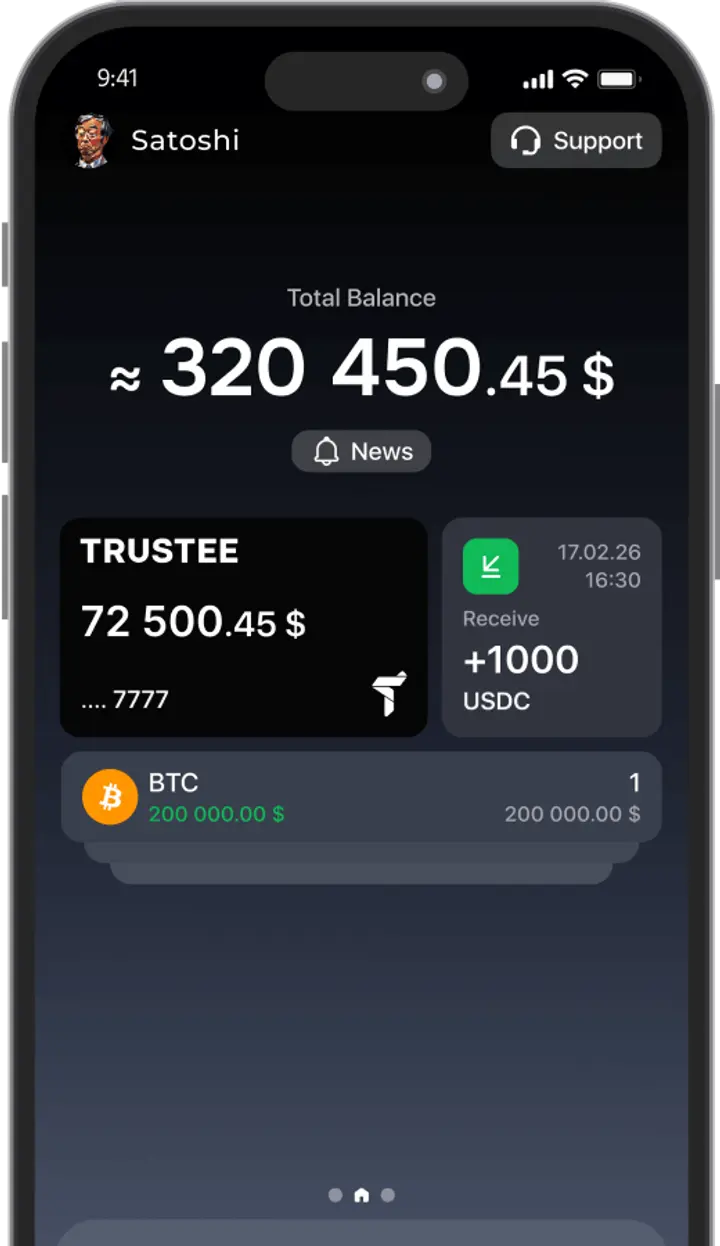
Beyond exchanges, coins can be purchased directly in wallets that support DOT. Among convenient services, Trustee Plus stands out — a mobile app with support for fiat cards where you can quickly buy DOT with euros without additional intermediaries. This makes purchasing Polkadot accessible even to users without exchange experience.
Conclusion
Polkadot (DOT) remains one of the most promising projects in Web3. Its technical solutions, active ecosystem and developer support make DOT a strong candidate for long-term growth.