




























The "Pump & Dump" scheme is common in the crypto market because it requires relatively low liquidity compared to stock and currency markets, where asset price manipulation is much more difficult. In this article, we will explain what cryptocurrency pump and dump schemes are, how to recognize them, and how they differ from organic price growth.
What is a pump/dump in the cryptocurrency exchange
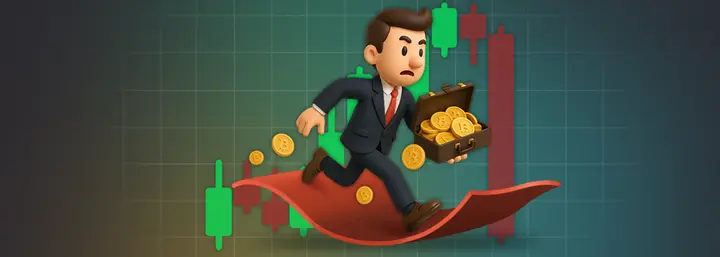
Pump and Dump is a manipulative scheme involving artificially inflating the price by buying and then selling assets in large amounts: securities, precious metals, or cryptocurrencies. The term "Pump" means that a trader artificially raises the price to increase demand for the cryptocurrency. "Dump" refers to the price crash after a rapid rise, when the trader takes profit.
The Pump & Dump scheme was first used in the 17th century in the UK: The South Sea Company inflated its stock price by promising investors big profits, resulting in a financial bubble.
Later, scammers applied such schemes on the stock market and then on the cryptocurrency market. Targets are "junk" stocks, cryptocurrencies, and tokens.
This applies to major cryptocurrencies too: the first big event for the crypto market was Bitcoin's dump in 2017, linked to many inexperienced investors who knew little about Bitcoin or the crypto market. After Bitcoin's price fall, altcoin prices crashed, some losing 90% or more within months.
How to recognize a pump and dump in cryptocurrencies
The Pump & Dump scheme has clear signs. For example, after a price rise, it usually falls back to the previous level before the pump or even lower.
Here is how to identify a cryptocurrency pump:
- The price starts to rise rapidly without reason, meaning no news precedes the increase that could justify the price rise.
- Media does not publish explanations for the price surge.
- Little is known about the coin or token, and the price growth is not accompanied by community discussions about developer activity, updates, or other significant events.
To understand how to spot a pump, look at the chart: the price forms a "mountain" or "triangle" shape, as shown in the screenshot below. Pump & Dump usually happens after listing on exchanges when investors pay increased attention.

Before pumping, a pre-pump occurs: organizers buy the asset and prepare to "drop" news to attract investors. This helps recognize upcoming crypto pumps.
How Pump & Dump works in crypto
The Pump & Dump scheme relies on network effects. The principle is "price growth provokes further price growth." The phenomenon is common in volatile markets and usually organized.
First, a group of organizer traders selects a platform for the crypto pump. They can do this even on large exchanges listing hundreds of tokens, many with low capitalization. When whales buy a large amount, the price rises significantly.
Then, they "heat up" audience interest by spreading false information in forums, social media, and messengers for mass buying: investors invest in the rapidly growing asset, pushing the price further. Scammers exploit the FOMO effect—fear of missing out.
When growth slows, first investors take profits (dump coins), crashing the price back to previous levels.
Pump groups pose as traders giving free buy/sell signals. Such schemes are fraudulent because admins deceive subscribers.
Here is how it happens:
- Admins pre-buy low-liquidity crypto.
- Then publish buy signals in groups.
- When users buy, price rises rapidly (pump).
- Once price grows enough, admins sell off assets, crashing the price (dump).
Main types and examples of Pump & Dump
There are two main types: short-term and long-term pumps.
Short-term pumps last minutes to days. Usually organized with low-liquidity crypto with minimal costs ($5,000-$10,000).
Short-term pumps are more common due to simplicity and quick profits. Below is an example of a short-term pump of Starbase triggered by a tweet of a famous person.

Long-term pumps last weeks or months. Caused by FOMO and investor greed seeing well-known crypto rising. Big assets like BTC, ETH are supported by communities, enabling longer growth.
Long-term pumps are also called bull runs. Unlike short pumps, it's harder to predict when big investors take profits and correction starts. Below is a Dogecoin pump lasting almost a month with price rising over 10 times. Tweets of the same celebrity caused DOGE's rapid growth, the most famous crypto pump of 2021.

Difference between short-term and long-term pumps
Besides duration, they differ in nature and other criteria.
Crypto choice
Long-term pumps are for cryptos with community value, attracting more investors and higher profits. "Shitcoins" can't be pumped with millions without immediate huge price spikes.
Pump cause
Short-term pumps are organized solely by scammers for quick profits. Long-term pumps can be spontaneous, e.g., media reports of big investment or hedge fund buying large crypto amounts.
Even tweets from celebrities can cause strong short-term pumps, an exception as users mistakenly think tweets are for publicity.
Example: Strabase token rose 4500% after an Elon Musk tweet of the station. Such situations are predictable since Elon Musk tweets have previously influenced Bitcoin and Dogecoin prices.
Difference between pump and organic growth
To understand growth nature, find reasons. Manipulative pumps lack real project events. Organic crypto growth follows fundamental factors like:
- Major platform updates
- Hard forks
- Launch of mainnet or new products
- Listings on major exchanges
- New partnerships with large companies
- Investments by major private investors or companies, etc.
Another sign of organic growth is increased trading activity across multiple major exchanges. For example, if an asset rises on one platform for no reason, check others: if trading rises there too, some investors may have insider info. Otherwise, such growth signals manipulative pumping.
Should you participate in pumps?
Profiting from crypto pumps is very risky. Only organizers and early buyers profit, depending on organizers' actions. The scam may fail, causing losses even for organizers.
Rationally, invest in cryptos with real blockchain industry value and justified price growth based on demand.
Is it possible to profit from Pump & Dump?
Yes, but shorter pumps carry higher risk of loss. Risk is highest with "shitcoins," whose prices can collapse in seconds. For profit, prefer liquid assets.
For example, Dogecoin pump gave many investors profit opportunities. DOGE has many long-term investors, who often profit from price growth. After collapse, price fell over 10 days—enough time to cut losses.
Conclusion
This article explained crypto pump and dump: what it is, how it works, how to spot it on exchanges, and how to distinguish it from organic growth.