





























Decentralized Exchanges (DEXs) Have Introduced New Ways for Holders to Earn from Crypto Investments.
In this article, we explain what liquidity pools are, how they work, and how to stake assets to generate passive income.
What Is a Liquidity Pool in Simple Terms?

The term "liquidity" comes from traditional financial markets. It refers to the ability to quickly exchange one asset for another with minimal loss. For example, if you want to exchange euros for dollars, you typically use an exchange, broker, or bank.
Liquidity implies the presence of a counterparty willing to make the opposite trade—exchanging their dollars for your euros—at the current market price. Liquidity providers earn fees for their services, either in the form of a fixed commission or a spread (the difference between the bid and ask prices).
In this scenario, the bank acts as the liquidity provider. The higher the liquidity, the more stable the asset.
Understanding Liquidity Pools
A liquidity pool is a collection of crypto assets locked in a smart contract. Each pool typically contains a pair of assets, such as ETH-USDT or BNB-BUSD, providing traders with the liquidity needed for swaps on decentralized exchanges. Many DeFi platforms use Automated Market Makers (AMMs), which enable permissionless, automatic trading of digital assets via DeFi liquidity pools. These platforms are also known as AMM protocols. Examples include Uniswap, 1inch, and PancakeSwap.
Liquidity pools and their underlying mechanisms are crucial in the DeFi ecosystem because they ensure that traders can instantly convert one asset to another without loss of value.
Before AMMs emerged, liquidity was the main issue for DEXs on Ethereum due to the lack of buyers and sellers—in other words, insufficient demand and supply. AMM protocols solved this by incentivizing liquidity providers to contribute their assets to pools, removing the need for intermediaries in DEX transactions.
Why Liquidity Matters for DEXs
-
Price stability: In small pools, a single large trade can significantly impact price, leading to impermanent losses for providers (explained below).
-
Lower slippage: Slippage occurs when the price of an asset changes during the execution of an order. Typical DEX slippage is 0.5%–1%, but can exceed 10% in low-liquidity pools—and up to 50% for new assets.
-
Reduced spread: Low liquidity increases the bid-ask spread, making the asset price deviate from market value.
How Do Liquidity Pools Work?
Liquidity pools are designed to incentivize users to stake their assets and provide market liquidity. Liquidity providers (LPs) lock assets in a smart contract and earn fees paid by traders for crypto swaps (trades on DEXs).
When users add assets to a pool, they receive LP tokens proportional to their deposit. When they withdraw, the LP tokens are burned. These tokens have value and can be used for trading or earning additional rewards on DEXs.
For example, LP tokens from PancakeSwap can be staked to farm CAKE tokens, offering dual rewards.
Its AMM algorithm is designed to maintain price stability using the "constant product" formula, ensuring balance between assets in a pool. Many other platforms adopt similar models.
Types of Liquidity Pools
Liquidity pools vary based on their underlying algorithms. We've already covered Uniswap's "constant product" model—one of the most popular in DeFi, though not ideal for stablecoin trading due to their low volatility. Curve Finance introduced a modified model better suited for stable assets, allowing large swaps with minimal price fluctuation.
Pools are also classified by the number of assets:
-
Single-asset pools (staking pools)
-
Dual-asset pools (standard)
-
Multi-asset pools
Single-asset pools allow users to stake just one asset, often used for promoting new projects and airdrops. On PancakeSwap, for example, users can stake various tokens to earn CAKE rewards.
Dual-asset pools are the most common, where users stake pairs of tokens to provide liquidity. Standard pools often use a 50:50 ratio.
These pools carry higher risks, especially with low-liquidity or new tokens. If you invest €100 and the low-liquidity token drops 50%, your share's value may fall to €75, assuming the second asset's price remains unchanged. This risk can deter investors and affect liquidity.
The 50:50 ratio also limits hedging. Reducing exposure to one asset means reducing the other as well. New DeFi platforms allow pools with flexible asset ratios. For example, the Osmosis AMM protocol on the Cosmos IBC network lets users create custom pools with any ratio.
Multi-asset pools support more than two assets. Balancer, for example, allows up to eight different tokens in a single pool.

How to Earn with Liquidity Pools
Liquidity mining offers passive income opportunities. Users can earn in three ways:
-
Profit from price appreciation of crypto assets
-
Share of trading fees paid by traders
-
Rewards for staking LP tokens
Reinvesting returns regularly can boost profitability. The greater your share in the pool, the higher your Annual Percentage Rate (APR). APR is dynamic, depending on the ratio between the pool's total assets and trading volume.
Risks of Liquidity Pool Staking
The main risks involve crypto price volatility and smart contract vulnerabilities. Always remember that investing carries the risk of capital loss—if prices fall, your asset value within the pool will decrease.
Another risk is impermanent loss, which occurs when one asset in the pool changes in price significantly due to large trades.
A third risk is hacking. Attackers may exploit protocol vulnerabilities to drain the pool or even compromise user wallets. Unfortunately, such incidents are common in DeFi.
DeFi is an unregulated market, and transactions are irreversible—this is both its biggest strength and a critical vulnerability. If your assets are stolen, there’s no way to recover them.
Staking in Liquidity Pools
You might encounter terms like crypto farming, liquidity mining, or liquidity pool staking. Essentially, they refer to the same process. In this section, we’ll walk you through staking mechanics and how liquidity pools function.
How to Create a Liquidity Pool
To create a DeFi liquidity pool, you must add liquidity by staking a pair of assets. You can choose any trading pair. Popular pairs often already have liquidity, so you can simply add your assets. If not, you become the first provider and earn 100% of the trading fees for that pair on the DEX.
You’ll need a crypto wallet to start.
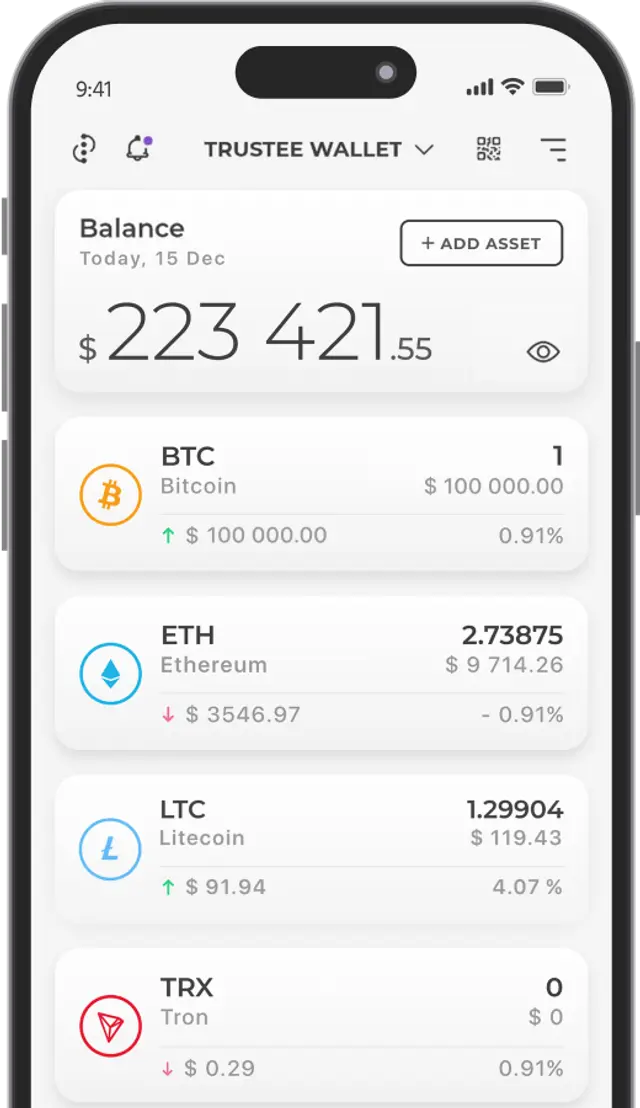
For example, Trustee is a multi-currency mobile wallet that supports 29 blockchains and over 1,000 tokens. It works with any DEX, including Ethereum and BSC, and features fiat purchases for digital assets.
If you use multiple wallets, you can import them into Trustee and manage everything from one app. Trustee also supports WalletConnect, making it easy to connect to any DeFi protocol.
Connect to a DeFi Platform
Let’s look at the staking process using Uniswap. Once your wallet is created and funded, connect to the DApp.
Choose your wallet. If you're using a mobile wallet, connect via WalletConnect by scanning the QR code.
Create a Pool and Add Liquidity
To create a pool, add a new position.
Choose a pair of cryptocurrencies. On Uniswap, you can set your own fee rate and the price range in which you’ll provide liquidity. Enter the amount to stake (e.g., ETH and USDT), and you’ll begin earning rewards.
Uniswap doesn’t issue LP tokens for liquidity addition. Other DEXs like PancakeSwap do, allowing users to stake LP tokens for extra rewards.
Other platforms have unique mechanics. Biswap, for instance, returns up to 90% of swap fees in BSW tokens. Some NFT tokens on the platform let you farm multiple tokens simultaneously.
Conclusion
While this method may be too risky for non-crypto investors, it’s a compelling option for holders with idle coins in their wallets. Liquidity pools help increase the profitability of crypto investments and offer a scalable, decentralized source of revenue.