


























TRON — a high-performance blockchain for mass payments, smart contracts and digital assets; TRX — its native coin.
If you are just getting acquainted with TRON and want to understand how the network works, what the TRX coin is good for and where to store, buy, sell and exchange it safely, — this article explains it in plain English: we will go step by step through the history, architecture and practical use, add a few examples and break TRON down into clear factors.
The history of TRON: key stages of development
TRON appeared in 2017 — at the height of the era when crypto projects promised a «new internet». Some built theory, others — infrastructure. TRON chose a practical course: give people fast transfers, low-cost smart contracts and an intuitive user experience — and they will come.
And they did: first as an Ethereum-based token, and already in 2018 the project launched its own mainnet, splitting from the «parent» network and moving to «self-sufficiency».
Below — a description of the project’s milestones with a focus on business impact, the strategic logic of decisions and control points.
2017 — the launch of the TRX coin and community formation. Public launch of TRX, initial liquidity and a core of early supporters
What this delivered:
-
- A financial and marketing «anchor» for the ecosystem was created.
- An audience emerged that was ready to test the product and provide feedback.
- Brand recognition and a platform for further listings.
June 2018 — TRON mainnet and migration from Ethereum. Launch of a proprietary blockchain and transfer of assets from Ethereum (ERC-20)
What this delivered:
-
- Control over L1 infrastructure — flexibility in fee policy, network parameters and roadmap.
- Reduced technological dependence and transactional costs for users.
- Improved UX (speed/cost) — higher retention and transactional activity.
- An opportunity to differentiate the product and build its own partner ecosystem.
2018 — acquisition and integration of BitTorrent with its global P2P audience
What this delivered:
-
- Access to millions of users and P2P culture as a distribution channel for crypto products.
- A base for experimenting with token incentives, decentralised storage and content distribution.
- Faster adoption thanks to existing traffic and community.
- Expansion of the product matrix (utility tokens, potential services on top of P2P).
2019–2020 — TVM, TRC-20/721 standards and the first waves of DeFi/dApp. Launch of the TRON Virtual Machine and ecosystem tools for developers
What this delivered:
-
- Compatibility with logic familiar to the dev community (an EVM-like model).
- Asset standardisation — predictable integrations, accelerated time from initial idea to final launch and go-to-market.
- Growth in the number of dApps and DeFi services, diversification of on-chain activity sources.
- Emergence of network effects: more applications — more users — more liquidity.
2021–2023 — the inflow of stablecoins and becoming a payments network
What this delivered:
-
- Mass use of TRON began for transferring stablecoins (especially USDT) due to low fees and high throughput.
- Stable transfers — a strong foundation for emerging markets and merchant payments.
- The network’s transaction revenue became more predictable.
- Strengthening of its position as a low-cost L1 payments infrastructure.
- Growth in partnerships with exchanges, processors and fintech providers.
2023–2025 — Stake 2.0, BTTC and a focus on a broad audience
What this delivered:
-
- An update to staking mechanics (Stake 2.0) and expansion of cross-chain capabilities via BitTorrent Chain (BTTC); emphasis on convenience in user operations.
- Flexible management of network resources and participant incentives.
- Elimination of the ecosystem’s «island» effect: flows of liquidity between networks, new integrations.
- Fewer hurdles for new users and developers, simplified onboarding.
- A larger addressable market thanks to cross-chain scenarios and multichain partnerships. Focus on bridge security and the economic resilience of staking models.
Main participants in the TRON ecosystem: roles and responsibilities
TRON’s strength — aligning incentives across governance, infrastructure and product; the quality of this coordination directly affects release velocity, transaction costs, and practical, user-friendly payment solutions.
Here’s what makes TRON a full ecosystem:
-
- TRON DAO — the strategic coordination centre that sets the protocol vision, prioritises the roadmap, manages grant programmes, and oversees standards and public communications.
- Super Representatives (SRs) — 27 validators responsible for block production and network security. Their role is close to an «operational parliament»: they run nodes, regularly update software, take part in votes on network parameters, publish reports and ensure infrastructure availability.
- SR candidates — a competitive reserve of validators that support network resilience and test upgrades. Nomination and rotation rely on staking and voting by TRX holders.
- Developers and integrators — the application layer that turns blockchain capabilities into user value. They build dApps, wallets, payment solutions, SDKs and fiat on-/off-ramps, enabling real use-cases (transfers, merchant payments, DeFi).
Description of TRON blockchain technology
TRON — a linear chain of blocks with smart-contract support, where TRC-20 — the standard for fungible tokens (akin to ERC-20), TRC-721 — the NFT standard, and TVM — the virtual machine on which these contracts «live».
Stable, coordinated network operation is based on the following components:
Consensus. The network runs on a Delegated Proof-of-Stake (DPoS) algorithm: 27 Super Representatives (SRs) take turns producing blocks. Who will be in the top 27 is decided by TRX holders via voting; vote weight is proportional to the amount of locked (staked) TRX. The model provides high throughput with controlled costs.
Voting and rewards. By freezing TRX, a user gains the right to allocate votes among SRs. Validators pay out a share of rewards to their delegators (rates, frequency and minimum thresholds — individual to each SR). This builds an incentive economy: SRs are motivated to maintain high uptime and transparent reporting, and delegators — to reassess their choice if performance deteriorates.
Resource model. A managed alternative to the «pure gas» used by Ethereum. It uses two resources:
-
- Bandwidth — covers simple transfers and data operations;
- Energy — spent when executing smart contracts (dApp logic, swaps, lending).
Resources accrue when you freeze (stake) TRX. While they suffice — fees are zero; if they are insufficient the network deducts TRX and burns it as a fee. Limits recover over time, you can reallocate between Bandwidth and Energy, delegate to addresses and contracts; in Stake 2.0 configuration changes are flexible and without moving base assets.
The resource model decouples everyday transfers from constantly buying «gas»: freeze TRX once — receive Bandwidth and Energy.
-
- The TRON resource model for business — planned operating costs: it defines the stake size required to generate the resources for average daily traffic.
- For users — a predictable way to interact with on-chain assets: regular transfers go through fee-free, complex operations — at minimal cost.
Stake 2.0. The updated staking mechanics add flexibility: fine-tuned lock-up periods, separate management of Bandwidth/Energy, rapid reallocation between addresses and dApps without transferring asset ownership. A user can tailor strategy to their profile — from micropayments to intensive contract execution.
Cross-chain via BTTC. BitTorrent Chain links TRON with Ethereum, BNB Chain and other networks, simplifying the movement of assets and liquidity. For businesses this reduces friction with multichain users and expands application reach. The key operational focus — bridge security, liquidity monitoring and clear response procedures.
TRON Virtual Machine. The Tron Virtual Machine (TVM) is compatible with the Ethereum Virtual Machine (EVM), but optimised for low execution cost:
-
- Block time ~3 sec: comfortable confirmation for user scenarios and payment flows.
- Throughput: thousands of transactions per second.
- Fees: with resources available, transfers can be free or involve minimal TRX burn.
The key idea — do not burden users with fee economics, but provide a clear scenario: «freeze TRX — receive resources — use the network for free». The combo of the resource model (Bandwidth/Energy), DPoS and low fees turns on-chain operations into a manageable cost line rather than a growth barrier.
To check how a TRON transaction was processed, how much Energy or Bandwidth it used, and whether it was successfully confirmed, you can use TronScan — the main blockchain explorer for the TRON network.
What is the TRX cryptocurrency
TRX — the native cryptocurrency of the TRON ecosystem (the TRX coin), fuel, access to resources and a voting instrument. In circulation — roughly 95 billion TRX; a portion of coins is irreversibly burned via fee payments (when resources are insufficient), giving the asset a deflationary tilt. There is no mining; blocks are produced by 27 Super Representatives (SRs), elected by stakers, generating about 62,668,800 new TRX daily.
Utility in everyday scenarios:
-
- «Petrol» for smart contracts (Energy).
- «Season ticket» for low-cost transfers (Bandwidth).
- «Ballot» for electing SRs and governing network parameters.
TRON applications across sectors
TRON is optimal where scale, speed and predictable costs matter: games, marketplaces, DeFi turnover, viral community tokens and automated payments. In particular:
Gaming (GameFi/NFT)
-
- Value. Low fees and 3-second blocks make micropayments and NFT trading routine rather than a luxury.
- Uses. In-game marketplaces, crafting and bridging of items, season passes, P2E economies.
- Risks. Tokenomics and speculative cycles; addressed by issuance limits, balanced rewards and marketplace AML procedures.
Decentralised applications (dApps)
-
- Value. Every basis point of fees is critical: TRON helps preserve margin in marketplaces, loyalty programmes and P2P services.
- Uses. Cashback tokens (TRC-20), discount NFTs (TRC-721), on-chain coupons, DAO voting.
- Risks. UX fragmentation (where the same apps look and work differently across systems); mitigated with social sign-in, fee abstraction and ready-made SDKs.
DeFi (lending, exchanges, liquidity)
-
- Value. High turnover at low operational cost: profitable to rebalance, farm and arbitrage.
- Uses. AMM/DEX, lending pools, stablecoin strategies, yield aggregators.
- Risks. Smart-contract vulnerabilities and bridge risk; audits, bug bounties and protocol position limits are required.
Memecoins (TRC-20)
-
- Value. Cheap launch and fast circulation enable community hypotheses to be tested at minimal cost.
- Uses. Community tokens, gaming promotions, «social» liquidity pools.
- Risks. Reputational and regulatory; reduce them via transparent issuance, avoiding hidden taxes, and contract verification.
AI and automation
-
- Value. When transactions are numerous, each must cost as little as possible: TRON suits bots, mass payouts and subscriptions.
- Uses. Payment webhooks, on-chain subscriptions, micro-payouts to freelancers and creators, agentic scenarios (AI bots operate a wallet within limits).
- Risks. Operational (keys, limits, anti-fraud); addressed with multisig, an allowlist of addresses and anomaly monitoring.
Advantages and limitations of TRON/TRX
Pros
-
- Low fees and fast confirmations. An environment for micropayments, remittances and high-frequency operations.
- Bandwidth/Energy resources. Planned quotas instead of constant «burning»: staking reduces cost and stabilises the gas budget.
- A strong stablecoin payments case. High throughput and low costs — ideal for merchants and fintech.
- Cross-chain via BTTC. Access to liquidity and users from other networks without complex bridge integrations.
Cons and trade-offs
-
- A compact validator set (DPoS). More efficiency, less distribution — requires attention to centralisation risks and governance processes.
- Resource allocation. Bandwidth/Energy must be balanced; when something runs short — unexpected fee deductions and failed transactions.
- Smart-contract and bridge risks. Vulnerabilities, admin keys, integration errors. Audits, bug bounties, limits and monitoring are needed.
Comparative analysis: TRON and other blockchains
|
Parameter |
TRON |
Ethereum |
BSC |
Solana |
|
Consensus |
DPoS |
PoS |
PoSA |
PoH |
|
TPS |
2000 |
30-100 |
300 |
5000+ |
|
Fee |
$0.001 |
$0.5-5 |
$0.1-0.5 |
$0.0001 |
|
Block time |
3s |
12s |
3s |
0.4s |
|
Smart-contract languages |
Solidity, Java |
Solidity |
Solidity |
Rust, C, C++ |
If we place the essentials on a separate shelf, the unique characteristics of Tron (TRX) compared with other blockchains are:
-
- Price and speed. Micropayments and stablecoin transfers «fly» and do not eat the budget.
- Resource model. You can «pay with air» (by freezing TRX), not only with the coin itself.
- A bet on practice. TRON is about everyday use, not «box-ticking». Hence the network’s popularity for USDT.
How to buy and where to store Tron (TRX)
Conclusion
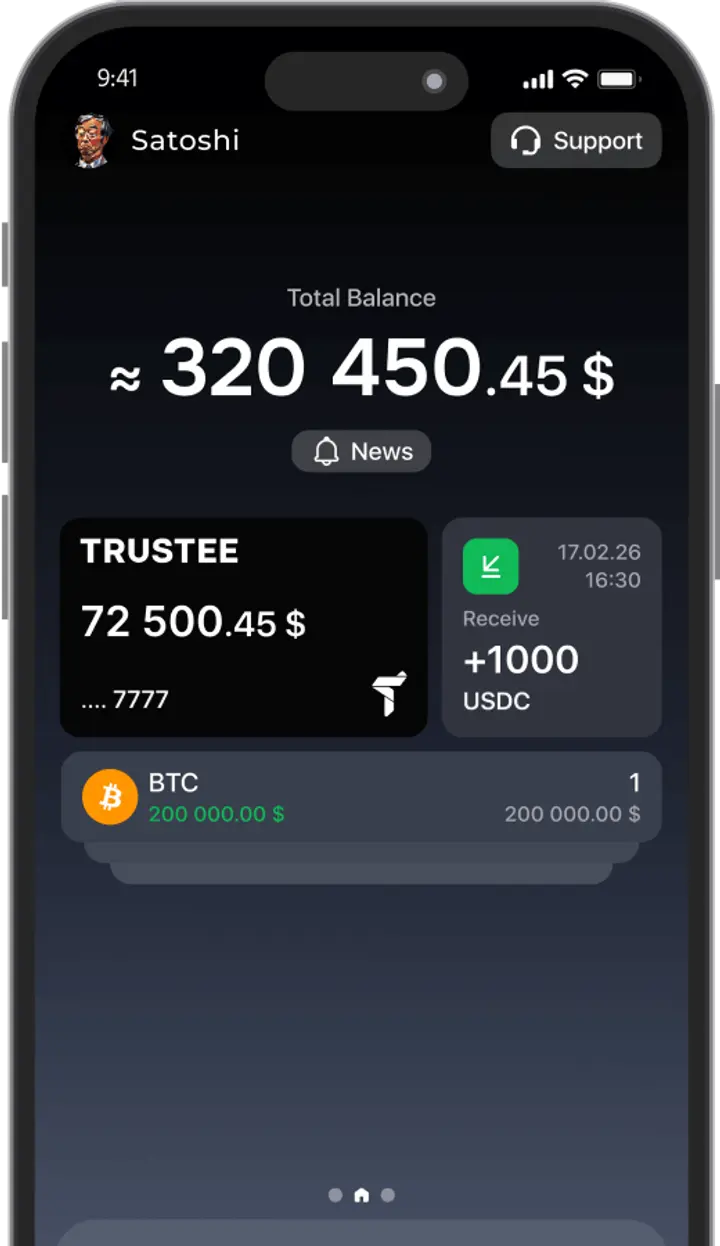
TRON — about everyday on-chain payments and fast smart contracts without unnecessary fee pain. TRX — the cryptocurrency that powers the network: from voting for Super Representatives to running DeFi and NFTs. If you need a practical tool for stablecoin transfers, micropayments and low-cost contract interactions, TRON is one of the most pragmatic choices. And thanks to Trustee Plus and Trustee Wallet you can store, buy, sell and exchange TRON-network assets without hassle: everything at hand, with an intuitive interface and fast operations.
Do DYOR, track the metrics and start small — literally with a single trial transaction.