


























In 2020, the decentralized exchange Uniswap released the UNI token, transitioning the project to autonomous governance. This sparked a new wave of interest, with Uniswap’s token surging over 40-fold in just a few months.
UNI is listed on major centralized exchanges like Binance, Coinbase, and Kraken, ensuring strong liquidity and global accessibility. Additionally, in 2024 the token has been actively used for voting on key protocol upgrades—especially its integration with Layer‑2 networks such as Arbitrum and Optimism.
In this article, we will explore why Uniswap is compelling, the outlook for the UNI token, and how to acquire it on the Uniswap platform.
What Is the Uniswap Token (UNI)?

UNI is an ERC‑20 token that grants holders governance rights within the Uniswap ecosystem. Voting power corresponds to the amount of UNI held. The token was launched in autumn 2020.
To fully appreciate UNI’s role and potential, let’s dive into what Uniswap itself is.
The Uniswap Platform
Uniswap is a decentralized liquidity protocol on Ethereum, operating through smart contracts to create liquidity pools and enable ERC‑20 token swaps without intermediaries, order books, censorship, or verification.
Liquidity pools are funded by liquidity providers (LPs) who deposit equal-value pairs of tokens into shared reserves in exchange for earning fees. This model solves the liquidity challenge, allowing traders to execute instantly without waiting for matching orders as on centralized exchanges.
However, the Bank for International Settlements (BIS) has raised concerns about liquidity provider centralization on DEX platforms like Uniswap, which could compromise decentralization.
How It Works
Uniswap is an Automated Market Maker (AMM) on Ethereum that uses the constant product formula x * y = k to determine token prices. If token x is bought, its price in y rises to keep the product k constant.
The Uniswap Ecosystem
Uniswap’s ecosystem includes three primary participant types:
-
Liquidity providers
-
Traders
-
Developers (building new DeFi tools using Uniswap)
Liquidity Providers
-
Passive LPs add assets to pools to earn fees.
-
Professional LPs utilise market strategies for DeFi projects.
-
Token projects create a liquid market for new tokens.
Traders
Traders swap tokens on Uniswap and pay transaction fees distributed among liquidity providers based on pool participation.
Trader categories include:
-
dApp users acquiring tokens for use in other Ethereum apps.
-
Speculators exploiting market tools and liquidity.
-
Arbitrage bots balancing prices across platforms.
-
Smart contracts (e.g. DEX aggregators).
Project History
Uniswap was founded by Hayden Adams, formerly a Siemens engineer, who began working on Ethereum smart contracts after leaving Siemens. Uniswap Labs was established in October 2017. Hayden credits the constant product AMM concept to Alan Lu of Gnosis, later popularised by Vitalik Buterin on Reddit, laying Uniswap’s foundation.
Smart contract development began in 2017. In summer 2018, Hayden received an Ethereum Foundation grant, and Uniswap launched on Ethereum mainnet in November 2018. He acknowledged contributors like Karl Floersch, Pascal Van Hecke, Callil Capuozzo, Uciel Vilchis, Philip Daian, Dan Robinson, Andy Milenius, among others.
Key Milestones
-
2019: Uniswap raised additional funding and launched Uniswap V2, enabling direct ERC‑20 token swaps and introducing oracle support.
-
Sept 2020: UNI token launched, establishing Uniswap as a community-governed protocol.
-
2021: Uniswap V3 launched with concentrated liquidity, tiered fees, NFT liquidity positions, and Layer‑2 (Arbitrum, Optimism) support.
-
2023: Integration with Polygon, Arbitrum, and Optimism; strategic partnership with PayPal in June.
-
2024:
-
Jan: mobile wallet launch with platform integration.
-
Aug: record $42 bn monthly trading volume.
-
Community approved new incentives to reward liquidity in smaller pools.
-
UNI Token Distribution
1 billion UNI were minted, distributed over four years:
-
60% to community (15% already allocated to active users)
-
21.266% to team
-
18.044% to investors
-
0.69% to advisors
Initial Token Allocation
Tokens were initially distributed to LPs in these pools:
-
ETH/USDT
-
ETH/USDC
-
ETH/DAI
-
ETH/WBTC
Early user bonus: wallets interacting before September 2020 qualified for 400 UNI.

Benefits of Holding UNI
-
Governance rights: propose and vote on protocol changes
-
Treasury control: influence fund allocation
-
Fee settings: vote on fee structures
-
Token listings: suggest adding/removing tokens
-
Liquidity management: control LP pool aspects
Using UNI for Governance
To participate, users delegate voting power to an address (including their own), without locking tokens.
Voting
Users can:
-
Vote on active proposals (for or against)
-
Create proposals
Proposing Changes
To submit a proposal, a user must:
-
Hold at least 1% of delegated UNI (~10 million UNI)
-
Submit it via the Governor smart contract
-
Maintain token holdings throughout the 7-day voting period
Uniswap: Strengths & Weaknesses
| Strengths | Weaknesses |
|---|---|
| Decentralized trading via non-custodial wallets—no sign-up or verification | High Ethereum gas fees |
| Passive income opportunities for LPs | Risk of impermanent loss when withdrawing liquidity during price swings |
| Easy token listing without censorship or permission | Increased risk of fraudulent token launches |
| Low fees for low-liquidity tokens | Supports only Ethereum tokens |
| Audited protocol | Non-custodial nature reduces hacks or central authority risk |
| Wide exchange availability (Uniswap and centralized platforms) |
UNI Price Performance
UNI is known for volatility. Launched at $1.10 in Sept 2020, it peaked at $44.97 by May 3, 2021—more than 40x growth.
By December 2024, UNI traded at $14.90—a 151.16% increase over the year. Market cap stood at $8.94 bn, with a 24‑hour trading volume of $828.8 mn.
Key stats (Dec 2024):
-
FDV: $14.89 bn
-
TVL: $5.2 bn
-
Market Cap/TVL ratio: 1.74
-
Circulating: 600.48 mn UNI
-
Total supply: 1 bn UNI
Buying and Storing Uniswap (UNI)
UNI is traded not only on Uniswap but also on Binance, Bithumb, OKEx, Huobi Global, Coinbase, Gate.io. It can be bought with crypto (USDT, BTC, BUSD, BNB, ETH) or fiat (USD, EUR, KRW).
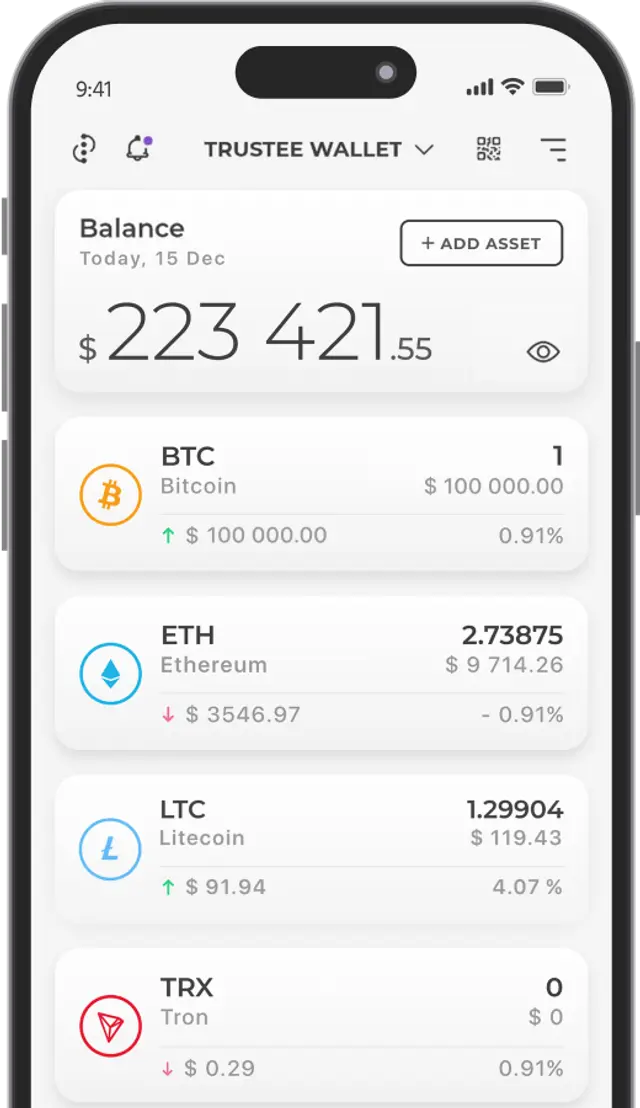
Wallets like Trustee Wallet support ERC‑20 and BEP‑20 UNI tokens.
How to Buy ERC‑20 UNI on Uniswap via Trustee Wallet
Trustee Wallet connects to Uniswap via WalletConnect. Instructions for using WalletConnect in Trustee Wallet are available here.
UNI Future Outlook and Forecasts
In the DeFi boom, Uniswap has a strong chance of success as it offers more efficient liquidity solutions than traditional DEXs.
Still, the project faces challenges in governance, tokenomics, and roadmap execution. The V3 upgrade in 2021 aimed to reduce LP risks and boost earnings, but didn’t fully meet UNI price growth expectations.
Uniswap continues expanding features and governance mechanisms. In May 2021, Vitalik Buterin suggested using UNI as an oracle token, potentially positioning Uniswap as a competitor to Chainlink.
Note that crypto remains highly volatile. Despite strong capitalization and liquidity, investors should assess risks carefully.