



























The Smoothie Bowl That Waited Too Long for Its Owner
Ubud, 3 PM. It’s very hot — over 30°C — and the air is so humid your t-shirt sticks to your back in a few minutes.
Dmytro is sitting at a small table. In front of him is a smoothie bowl with mango and dragon fruit. Next to it, ice is slowly melting in his iced coffee. The waitress has already come twice with the card terminal, still smiling politely.
But Dmytro is not eating. He is looking at his phone and trying to fix something. His USDT is stuck between a wallet, an exchange, and a local cash-out service. He needs to turn it into rupees — before the smoothie gets warm.
It’s easy to understand why he is confused. Yesterday everything was simple: money in, money out, life goes on. Today, even a small payment needs many steps and different services, and he has to figure it out right there, with the waitress waiting.
He has not had a day like this before. But for migrants, freelancers, and digital nomads, this is actually quite normal.
And this is where the story starts.



Introduction
Dmytro Y. is a backend developer at an outsourcing company. He works remotely with clients from the US and Singapore. Part of his salary comes to a regular bank card, and part is paid in USDT to a crypto wallet. This is pretty common for Ukrainian IT specialists working with international clients: faster payments, simpler setup, no SWIFT fees, no three-day waiting times.
Because there is one problem that usually doesn’t show up in palm tree Instagram stories. Every time he needs to pay for something real — coffee, rent, flight tickets, or a scooter — it turns into a small quest. It turns out that in real life, there is a big gap between “having USDT in a wallet” and “actually paying at a cafe.” And Dmytro finds himself falling into that gap more often than he’d like.
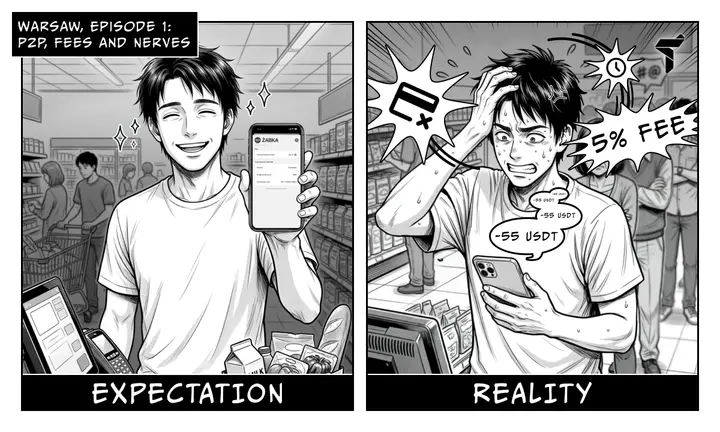
Warsaw. Episode 1: P2P, Fees, and Nerves
When Dmytro first moved to Warsaw, he thought he understood everything quickly. He signed up on an exchange, found a few sellers with good ratings, and thought it would be simple: USDT → exchange → zloty on a card → coffee at the nearest Żabka.
Even a normal transfer quickly turned into a long process with questions, explanations, and waiting. It started to feel like you are not just moving your own money, but doing a small task every time.
At first, it seemed fine. But soon it became clear: there is no real stability. One service has a better rate, another is faster, but every step needs attention, time, and checking.
Then there is P2P exchange. It never feels simple. Some people split one payment into 10–15 small transfers. Sometimes money takes hours to arrive. And after that, the bank may still ask where the money came from. Some sellers even add extra fees in the order notes — like a 5% “commission” taken from the money Dmytro should receive. Every transaction is different, and it rarely works the same way twice.
After a few months of this, Dmytro understands a simple thing: it’s not about fees or rates. The most expensive thing is the time and attention you spend just to access your own money.
Kantors. Episode 2: The Real Cost of Cash Exchange
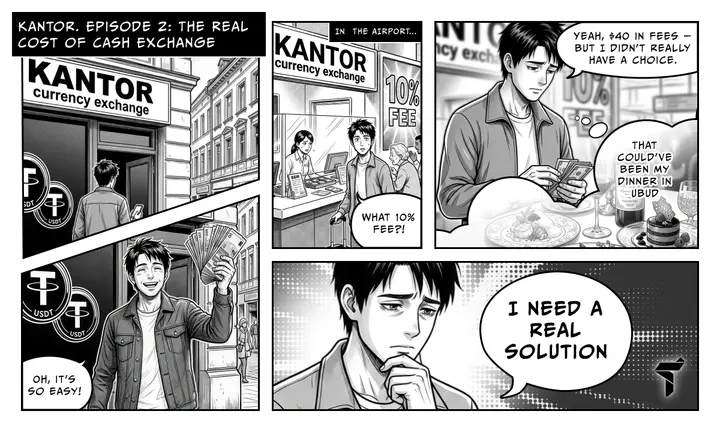
The next logical step were offline exchange offices, also called “kantors”. In Warsaw, there are a lot of them, especially in the city center. It sounds simple: you walk in, send USDT, get cash in hand. Clean, fast, safe. Yeah… not really.
In the first place Dmytro visited, the rate was so bad he almost wanted to leave without saying anything. In the second one, it was a bit better, but still around 3.5% worse than the market rate. In the third one — about 4%. But the most memorable one was near the Central Station, where the difference was more than 6%. And the woman behind the glass was smiling: “No commission!” Of course, no commission. They just hide it in the rate, hoping people won’t notice.
After that, Dmytro made a simple decision: no more of this. He needed a real solution, not this kind of game with money moving around in circles.
A Simple Question from Nastya
Everything changed after one random call. One day, Dmytro had a call with Nastya — an old friend and also a colleague from another team. Nastya had been moving between Berlin and Batumi for the last three years.
They were talking about a new framework, and at some point Dmytro casually complained about another crypto exchange problem.
Nastya listened for a few minutes, then interrupted him:
— Wait, are you serious? You’ve been struggling with the same problem for a year and still haven’t changed anything. You’re a developer, for god’s sake. Where is your basic automation? At least in your own life.
— And what am I supposed to do? — Dmytro replied.
— Just get a crypto card. People have been using them for years already — students, freelancers, business owners, everyone.
Of course, Dmytro had heard about crypto cards before. But only somewhere in the background, almost like internet stories. He knew they existed, but never seriously looked into them.
He always thought crypto cards were either for hardcore crypto people or for some shady schemes.

What Is a Crypto Card? (Simple Explanation)
A crypto card looks like a normal bank card (Visa or Mastercard) — but instead of dollars or euros on the balance, you hold crypto like USDT or USDC.
For the user, everything works very smoothly. You simply pay with the card in a store, café, or for an online subscription, and at that moment the system automatically converts the needed amount of crypto into the local currency — rupees, zloty, euros, or anything else. For the seller, it looks like a completely normal card payment. They do not even know you paid with crypto.
That is the main difference from a regular bank card: you do not keep fiat money on the account and you do not need to cash out crypto through an exchange every time you want to buy a coffee. Your crypto stays crypto until the exact second you pay. The conversion happens in real time at the market rate, without long waiting times or P2P.
Nastya’s Masterclass: From Setup to the First Coffee
As it turned out, the crypto card market has grown a lot in recent years. There are now dozens of options: from large and trusted services to strange “grey” cards from unknown platforms you probably would not trust even with your Netflix subscription.
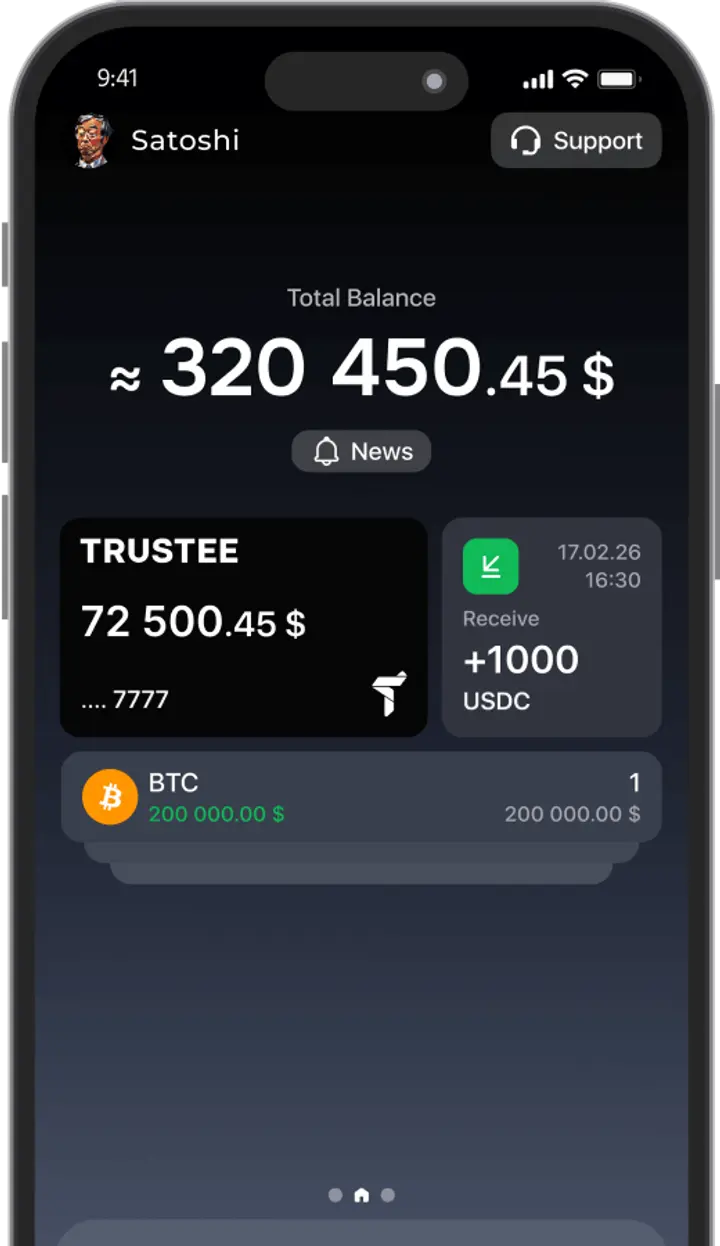
Nastya recommended Trustee Plus — a Ukrainian crypto service that has been on the market since 2022 and already has more than 1,000,000 users. What caught Dmytro’s attention was how simple everything looked: one app, a virtual Visa card in dollars, and the ability to start paying with crypto just a few minutes after registration.
The whole process took Dmytro about 20 minutes. Step by step:
- Installation and registration. The app is available on the App Store and Google Play. Registration is done with a phone number or email. No long forms or “tell us about yourself” questions.
- Verification (KYC). To issue a card, you need to confirm your identity. Dmytro did it directly in the app: a photo of his passport and a selfie with the document. It took about 7 minutes.
- First deposit. Dmytro sent 200 USDT from his usual wallet to the address shown in Trustee Plus. Network — TRC20, with a minimal fee. The funds arrived in about three minutes.
Important point: 0% fee for crypto deposits and 0% fee for stablecoin swaps inside the app. - Card issuance.On the main screen, he tapped “Issue card”. The virtual card costs $10 (one-time fee). Service is free for five years while the card is active. Card details appeared instantly.
- Card top-up. A separate step is funding the card itself. It doesn’t automatically use your full wallet balance. Dmytro simply chose an amount in USDT and moved it to the card balance inside the app. After that, the money was ready to spend in real stores.
Top-up fee is 0.5%, card payments have 0% fee. - Adding to wallet. Dmytro can view his card details by tapping on it in the app. From there, he can manually add the card to Apple Wallet or Google Wallet.
- First payment. Dmytro went to a coffee shop near his office, ordered a flat white, and tapped his phone on the terminal. Payment went through instantly. The system automatically deducted the exact amount in crypto at the current USD rate.
Dmytro’s reality check in numbers
To compare it with how he used to live before:
|
Service |
Cost/Fee |
|
Card issuance |
$10 (one-time) |
|
Monthly maintenance |
$0 (for 5 years) |
|
Payments in stores |
0% |
|
Crypto top-up fee |
0% |
|
Card top-up fee |
0.5% |
|
Stablecoin swaps inside wallet |
0% |
|
Monthly spending limit |
до $30 000 |
|
Acceptance |
60M+ locations worldwide, Apple Pay/Google Pay |
Nuances worth knowing:
- No physical card.
This is a fully virtual card. For 95% of everyday situations, that’s not an issue. But in some remote places — like a small restaurant in rural Turkey with an old terminal and no NFC — you might run into limitations. - Cash withdrawals.
You can’t withdraw cash from this card at regular ATMs yet. If you need cash, you still have to use classic P2P or withdraw to a regular bank card. - Settlement currency.
The card’s main fiat currency is USD. When you pay in PLN, IDR, or other currencies, conversion happens automatically at the market rate of the payment system at the moment of the transaction.
Life “After”
A month passed after Dmytro signed up for Trustee Plus. In that time, P2P sellers, exchange offices, and all the manual work with money just disappeared from his life.
Dmytro quickly ran the numbers — pure savings were around 6–8% of all his expenses. Before, this money just disappeared in exchange rate differences, exchange fees, and “tricky” P2P orders. But the main thing — Dmytro stopped burning time. If you calculate his hourly rate, the hours he used to spend in bank support chats or standing in exchange office queues turned out to be the most expensive cost of all.
Bike rental in Canggu? He just taps his phone with Trustee Plus and goes.
Flight tickets to Kuala Lumpur? The Trustee Plus card handles it.
Even subscriptions like ChatGPT Plus and Spotify are now just charged automatically, without Dmytro doing anything extra.
And even in a tiny family warung on the outskirts, where they cook the best nasi goreng, there is a card terminal. It turned out the world was already ready for digital payments — you just needed the right key to access it.
With Trustee Plus, crypto finally became what it was supposed to be from the start — a simple and fast way to pay, available anywhere in the world.

Conclusion
Dmytro’s story is not unique. Every Ukrainian IT specialist or freelancer who earns in crypto eventually goes through the same path: P2P, exchange offices, failed attempts to “game” the system, and a lot of wasted time. Some people stay stuck in it for years, while others spend 20 minutes setting up an app and simply move on.
All that’s left is to stop wasting time and automate the routine. As Nastya said: “For an IT guy, this is basic.”