
























Token sales make it possible to purchase tokens before they are listed on exchanges at a favourable price and to deliver quick profit to early investors.
Here we explain what token sales are, which types exist, how to participate, and where to find a list of token sales.
Cryptocurrency token sales — what are they?
A token sale is a form of cryptocurrency crowdfunding in which a token can be purchased at an early stage before it becomes available to users on trading platforms. As a rule, to take part in token sales you must meet a number of conditions and requirements that depend on the platform hosting the token sale.
The outcome depends on many factors: project activity, marketing, and token supply and demand. For example, if a token’s price rises sharply before listing and there are more people wishing to sell than potential investors — a flop at listing can be expected, although this is not common. Therefore, you should conduct thorough project analysis and DYOR — Do Your Own Research.
Examples of successful token sales:
-
$TRUMP (memecoin) — launched in January 2025 on the Solana blockchain. In less than 24 hours after the ICO its price rose by more than 300%, lifting the cryptocurrency to 19th place by capitalisation. For the founders this meant hundreds of millions of dollars in profit: from token sales and fees alone at least $350 million was earned.
-
Remittix (RTX) — the presale ended with sales exceeding $21.8 million, making it one of the most successful in 2025. Investors expect potential growth of up to 5,000%, and a BitMart listing has already provided this project with additional liquidity and visibility in the market.
-
Wall Street Pepe (SOL) — a memecoin with an active ICO on Ethereum. It raised more than $70 million, demonstrating significant investor interest. The project is now expanding on Solana, which may deliver new ROI multiples (up to X10 and beyond).
ICO, IEO, IDO, IFO — what are they and how do they differ?
Since the first public sales appeared, token sales have evolved and new forms of cryptocurrency crowdfunding have emerged.
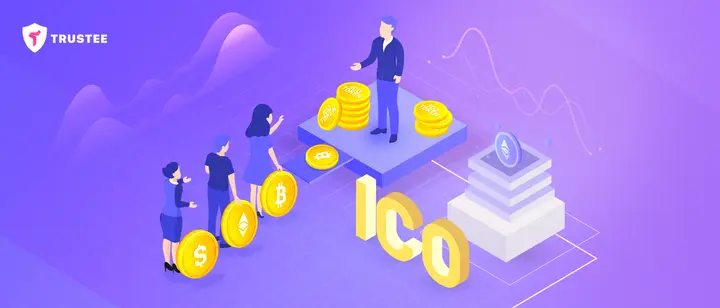
There are several types of token sales, each with its own advantages and disadvantages — more on these below.
ICO
The first type of token sale was the Initial Coin Offering (ICO) — an initial coin offering. ICOs are conducted by platforms that issue their own native tokens.
The developers of the second-largest cryptocurrency by capitalisation, Ethereum, also raised investment through an ICO. In the first 12 hours of its token sale the project raised 3,700 BTC — about $2.3 million at the time.
There are no standards for ICO projects: any platform can run its own initial coin offering. Nor are there requirements and restrictions for investors themselves. This led to numerous problems and became one of the most widespread forms of fraud in the crypto industry. Hence the need for new forms of token sales.
IEO
The next stage in this evolution was the Initial Exchange Offering (IEO) — an initial exchange offering. Unlike an ICO, an IEO is conducted on an exchange where the asset will subsequently be traded.
Not all projects are admitted to an IEO, only those selected by the exchange’s expert team. In addition, project founders must pay an admission fee. On the one hand this increases the cost of running a token sale, but on the other it boosts user trust and helps attract more investors.
The advantage of an IEO is that tokens are guaranteed to be listed on a crypto exchange after the token sale, so investors are more willing to participate. Projects also receive additional liquidity, increasing the likelihood of raising the required amount. Moreover, marketing costs can be reduced.
However, participation in an initial exchange offering is available only to users of the exchange on which the IEO is held. Participants must also meet minimum requirements. For example, to take part in an IEO on Binance Launchpad you need to complete KYC, and token purchases are available only with BNB.
IDO
Restrictions on centralised exchanges became a problem for some investors. To address this, Initial DEX Offering (IDO) — an initial offering on decentralised exchanges was created.
IDOs removed the need for centralised intermediaries and significantly simplified project listing requirements. No verification is required to participate and there are no user restrictions. All you need is a wallet, coins for transaction fees, and a certain amount of cryptocurrency to invest.
But IDOs are not perfect either.
- Firstly, token sales on the Ethereum platform can be costly due to high network fees, which introduces additional user risk.
- Secondly, any project can run its own IDO, which opens the door to fraud.
IFO
Earlier forms of token sales shared a common drawback: when demand was high, some users failed to buy tokens and therefore could not participate. To solve this, a new model was devised — the Initial Farm Offering (IFO) — an initial farm offering.
The first to run IFOs was the well-known PancakeSwap exchange on the Binance Smart Chain. To participate you need to stake your assets in a special pool for a limited time: on PancakeSwap, for example, an initial farm offering lasts only one hour. If demand exceeds supply, tokens are purchased only for part of the reserved amount and the remainder is returned to investors.
SHO
Strong Holder Offering — an offer for ‘strong holders’. This is an alternative to the IFO: participants must hold a certain number of tokens for a set period before distribution begins. That is why such participants are sometimes called ‘strong holders’.
However, the drawback of SHO is that sizeable amounts are required to participate. For example, on DAO Maker you must hold at least 1,000 (about $4,500) DAO tokens, and receipt of tokens is not guaranteed.
How to participate in a token sale on Coinlist
Coinlist — a popular platform for token sales founded in San Francisco. The company does not guarantee that tokens will be listed on exchanges, but it carefully analyses and selects projects, so the likelihood remains high.
Well-known crypto projects have launched on Coinlist, some of which entered CoinMarketCap’s top 100, and Solana even made the top ten. All token sales showed decent results, but some stand out in particular: for example, Casper (CSPR) delivered 67,970% returns to early investors, Flow (FLOW) — 43,350%, and Solana (SOL) — 26,380% at its peak.
Below we demonstrate how to take part in token sales using this platform as an example.
Step 1 — Create an account
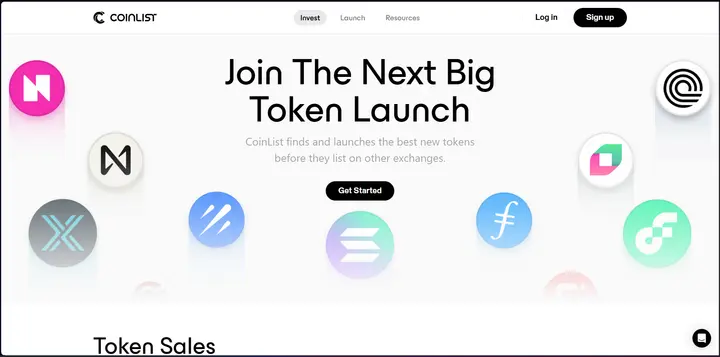
To access a new token sale on Coinlist, you need to register on the platform. Go to the exchange website and click the Get Started button located beneath the large heading on the screen.
Fill out the registration form, complete the captcha and click Create Account, then confirm your email address by following the link in the message.
Step 2 — Verify your identity
After completing registration you will land on the dashboard. To gain access to token sales you must complete identity verification. It will be available immediately after your email address is confirmed.
Simply follow the on-screen instructions. To verify successfully you will need to provide information about yourself as well as documents confirming your identity and residential address.
Step 3 — Top up your account
To participate in a token sale you will need USDT. Go to the Wallet section and click Deposit. Then send USDT to the specified address.
Step 4 — Register for the token sale
Go to the Token Sales page and choose an available project from the list.
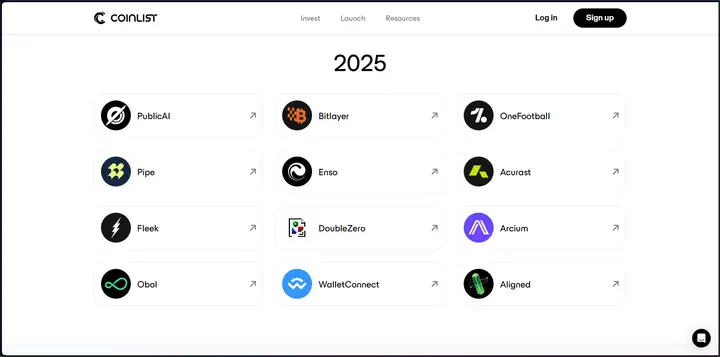
Next, complete several steps to register for the token sale:
-
Click Join Now (you can review all the terms on the selected token sale’s page in advance).
-
Sign in again as a Coinlist user.
-
Fill in the questionnaire.
If all steps are completed, wait for the token sale to start. Shortly beforehand, visit the event page to prepare for the purchase. As soon as the sale begins, you should buy tokens as quickly as possible.
Token Sales Calendar: new and upcoming token sales
Information about upcoming token sales is usually published well before launch on specialised services.
Here are several platforms where you can find up-to-date data:
- CoinMarketCap ICO Calendar — a global ICO calendar with detailed information on dates, projects and participation terms.
- ICO Drops — one of the most popular platforms with a calendar of active, upcoming and completed ICOs and IEOs.
- CryptoTotem — a convenient ICO/IDO calendar indicating sale end dates and project details.
- CryptoRank.io — a service for tracking upcoming ICOs, IEOs and IDOs with filters by date and platform.
- CoinCodex Token Sales — a calendar of all types of token sales with ROI and phases (current, upcoming, completed).
Conclusion
Token sales remain an important tool for investors seeking access to projects at early stages of development. Successful token sales can deliver substantial profits after an exchange listing; however, do not forget the risks — from lack of liquidity to potential scam schemes.