
























Stellar (XLM) is not just another cryptocurrency in an endless sea of altcoins. It is a blockchain platform with a clear mission: to make international payments and money transfers accessible to everyone.
If Bitcoin is “digital gold” and Ethereum is the “world computer”, then Stellar is a “payments superhighway” for instant, low-cost transactions between any currencies in the world.
The history of Stellar
To understand what makes the Stellar project unique, it is worth starting with the fact that its creation is linked to a legendary figure in the crypto industry: Jed McCaleb. This is the same McCaleb who, before Stellar, managed to:
- in the early 2000s, develop eDonkey2000 — one of the most popular P2P file-sharing services in the world at the time.
- in 2010, create the legendary crypto exchange Mt.Gox, which at its peak handled 70% of global BTC trading, and was later sold and hacked in 2014.
- in 2011, co-found Ripple (XRP), which has remained in the top ranks of CMC for 15 years.
Launch of the Stellar network
On 31 July 2014, Jed McCaleb launched the Stellar network as a fork of Ripple’s code. This happened less than a year after he left Ripple in 2013. The reason for his “departure” was fundamental disagreements about the project’s future development, particularly the network’s centralisation and its focus on working with banks. McCaleb, on the other hand, wanted to build an open and decentralised crypto project. At a time when Ripple was focused on major banks and corporations (B2B), Stellar was intended to be accessible to everyday people and small businesses (B2C).
McCaleb founded the non-profit organisation Stellar Development Foundation and secured initial funding for Stellar by receiving a $3 million loan from the payments company Stripe. This made it possible to develop the project without commercial obligations.
Stellar and ISO 20022
Today, XLM plays a key role in ISO 20022 — a modern international open standard for exchanging electronic messages between banks and systems such as SWIFT, ensuring blockchain compatibility with traditional finance.
This standard defines the rules and data formats (based on XML) for payments, securities, and card operations, making Stellar potentially one of the key tools of the future global financial system.
Technical features of XLM and the Stellar blockchain
Since launch, Stellar was built as a fork of Ripple’s code, but from April 2015 Stellar released an updated version of the protocol instead of the previous system borrowed from Ripple. This made it a fully independent project with its own unique consensus algorithm: Stellar Consensus Protocol (SCP), developed by Stanford professor David Mazières.
How SCP works
Unlike Bitcoin (Proof-of-Work) and Ethereum (Proof-of-Stake), instead of miners or stakers Stellar uses a trust system between nodes. Each node selects a set of other nodes it trusts, and transactions are confirmed by reaching consensus among these “trusted groups”.
Validators in Stellar Consensus Protocol (SCP) do not receive direct rewards: no block rewards, no staking premiums, and no fees. They operate based on trust and their own interest. Most validators are business users (for example, MoneyGram, IBM World Wire, Circle (the issuer of USDC), Vibrant, and other payments companies). They run nodes to protect their infrastructure and transactions on the network. If something happens to Stellar, their business suffers. Thanks to this approach, the network is reliable and resilient to attacks and centralisation.
Advantages of SCP:
- Speed — transactions are confirmed in 3–5 seconds.
- Instant finality: 90% of transactions are final instantly, with a maximum of 5 seconds under peak load.
- Low fees — the average transaction costs $0.00001 (thousandths of a cent).
- Energy efficiency — no mining required; it uses millions of times less electricity than Bitcoin.
- Scalability — 1000+ TPS per second.
Speed, issuance, and fees
Why does this matter?
For international bank transfers, speed and low fees are critical. Stellar confirms transactions faster than banks can process a SWIFT payment, and it costs virtually nothing. This strengthens XLM as a tool for institutional payments.
Issuance and inflation
Initially, Stellar had built-in inflation of 1% per year to reward XLM holders. But in 2019, after a community vote, inflation was removed, making XLM a deflationary asset. Around 30 billion XLM are currently in circulation out of a maximum supply of 50 billion.
Security and decentralisation
Stellar validators
The Stellar network is currently supported by 77 validators (nodes), including:
- 3 nodes from the Stellar Development Foundation
- 74 nodes from 22 independent organisations (including IBM, Coinbase, Wirex)
Stellar stability
Over more than 11 years of operation, the Stellar blockchain has not suffered major hacks, 51% attacks, or prolonged outages. The network runs with stable uptime close to 100%.
Key upgrades and features
|
2014 |
Official launch of the network with 100 billion “stellar” tokens (later Lumens/XLM). |
|
2015 |
Migration to SCP — the proprietary Stellar Consensus Protocol. Token rebrand to Lumens. |
|
2017–2018 |
Partnership with IBM to build the World Wire system. |
|
2019 |
“Burn” of 55 billion XLM and removal of the inflation mechanism. |
|
2021 |
Partnership with MoneyGram for international money transfers |
|
2021–2022 |
Active CBDC pilot projects involving national governments. |
|
2023 |
Soroban Mainnet launch — smart contracts on Rust/WASM. |
|
2024 |
Protocol 20 — an upgrade for Soroban and privacy solutions (zk-SNARKs). |
|
2024 |
Partnership with Mastercard for secure and fast P2P transfers. |
|
2025 |
Stronger alignment with ISO 20022 standards for banking integrations. |
Built-in decentralised exchange (DEX) on Stellar
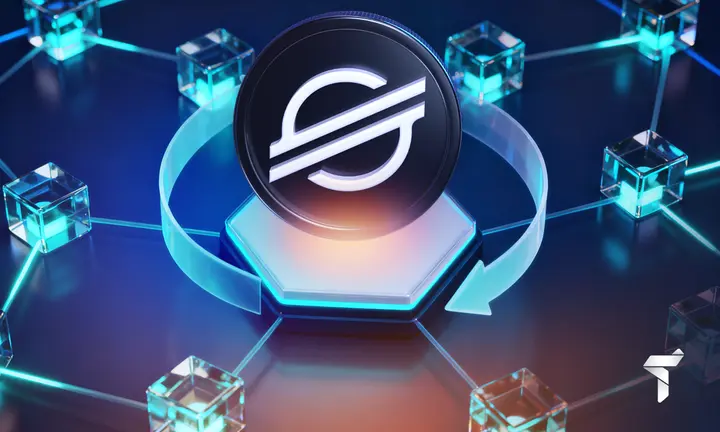
A unique feature of Stellar is its built-in DEX. Unlike many other blockchains, where a DEX is a separate smart contract, on Stellar the decentralised exchange is an integral part of the protocol itself. This means anyone can swap tokens on the Stellar network without third-party platforms.
Any user can place a buy or sell order via API or a wallet. As a result, users do not depend on the liquidity of a specific exchange, because the protocol automatically finds the best offers across the entire ledger. This not only increases transaction speed but also significantly reduces fees, making asset exchange максимально efficient.
How it works:
Stellar automatically finds the best swap path between currencies. For example, if you want to exchange euros for Japanese yen and there is no direct pair, the network will automatically execute EUR → XLM → JPY in a few seconds.
Key difference from Bitcoin and Ethereum
Bitcoin is “digital gold”: a defensive digital asset that functions as a store of value.
Ethereum is the “world computer” for dApps and smart contracts.
Stellar is a “global payments infrastructure” for international transfers, tokenisation of real-world assets, connecting traditional banks to blockchain, and financial inclusion for people without bank accounts.
Stellar has everything needed to enable people to benefit from the modern economy in countries where access to banks is limited due to a lack of branches. This technology makes it possible to send and receive money using only a smartphone and a crypto wallet.
XLM cryptocurrency: use cases and economics
Where the Stellar blockchain and the XLM cryptocurrency are used:
International money transfers
This is Stellar’s main use case. According to JP Morgan, international transfers grow by 5% annually and will reach trillions of dollars by 2027. Traditional systems (SWIFT, Western Union) are slow (3–5 days) and expensive (5–10% fees).
Stellar solves this:
- a transaction in 3–5 seconds
- $0.00001 fee
- support for any currencies
Partnership with MoneyGram
In 2021, Stellar entered into a partnership with MoneyGram — one of the largest money transfer companies. This made it possible to integrate the blockchain into real financial infrastructure.
Banking infrastructure
IBM World Wire (Blockchain World Wire)
In 2017, IBM chose Stellar as the foundation for its global payments solution, connecting banks in different countries via blockchain. This is one of the largest examples of enterprise use of this blockchain.
Partnership with Mastercard
Mastercard integrated Stellar for secure and fast P2P transfers, cross-border payments, and asset tokenisation.
Tokenisation of real-world assets (RWA)
Stellar is a top-four blockchain by development activity in RWA (Real-World Assets). Companies активно use it to tokenise:
- real estate
- stocks and bonds
- commodities
- government bonds
In 2021, investment company Franklin Templeton launched the first tokenised US mutual fund on the Stellar blockchain.
CBDC
Stellar supports ISO 20022 — a global standard for financial messaging used by central banks. This makes XLM one of the candidates for central bank digital currency (CBDC) infrastructure.
Humanitarian mission and financial inclusion
Stellar Aid Assist is a platform and tool developed by the Stellar Development Foundation for fast and transparent delivery of humanitarian and cash assistance to people in countries affected by military conflicts, natural disasters, as well as in developing countries. It ensures that funds reach those in need without intermediaries.
How to buy and store XLM
You can buy XLM on:
- Centralised exchanges (CEX): Binance, Bybit, Coinbase, Kraken
- Decentralised exchanges (DEX): Uniswap, PancakeSwap. There you can find XLM as tokens on Ethereum (ERC-20) or BSC (BEP-20), but this will not be the “native” XLM on the Stellar network — it will be wrapped wXLM.
- Specialised trading interfaces: StellarX, StellarTerm. They allow you to interact with Stellar’s single order-book ledger and access the built-in DEX to buy XLM.
- Exchange services: Changelly, Changenow, Crypto.com.
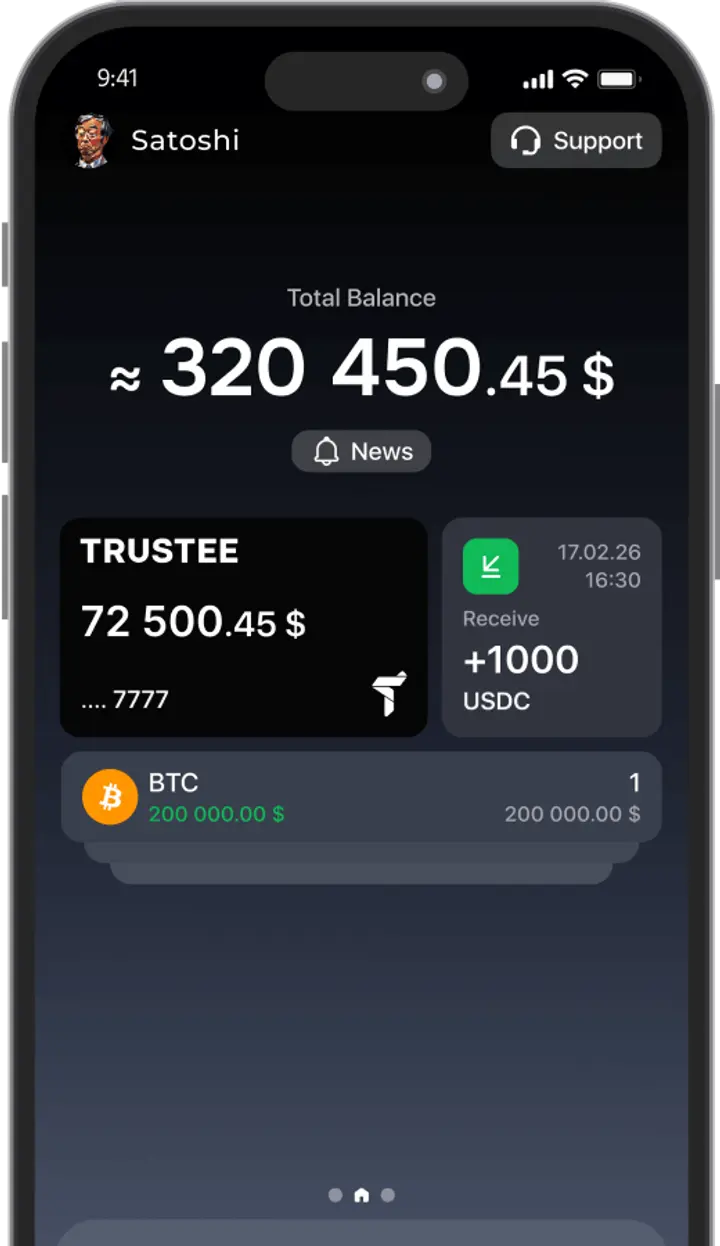
- Crypto wallets: the non-custodial Trustee Wallet — using Smart Swap in the “Exchange” menu, or Trustee Plus — a licensed custodial wallet with a built-in exchange.
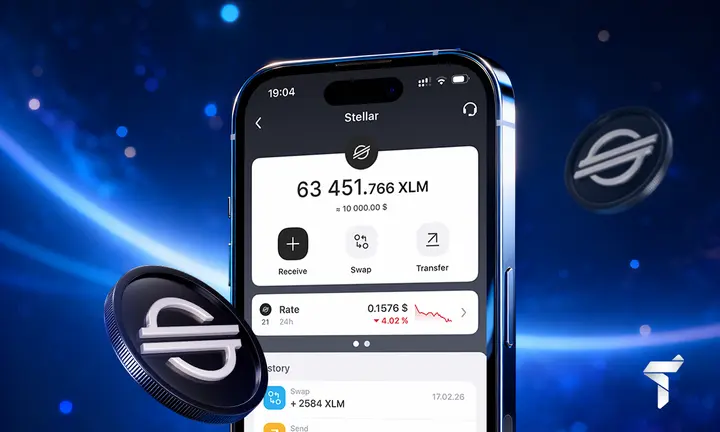
[info content="IMPORTANT: To activate an account on the Stellar network, you need a minimum balance of 1 XLM. This is protection against spam and DoS attacks on the network." color="red"]
You can store XLM on:
Hardware wallets:
- Ledger Nano S/X
- Trezor Model One/T
- SafePal S1
Mobile and desktop wallets:
- Trustee Wallet — a non-custodial wallet with XLM support, a user-friendly interface, and full control over your keys.
- Lobstr — a mobile Stellar wallet with a built-in DEX.
- Solar Wallet — a desktop wallet for XLM.
Custodial solutions:
-
Trustee Plus — for convenient storage with the option of fast conversion.
For large amounts, use hardware wallets. For everyday operations, Lobstr or Trustee Wallet are more convenient.
Stellar tokenomics
From the official launch of the Stellar network in 2014, the protocol предусмотрел a total issuance of 100 billion tokens. In 2019, the team carried out a “burn” of 55 billion XLM and abandoned the inflation mechanism (1% per year).
- Current total supply is: 50 billion XLM.
- In circulation (as of 2026): ~30 billion XLM (~60%).
Distribution:
- 20% — Stellar Development Foundation.
- 80% — distributed through development programmes, partnerships, and airdrops.
Deflationary model:
With the removal of inflation, XLM effectively became a deflationary asset. Judge for yourself: the coin supply is fixed, and if someone loses their private keys, sends tokens to incorrect addresses, or to the wrong smart contract from which coins cannot be recovered, the tokens disappear forever, reducing supply. As for Stellar network fees, they are tiny (around $0.00001). Therefore, it is not possible to “burn” many coins via transactions: only about 50 XLM leave circulation per day.
Key drivers that influence the XLM price:
- Overall market sentiment (correlation with BTC ~0.7–0.8)
- Institutional adoption (partnerships with IBM, Mastercard)
- Growth of the RWA sector
- Integration with CBDC
- Technology upgrades (Soroban, Protocol X-Ray)
Stellar vs Bitcoin vs Ripple comparison
|
Parameter |
Bitcoin |
Ethereum |
Ripple |
Stellar |
|
Launch |
2009 |
2015 |
2012 |
2014 |
|
Purpose |
Digital gold, a defensive digital asset that functions as a store of value. |
World computer for dApps and smart contracts |
Internet of value for banks and financial institutions |
Financial inclusion and fast, cheap international payments |
|
Consensus |
PoW |
PoS |
RPCA |
SCP |
|
Confirmation time |
10–60 min |
12 sec — 2 min |
3–5 seconds |
3–5 seconds |
|
Average fee |
$1–5 |
$0.50–5 |
$0.0002 |
$0.00001 |
|
Maximum supply |
21m BTC |
No limit |
100bn XRP |
50bn XLM |
|
Throughput |
7 tx/sec |
15–30 tx/sec |
1500+ tx/sec |
1000+ tx/sec |
|
Decentralisation |
High |
High |
Low (controlled by Ripple Labs) |
High |
|
Smart contracts |
Limited, basic smart contracts (Bitcoin Script) |
Yes, a global decentralised computer for dApps and smart contracts |
No |
Yes, |
|
Audience |
Enthusiasts, a broad base of investors (retail and institutional) |
Developers, fintech companies, DeFi projects, Web3 users |
Financial institutions, banks, payment operators (B2B) |
Everyday users, the “unbanked” (P2P / B2C), small and medium-sized businesses, humanitarian organisations. |
Pros and cons of Stellar
Pros
- Lightning-fast speed — 3–5 seconds for confirmation.
- Tiny fees — $0.00001 per transaction.
- Energy efficiency — no mining required.
- Smart contracts — Soroban for DeFi and RWA.
- Built-in DEX — swapping any tokens without intermediaries.
- ISO 20022 — compatibility with banking standards.
- Enterprise partnerships — IBM, Mastercard, MoneyGram, Franklin Templeton.
- Financial inclusion — access to finance for 1.7 billion people without access to banking services.
- Proven reliability — 11+ years without outages.
- Active development — regular protocol upgrades.
Cons
- Smaller market capitalisation than BTC/ETH — lower liquidity.
- Market correlation — the price follows Bitcoin.
- Competition — XRP, ALGO, HBAR compete for the same niche.
- Complexity — many features may be unclear to beginners.
- Reliance on partnerships — success depends on corporate adoption.
- Regulatory risks — as a payments system, it may face stricter regulation.
- Low demand for XLM — fees are so low they do not create meaningful “utility” demand.
Stellar outlook and development
The Stellar team has set three main goals for 2026:
- Make the top 10 in DeFi by TVL (Total Value Locked) — $1.5 billion.
- 5 million monthly active users.
- $3 billion in real transactions (Real-World Volume).
To achieve these goals, according to the Stellar Development Foundation roadmap for 2026, a number of key developments are planned:
Q1 2026
Lab 3.0 — an upgrade to smart contract functionality to accelerate development and the rollout of innovations.
Stellar Disbursement Platform — a new cloud mode enabling enterprise clients to connect to the network faster and more easily.
Q2 2026
Updated Stellar CLI — a significant improvement to command-line functionality and interface.
CDP 1.0 — introducing a fast and low-cost way to load and transform historical network data.
Q3 2026
ETL improvements — transforming ledger data into useful subsets that simplify on-chain tracking.
RPC update — simplifying developer access to the Stellar network.
Enterprise payments support — the ability to process all major payment types, including crypto and fiat.
AI assistant Stella — a powerful AI tool available across different platforms.
Freighter for iOS and Android — expanded functionality that removes the need to switch between a browser and Freighter.
Q4 2026
Lab 4.0 — deeper analysis of transaction-level modelling.
SDP disposable wallets — creating disposable wallets on demand.
Contract Copilot — simplifying Stellar smart contract creation by automating boilerplate code generation.
OpenZeppelin — introducing a token standard within the Stellar ecosystem.
Scalability — 5000 transactions per second.
Stellar’s role in the ecosystem
Stellar was originally created as a tool to provide everyday people and small businesses with access to fast, low-cost international payments.
Over 11 years, Stellar has proven itself a strong, time-tested technical solution, so it is no surprise that its use cases have expanded significantly. Today, in addition to “financial inclusion”, Stellar occupies several unique niches:
A bridge between TradFi and DeFi
Stellar connects traditional financial institutions to blockchain without requiring a complete infrastructure overhaul.
A platform for RWA
Tokenisation of real-world assets is one of the most promising sectors. Stellar is among the top four by development activity.
Infrastructure for CBDC
Compatibility with ISO 20022 makes Stellar an ideal choice for central bank digital currencies.
What affects the XLM price
The overall market:
XLM has a high correlation with Bitcoin (~0.7–0.8). A bull crypto market means XLM rises; a bear market means it falls.
Institutional adoption:
Each new partnership (MoneyGram, IBM, Mastercard) or integration with another bank can potentially increase trust and demand. For example, the expected launch of XLM futures on the Chicago Mercantile Exchange in 2026 — one of the largest regulated derivatives markets.
Technology upgrades:
The Soroban launch (2024) attracted the DeFi community’s attention. Protocol X-Ray (2026) could make Stellar a leader in private corporate blockchains.
The regulatory environment:
The Trump administration (2025–2029) proved to be pro-crypto. After Trump’s election in November 2024, XLM rose by 470% over several weeks. Positive regulation in the US could further push the price higher.
CBDC and RWA:
If Stellar becomes the foundation for central bank digital currencies or the dominant platform for asset tokenisation, demand for XLM could rise significantly.
Who might be interested in XLM?
- Investors — as diversification into a payments-focused crypto asset with strong partnerships.
- Companies — for international transfers and asset tokenisation.
- Developers — to build DeFi and RWA applications on Soroban.
- People without access to banks — for access to global finance via a smartphone.
- Traders — high liquidity on major exchanges, CME futures in 2026.
Conclusion
Stellar (XLM) is a blockchain platform with a clear focus: making global finance fast, cheap, and accessible to everyone. From international transfers to asset tokenisation, from financial inclusion to enterprise payments systems, Stellar covers a full range of scenarios.
Stellar is not one of those crypto assets that promises to make you rich overnight, although XLM delivered +470% in the week after Trump’s election (which, admittedly, is not bad). It is a time-tested blockchain with real partnerships, technological innovation, and a clear mission: to build a new global financial system. And the fact that Stellar is mentioned in the ISO 20022 standard only reinforces that these are not “team dreams”, but concrete plans.
In today’s world, where an international bank transfer can take several days because it passes through a network of correspondent banks, and can cost 3-10% of the amount (due to fees across the entire chain of intermediaries), the existence of instant payment technologies makes this model, to put it mildly, strange. So let’s not guess how long the old financial system has left: clearly, its role will gradually diminish.