




























Bitcoin developers have prepared a major network upgrade called Taproot, which was supported by 98% of miners. The activation is scheduled for November 2021. In this article, you will learn what the Taproot upgrade is, what problems it solves, and how it will affect the Bitcoin network and the industry as a whole.
Key Takeaways
- Taproot is an activated Bitcoin protocol upgrade that combines Taproot spending rules, Schnorr signatures and Tapscript. It became active at block height 709,632 in November 2021.
- Taproot outputs may be spent through a key path using a Schnorr signature or through a script path that reveals only the condition actually used.
- By committing possible spending conditions to a Merkle tree, a transaction does not have to publish every alternative script. This may reduce on-chain data and improve the privacy of complex transactions.
- Schnorr signatures provide a foundation for more efficient multi-party signing schemes and may allow certain complex operations to appear on-chain like an ordinary single-signature transaction.
- Taproot does not make Bitcoin completely anonymous and does not automatically reduce the fee for every transaction. Its greatest benefits apply to complex scripts, multi-signature arrangements and second-layer protocols such as the Lightning Network.


Taproot Technology in Bitcoin – What It Means
Since the Segregated Witness (SegWit) update in 2017, the Bitcoin network has not undergone any significant changes that would seriously impact its functionality.
To improve network scalability, modify the Bitcoin protocol’s script mechanics, and enhance privacy and security, developers proposed a soft fork of the Bitcoin protocol called Taproot. This update was combined with a major change known as Schnorr signatures.
In order for the changes to take effect, the majority of miners had to support them. As of June 2021, 98% of miners had approved the Taproot update.
What Is Bitcoin Taproot
Taproot is a Bitcoin soft fork aimed at modifying the protocol's scripts to improve functionality in multiple areas. The name itself is symbolic (taproot as "root") as it reflects the nature of the update – certain transaction data will metaphorically be stored "deep in the soil."
Even older clients and nodes will continue to receive valid data – although some new data will be unavailable to them.
How It Works and Its Impact on the Bitcoin Ecosystem

In Bitcoin’s current implementation, creating transactions – especially those involving multiple outputs (sending to several addresses at once) – can be quite complex. This includes time locks (waiting periods) users may set, and multi-signatures used to enhance transaction security with various “spending” conditions.
Every Bitcoin transaction triggers scripts that define what actions users can take with the coins. To confirm the right to use BTC, users sign transactions with a private key. Once the coins are spent, these scripts enter the public network and are stored on the blockchain. This creates two main issues:
- Blockchain size increases – Each copy exceeds 200 GB and continues to grow, potentially leading to significant data storage challenges in the future.
- Transaction anonymity is compromised – Scripts reveal certain details about users who spent the coins.
This means anyone can identify transactions involving complex scripts. For blockchain analysis companies like Chainalysis, it becomes easier to track users’ transactions.
Taproot BTC will conceal scripts in such a way that observers won’t be able to tell whether scripts were even used.
A basic example could be a contract where any one of three pre-approved addresses may spend the output. With Taproot, if one address spends the coins, only that address’s information is revealed — the other two remain confidential to everyone but the contract creator. External observers will only be able to confirm that the transaction occurred.
The Purpose of the Taproot Bitcoin Update
To implement the planned upgrades, Taproot was combined with the long-awaited Schnorr signatures. The idea is to merge transaction signatures into a new single signature — a method made possible only by combining Taproot with Schnorr signatures.
This enhances privacy and reduces the amount of data stored on the Bitcoin blockchain, which in turn lowers transaction fees, since fees are calculated in satoshis per byte. The smaller the transaction size, the lower the fee.
P2SH (Pay to Script Hash) Solutions for Bitcoin
The first attempt to interact with scripts was the Pay to Script Hash (P2SH) soft fork, which allowed transactions to be sent directly to a script hash address (starting with 3) instead of the standard Bitcoin address (starting with 1). This method was introduced in BIP16 back in 2012. P2SH limited transaction size to 520 bytes, compared to 10,000 bytes in the main network and SegWit.
The P2SH format enabled coins to be sent to addresses secured by various methods. For instance, users could apply multi-signatures or set passwords for data encryption. This improved wallet security, but didn’t solve other blockchain issues.
The activation threshold for Taproot was initially set at 90%. To successfully implement the update, 90% of mined blocks had to include a signaling bit — a unique marker indicating acceptance of the upgrade. This threshold had to be met by August 11, 2021. After several unsuccessful attempts, miners reached consensus on June 12.
Merkle Trees (MAST) in Bitcoin
To reduce transaction size, increase privacy, and improve smart contract capabilities, Bitcoin developers proposed Merklized Abstract Syntax Trees (MAST).
MAST combines the features of Abstract Syntax Trees (AST) and Merkle trees. Here's how ASTs work:
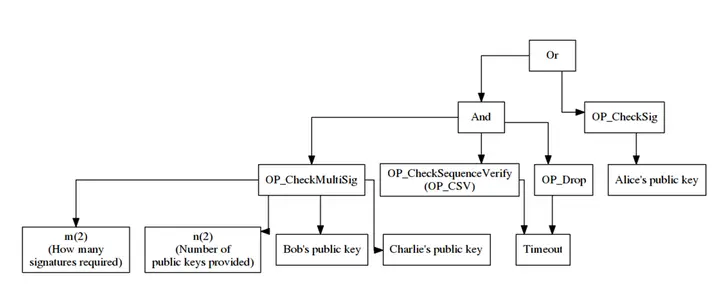
The AST function allows scripts to be described in separate segments, making them easier to analyze and optimize. A Merkle tree lets you verify that a particular element belongs to a dataset without revealing the entire dataset. This enables users to write scripts that act as dynamic public keys and signatures. This capability is implemented in the Bitcoin SPV wallet. Merkle trees reduce blockchain load by verifying that individual transactions belong to a block without adding bulk.
Like Taproot, MAST brings important benefits to the ecosystem:
- Reduces transaction size and, accordingly, cost.
- Enhances data privacy.
- Enables advanced smart contracts without additional strain on Bitcoin network nodes.
When MAST Is Useful
If you need to execute a complex transaction with conditional logic, Merklized Abstract Syntax Trees can help. For example, you may want to transfer coins to a relative if a certain address remains inactive for one year. Using a regular script would mean all the data, including the logic, would be stored on the blockchain — reducing privacy and increasing transaction size.
Implementing Schnorr Signatures in the Bitcoin Protocol
Satoshi Nakamoto originally used the Elliptic Curve Digital Signature Algorithm (ECDSA), a public key algorithm for digital signatures. He chose ECDSA because it was well known and open-source. German cryptographer and mathematician Claus Schnorr developed the Schnorr Signature algorithm (SDSS) before Bitcoin existed but patented it, preventing open use until the patent expired in 2008.
Schnorr signatures have several advantages over the current algorithm:
-
Easier to implement
-
More efficient for generating short signatures
-
Allow aggregation of multiple private keys into a single digital signature
In other words, Schnorr signatures enable the creation of a single aggregated signature (multiple signatures in one) instead of using a traditional multisig scheme like ECDSA. This reduces the size of complex transactions. Therefore, updating the Bitcoin network to use SDSS will elevate digital signature efficiency.
Graftroot or Cryptographic Signatures
To expand Taproot’s capabilities, crypto developers proposed Graftroot — the next evolutionary step in the Bitcoin ecosystem, building on Taproot and Schnorr signatures. Graftroot enables more flexible transaction and script conditions while maintaining network privacy and security.
Graftroot was developed to address a Taproot limitation: only one alternative condition can be recorded in a tree for on-chain inclusion. Graftroot allows unlimited alternatives without moving the coins.
This is useful for creating flexible transaction logic.
You can also define additional rules, such as enabling coin spending via a passphrase. This function is known as threshold signatures, and it allows delegation of signing rights to surrogate scripts not initially defined by private key owners.
Frequently Asked Questions About the Bitcoin Taproot Upgrade
What is Taproot in Bitcoin?
Taproot is a Bitcoin soft fork that introduced new rules for creating and spending version 1 SegWit outputs. It combines Schnorr signatures, a new script-tree structure and Tapscript, allowing complex spending conditions to be implemented more efficiently and with less information revealed on-chain.
When was Taproot activated?
Taproot was activated on the Bitcoin mainnet at block height 709,632 in November 2021. After activation, upgraded nodes began enforcing the new consensus rules for Taproot transactions, while wallets and services were able to add support for P2TR addresses gradually.
How does Taproot improve transaction privacy?
When a Taproot output is spent through the key path, the blockchain records the relevant key and signature without revealing additional conditions. When the script path is used, only the executed branch and proof of its inclusion in the tree are disclosed. Other possible scripts remain hidden. However, addresses, amounts and transaction history may still be analysed, so Taproot does not provide complete anonymity.
Does Taproot reduce Bitcoin transaction fees?
Taproot may reduce the size of certain complex transactions, particularly those involving several conditions or participants. A smaller virtual size can result in a lower network fee. Savings may be limited or absent for a simple single-signature payment because the final fee depends on the transaction structure and the current rate in sat/vB.
Do users need to do anything to use Taproot?
No action is required simply to continue holding BTC. To receive funds at a Taproot address or use its additional features, users need a wallet that supports P2TR and Bech32m addresses, which usually begin with “bc1p”. Before sending, users should confirm that the relevant wallet or service supports the selected address type.