



























ERC-20 is a technical token standard on the Ethereum blockchain. It defines a common set of rules that allows tokens to appear in wallets, move between addresses and interact with exchanges, smart contracts and DeFi applications.
Stablecoins, governance tokens, DeFi assets and many other digital tokens can be issued under the ERC-20 standard. Well-known examples include USDT, USDC, DAI, LINK and UNI. Some of these assets may also exist on other blockchains, so the network must always be checked before making a transfer.
In this article, we explain how ERC-20 tokens work, how they differ from ETH, TRC-20 and BEP-20 tokens, how to transfer and store them, and what to consider when choosing a wallet.
What are ERC‑20 tokens?

ERC‑20 is a universal protocol for creating new tokens that meet specified standards and form the foundation of many modern tokens. Its main features include:
-
interchangeability;
-
portability — transfers between addresses;
-
fixed issuance — the total number of tokens is defined at creation; developers cannot mint more unless specified in the smart contract.
What does the abbreviation ERC‑20 mean?
Ethereum Request for Comments is a protocol that allows proposals for improving the Ethereum network. The number 20 is simply the proposal’s unique identifier. Thus, ERC‑20 tokens are those that conform to this protocol.
What other ERC standards exist?
Beyond the 20 protocol, there are others, for example:
-
721 — non-fungible tokens (NFTs), each with a unique code;
-
1400 — security tokens;
-
865 — allows paying transaction fees not in ETH but in the token itself, the ETH fee still paid by the smart contract owner;
-
777 — marketed as a more flexible alternative to ERC‑20.
Why is the ERC‑20 standard necessary?
Before 2015, when Vitalik Buterin introduced ERC‑20, users faced the problem of incompatibility among Ethereum tokens, each with a unique smart contract.
Supporting an ever-growing number of tokens was time-consuming and complex. The creation of a unified protocol across all tokens resolved this issue.
The main goals were:
-
a single protocol for token compatibility and support;
-
a digital equivalent of securities;
-
a tool for running ICOs — the then-popular method for crypto fundraising.
The protocol indeed simplified users’ lives by solving several problems at once:
-
speeding up token operations like adding, removing, and transferring;
-
eliminating the need to write fresh code for each new token;
-
enabling fast listing on various services and exchanges without lengthy approvals or custom adjustments;
-
establishing a uniform set of rules across all Ethereum tokens.
Core characteristics of the protocol
The defining factors include 6 mandatory and 3 optional parameters:
Mandatory
-
totalSupply — total token amount allowed for issuance, preventing inflation past the maximum;
-
balanceOf — current balance of tokens at a given address;
-
transfer — method to send tokens from one address to another;
-
transferFrom — method to transfer tokens from one participant to another;
-
approve — grants permission for a smart contract to distribute tokens without exceeding the total limit — e.g. balance check;
-
allowance — verifies that an address has sufficient tokens to complete a transfer.
How do ERC‑20 tokens differ from traditional cryptocurrencies?
ERC‑20 tokens, issued on the Ethereum standard, differ from cryptocurrencies in several ways:
-
they don’t have their own blockchain;
-
they are issued by a specific team rather than mined;
-
they may serve as discounts or bonuses for a product;
-
they do not directly represent the value of goods or purchasing power;
-
they act as markers of funds or usage rights and may function as debt receipts;
-
they are managed via smart contracts, which ensure obligations coded into them are enforced.
For a detailed comparison between tokens and coins, check our article: "What is a token in simple terms?"
ERC‑20: list of popular tokens
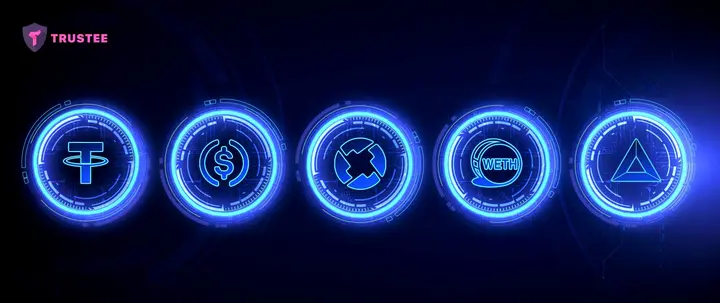
According to Etherscan, 1,279 tokens had been issued using the ERC‑20 standard as of this article’s publication. Notably, before moving to their own blockchains, projects such as BNB, EOS, Tron, and VeChain used this protocol.
The most well-known tokens include:
-
Tether USD (USDT) on ERC‑20 — a stablecoin from Tether Limited that represents a digital equivalent of the euro;
-
USD Coin (USDC) — a stablecoin developed by the open-source Circle project;
-
0x (ZRX) — an open protocol for decentralized exchanges (DEX), handling trades via smart contracts that DApps can integrate with;
-
OmiseGO (OMG) — a decentralized financial network on Ethereum, offering peer-to-peer real-time payments for banks and financial institutions;
-
wETH — “wrapped ETH,” a wrapper for Ethereum’s ETH token on the ERC‑20 standard, mainly for DEXs;
-
BAT — Basic Attention Token, a digital advertising industry token;
-
plus Huobi Token, Bitfinex LEO, Crypto.com Coin, KuCoin Shares, ICON, Augur, Bancor, Raiden.
What are the main advantages?
The benefits echo the goals of its creation. They include:
-
reduced time and resource costs — using existing Ethereum infrastructure instead of building a new blockchain;
-
token interchangeability;
-
compatibility — tokens can easily integrate with other apps in the system;
-
liquidity — this standard underpins many projects.
Disadvantages
ERC‑20 tokens carry certain risks: bugs, vulnerabilities, and immutability after deployment.
The simplicity of token creation also makes it easy for scammers to launch fake projects and ICOs, often disappearing after collecting funds.
Another downside is the risk of sending tokens to the wrong smart contract, resulting in loss if the contract doesn’t support receiving them.
Low network throughput is another issue. As demand for dApps rises, network congestion increases, transaction speeds drop, and fees rise. Plus, ERC‑20 transactions require paying network fees in ETH.
How to use them?
The basic functionality aligns with any cryptocurrency:
-
balance storage;
-
transaction execution;
-
exchange trading;
-
token issuance.
Wallets for ERC‑20 tokens
The number of wallets supporting ERC‑20 tokens almost directly correlates with the number of projects using the standard. Universal compatibility ensures smooth operation within Ethereum. Nearly all software wallets (MetaMask, MyEtherWallet) and hardware wallets (Ledger, Trezor) supporting Ethereum work with ERC‑20 tokens.
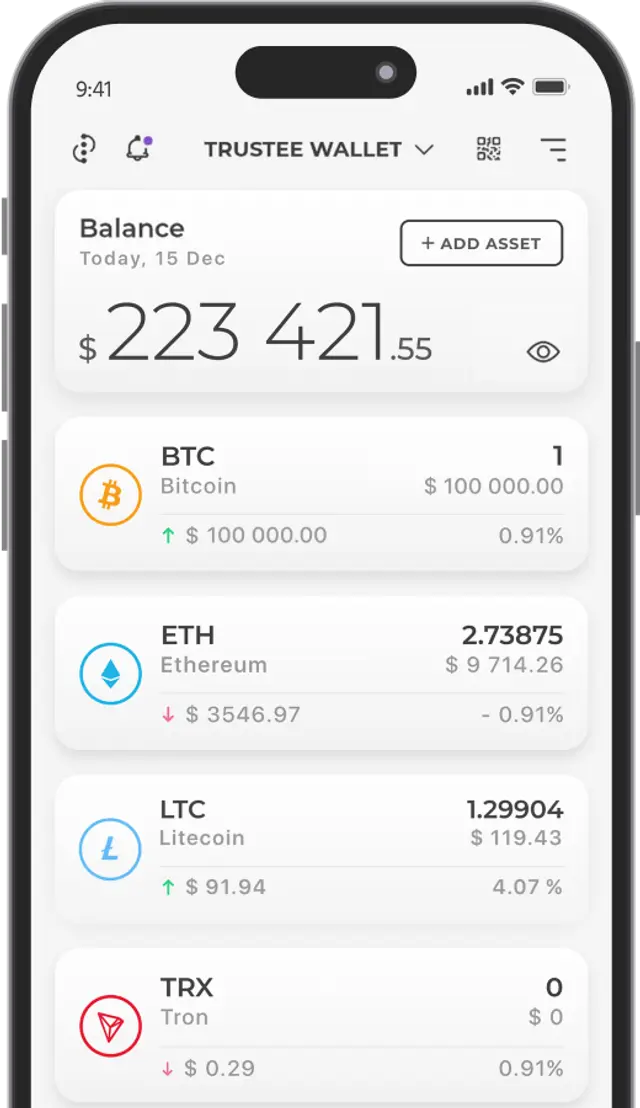
Multi‑currency Trustee Wallet allows trading and storing ERC‑20 tokens, and is among the most practical crypto wallets. It features a simple UI, advanced security, favorable conditions, and the ability to buy and sell tokens using bank cards — just part of what this non‑custodial wallet offers.
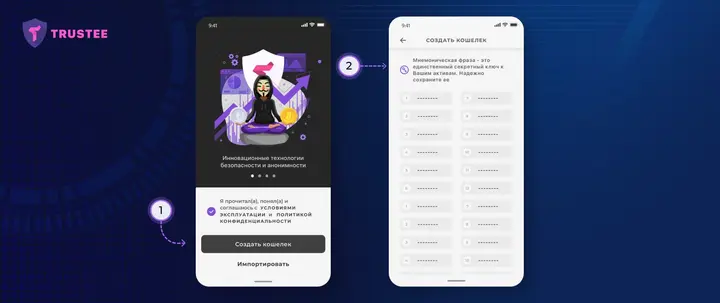
To create a wallet for storing tokens and other coins, simply download it from the App Store or Play Market and install it on your mobile device.
Setup takes only 2 steps:
-
Tap “Create Wallet”;
-
Write down your recovery phrase.
Your most convenient crypto wallet for tokens is ready to use!
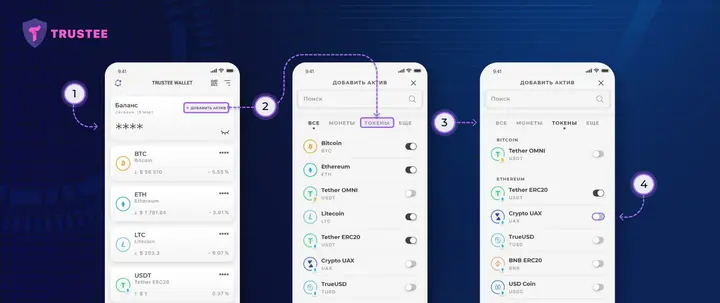
To add an ERC‑20 token to Trustee Wallet:
-
Open the desired wallet in the app;
-
Tap “Add Asset”;
-
Navigate to the “Tokens” tab and select from a list or add a custom token using its smart‑contract address;
-
Toggle the switch next to the token ticker.
Summary
ERC‑20 is a universal protocol for creating tokens with key specs: interchangeability, portability, and fixed issuance.