



























As the digital asset market develops, regulators, centralised exchanges and analytics companies are paying increasing attention to transactions offering enhanced privacy. This is due not only to the growing popularity of cryptocurrencies but also to the need to combat money laundering, the financing of illegal activities and the circumvention of financial restrictions.
The Trustee team explains what anonymous cryptocurrencies are, how privacy coins differ from Bitcoin and other public blockchains, which technologies protect user privacy and which risks must be considered when working with such assets.
Key Takeaways
- Bitcoin, Ethereum and most other public cryptocurrencies are pseudonymous rather than anonymous: addresses do not contain the owner’s name, but transaction histories, amounts and links between addresses are available for analysis.
- Privacy-focused cryptocurrencies use stealth addresses, ring signatures, confidential transactions, CoinJoin, MimbleWimble and zero-knowledge proofs to conceal the sender, recipient, amount or transaction graph.
- Monero provides privacy by default, while Zcash supports both shielded and transparent transactions. Dash offers optional CoinJoin functionality but is not generally classified as a full privacy coin.
- No technology guarantees absolute anonymity: a user may be identified through an IP address, device, centralised exchange, wallet-use errors, address reuse or voluntarily disclosed information.
- The availability of privacy coins depends on the platform and applicable legislation. Centralised services may conduct KYC/AML checks, restrict withdrawals to shielded addresses or delist certain assets.


Anonymous Cryptocurrencies: What Are They?

One of the principal characteristics of a public blockchain is transparency. Transactions are recorded in a distributed ledger and remain there after confirmation. Any user can open a blockchain explorer and view addresses, amounts, transaction times, fees and other publicly available information.
At the same time, a wallet address does not normally contain the owner’s name, telephone number or passport details. This is why transactions on public blockchains are described as pseudonymous. However, the absence of a name from an address does not make the transaction anonymous.
Transactions on blockchains such as Bitcoin, Ethereum, Dogecoin and Litecoin can be tracked and grouped using blockchain analytics methods. If a user transfers funds to a centralised exchange where they have completed verification, or publicly links an address to their identity, associating transactions with a particular person becomes considerably easier.
Which Cryptocurrencies Are Known as Privacy Coins?
Anonymous cryptocurrencies, or privacy coins, are digital assets whose protocols contain specialised mechanisms for protecting financial information. Depending on the project, they may conceal the sender’s address, the recipient’s address, the amount, the balance or the relationship between transaction inputs and outputs.
This does not mean that identifying a user is impossible under all circumstances. Even when data is concealed at the blockchain level, information may be revealed through a centralised service, an IP address, malicious software, network-traffic analysis, user errors or interaction with transparent blockchains.
For example, Zcash supports two types of transactions. In transparent transactions, addresses and amounts are visible on the blockchain, as they are in Bitcoin. In fully shielded transactions, the sender’s and recipient’s addresses, the amount and the memo field are concealed. The level of privacy therefore depends on the address type, wallet and selected method of sending funds.
Users should not rely completely on cryptocurrency anonymity, and such assets should certainly not be used for illegal activities. Even the most advanced cryptographic methods do not guarantee complete privacy when software is configured incorrectly or associated data is disclosed.
Privacy coins also receive increased attention from regulators and cryptocurrency service providers that comply with KYC/AML requirements. The availability of a particular coin, trading pair or withdrawal method may therefore depend on the platform and applicable rules.
How Privacy Coins Emerged
As blockchain analytics developed, it became clear that the pseudonymity of a public ledger did not provide complete privacy. Bytecoin appeared in 2012 as the first implemented cryptocurrency based on the CryptoNote protocol, which was designed to conceal links between transaction participants.
CryptoNote used one-time addresses and one-time ring signatures. Ring signatures themselves had previously been proposed by Ronald Rivest, Adi Shamir and Yael Tauman, while CryptoNote adapted the concepts of ring signatures and traceable signatures for electronic money. Daniel Bernstein was mentioned in the original version of the article because of the use of an elliptic curve and EdDSA, but he was not the author of the ring-signature concept.
A ring signature confirms that a transaction was signed by one member of a selected group but does not reveal which particular key was used. Additional linkability makes it possible to identify double-spending attempts without revealing the genuine sender.
Pseudonymous and Anonymous Cryptocurrencies: What Is the Difference?
Pseudonymous cryptocurrencies are those in which addresses do not directly contain personal information, but transaction histories remain public. Bitcoin, Ethereum and most other open blockchains fall into this category.
Such coins do not provide built-in privacy for the complete transaction history. An address may remain unknown to an observer only until the user links it to an exchange account, public profile, payment request or other identifying information.
By contrast, privacy-focused cryptocurrencies use cryptographic and network-level mechanisms that make transaction-graph analysis more difficult. However, the degree of protection varies: some projects enable privacy by default, while others make it optional.
The claim that it is impossible to identify the sender and recipient in any anonymous cryptocurrency, even through detailed analysis, is therefore too categorical. It is more accurate to say that such systems substantially reduce the amount of publicly available information and increase the cost and complexity of analysis.
Some wallets for transparent blockchains support CoinJoin. This does not involve transferring funds through a trusted developer, nor does it necessarily involve off-chain mixing. CoinJoin is a jointly constructed transaction in which several users combine inputs and create a set of outputs, making it more difficult to match senders and recipients unambiguously. The implementation may be non-custodial, but unsuitable parameters, the user’s subsequent actions and clustering methods can reduce its effectiveness.
How Anonymous Cryptocurrencies Work
Privacy coins use algorithms embedded in the protocol or official software. The best-known privacy technologies include stealth addresses, ring signatures, RingCT, CoinJoin, MimbleWimble, Dandelion++, zk-SNARKs and other zero-knowledge proofs.
These mechanisms solve different problems. A stealth address protects the recipient, a ring signature makes it harder to identify the genuine input, a confidential transaction conceals the amount, and network protocols such as Dandelion++ make it more difficult to associate a transaction with its originating node. No single technology closes every possible channel through which information may be leaked.
Advantages and Disadvantages of Privacy Coins
Privacy coins provide users with tools for protecting financial information, but they also create technical, legal and infrastructure-related risks. The principal advantages and disadvantages of anonymous cryptocurrencies are listed below.
| Advantages | Disadvantages |
|---|---|
| They make it considerably more difficult to identify participants and analyse transaction histories. | They may be used by criminals to conceal the origin of illegally obtained funds. |
| They protect confidential financial information, including balances, payment amounts and commercial relationships. | Increased regulatory scrutiny prevents some privacy coins from being listed or integrated. |
| They allow lawful transactions whose details users do not want to disclose publicly. | Centralised exchanges may restrict deposits or withdrawals or delist such assets completely. |
| They reduce the effectiveness of large-scale user profiling and arbitrary transaction censorship. | Concealed financial flows make it more difficult to monitor tax offences, money laundering and the financing of illegal activities. |
| Concealing balances and transaction histories may reduce the risk of targeted attacks against the holder of a large sum. | After theft or fraud, tracking the movement of funds and recovering assets may be considerably more difficult. |
If a user becomes a victim of fraud or has a large sum stolen on a transparent blockchain, analysts may attempt to track the movement of the funds and identify the points at which they reach regulated services. Considerably less information is available on a private network, so an investigation may be more difficult. However, this does not mean that analysis is always useless: traces may remain on devices, in network traffic, on exchanges, through bridges and within other external services.
Top 7 Well-Known Anonymous Cryptocurrencies and Privacy Projects
The privacy-coin category includes dozens of assets, but their market capitalisation, liquidity and availability change continuously. Moreover, not every project included in traditional privacy-coin rankings provides confidentiality directly at the blockchain level. Let us consider seven of the best-known examples and clarify the characteristics of each one.
Monero: Private Cryptocurrency by Default

Monero remains one of the best-known projects focused on private and censorship-resistant payments. XMR’s current market capitalisation and ranking change continuously, so fixed figures quickly become outdated.
Monero conceals the sender using CLSAG ring signatures, the recipient using one-time stealth addresses and the amount using Ring Confidential Transactions, or RingCT. These mechanisms operate at protocol level and are applied to all standard transactions.
The original version of the article included the opinion of Monero community member thefuzzstone, who highlighted the following characteristics of the project:
- no mandatory trusted parameter-generation ceremony;
- no conventional premine or instamine intended for the founders;
- no built-in permanent fee automatically directed to developers;
- an open development model without a single company controlling the protocol.
One of Monero’s advantages is its active community of developers, researchers, translators and users. Protocol discussions, code changes and research are conducted publicly through repositories, working groups, Matrix, IRC and other open channels.
Privacy is not optional in Monero. A user cannot accidentally send an ordinary transparent transaction similar to a Bitcoin transfer. This expands the overall anonymity set because standard operations use the same fundamental privacy mechanisms.
Monero’s principal technologies protect different elements of a transaction:
- ring signatures make it difficult to identify the genuine output being spent and protect the sender;
- RingCT conceals the transaction amount and confirms that the balance is correct without publishing it;
- one-time stealth addresses prevent an external observer from associating an output with the recipient’s public address;
- Dandelion++ changes how transactions propagate between nodes and makes it more difficult to associate an operation with its originating IP address, although it does not guarantee complete network anonymity.
The original article mentioned Triptych as a promising protocol for increasing the anonymity set. The direction of research subsequently changed. In 2026, Monero developers are working on FCMP++, a proof system establishing membership in the complete set of eligible outputs, as well as the new Carrot address and key scheme. Integration is undergoing testing and auditing, and a final activation date has not been established.
Users do not need to select most Monero privacy mechanisms manually: the privacy of the sender, recipient and amount is built into a standard transaction. However, protecting network-level and external metadata still requires an up-to-date wallet, verified software and a secure connection.
Zcash (ZEC)
Zcash uses zk-SNARK zero-knowledge proofs, which make it possible to confirm the validity of a shielded transaction without publishing the participants’ addresses, the amount or the contents of the memo field. Zcash nevertheless supports both transparent and shielded pools, so actual privacy depends on the address and wallet being used.
In a shielded transaction, coins are not “burned and created again” in the conventional sense. The protocol publishes cryptographic commitments for new shielded notes and nullifiers for spent notes. This prevents double spending and verifies balance conservation without revealing the relationship between inputs and outputs.
Early versions of Zcash used trusted parameter-setup ceremonies. After the activation of NU5, the new Orchard shielded pool moved to the Halo 2 proof system, which does not require a trusted setup. Older pools and transparent addresses continue to exist, so users must check the capabilities of the particular wallet they use.
The claim that Zcash has a permanent twenty per cent “developer tax” with fixed distribution is outdated. The mechanisms used to fund the Zcash ecosystem have changed during network upgrades and are determined by the protocol rules currently in effect and community decisions.
Dash (DASH)
Dash is frequently included in older rankings of anonymous cryptocurrencies, but the project itself does not describe every transaction as private by default. The standard Dash blockchain is public and allows addresses, amounts and transfer histories to be analysed.
For additional financial privacy, Dash Core and Dash Electrum wallets offer CoinJoin. Several users construct joint transactions with equal denominations, making it more difficult to analyse the origin of individual outputs. The process is non-custodial: coins are not transferred to an operator or masternode for safekeeping.
CoinJoin provides limited, or “consumer-level”, privacy rather than guaranteed anonymity. The result depends on the number of rounds, the subsequent consolidation of outputs, network metadata and the capabilities of blockchain analytics. Dash is therefore more accurately described as a transparent cryptocurrency with an optional CoinJoin tool rather than a full privacy coin.
Horizen (ZEN)
Horizen was launched as a project derived from Zcash and historically supported technologies from the Zerocash family. However, the project’s architecture and direction have changed several times, so describing ZEN as a conventional anonymous coin, as the original article did, no longer reflects the current state of the ecosystem.
Horizen’s modern strategy focuses on creating EVM-compatible infrastructure for confidential applications, selective data disclosure and compliant privacy. Development includes confidential-computing technologies, zero-knowledge proofs and configurable access. The privacy of the native token, a particular network and an individual application must therefore be assessed separately rather than applying the characteristics of the early protocol to the entire modern ecosystem.
Verge (XVG)
Verge is an open cryptocurrency network that uses Tor and I2P to conceal a user’s IP address and network route. These technologies primarily protect network metadata but do not make the blockchain itself completely private: addresses, amounts and the transaction graph remain available for analysis. Verge therefore cannot be considered equivalent to Monero or shielded Zcash transactions.
Beam (BEAM)
Beam’s developers created a confidential blockchain based on MimbleWimble and later supplemented it with LelantusMW technology, smart contracts and confidential assets.
Beam conceals amounts and does not record conventional permanent sender and recipient addresses on the blockchain. Transactions can be aggregated, while Dandelion++ is used to make analysis of the transaction graph and the original source of network propagation more difficult. Nevertheless, external metadata, wallet errors and data disclosed by either party may still reduce privacy.
Grin (GRIN)
Grin was launched in 2019 and is a minimalist implementation of MimbleWimble. Conventional addresses and transparent amounts are not published on the blockchain, while transactions can be aggregated and partially removed from the long-term state through the cut-through mechanism.
Grin uses linear issuance: the target reward is 60 GRIN per block with a one-minute block time, or approximately one GRIN per second. The nominal reward does not decrease over time, but the relative inflation rate gradually falls as the total supply grows.
How and Where to Buy Privacy Coins
The availability of Monero, Zcash, Dash, Beam, Grin and other assets depends on the particular exchange, jurisdiction and compliance policy. Market-data websites, including the CoinMarketCap privacy-coin category, can be used to view trading platforms and pairs, but users must separately check whether deposits and withdrawals are available, whether shielded addresses are supported and whether the network is currently operating normally.
How to Buy Cryptocurrency Privately
Most centralised cryptocurrency exchanges comply with KYC/AML requirements and may request identity verification, proof of the source of funds and additional information. Even when registration does not require immediate verification, a service may collect the user’s IP address, device information, cookies, transaction history and other data that could be used to identify them.
A decentralised exchange does not guarantee anonymity either. Uniswap, PancakeSwap, 1inch and similar protocols operate on transparent networks and do not normally support native Monero or Grin. Their transactions are visible on the blockchain, while the web interface, RPC provider or wallet may receive metadata. P2P marketplaces, atomic swaps and specialised protocols exist for certain privacy coins, but users must comply with applicable legislation and independently assess the security of the software and counterparty.
Anonymous Cryptocurrency Wallets

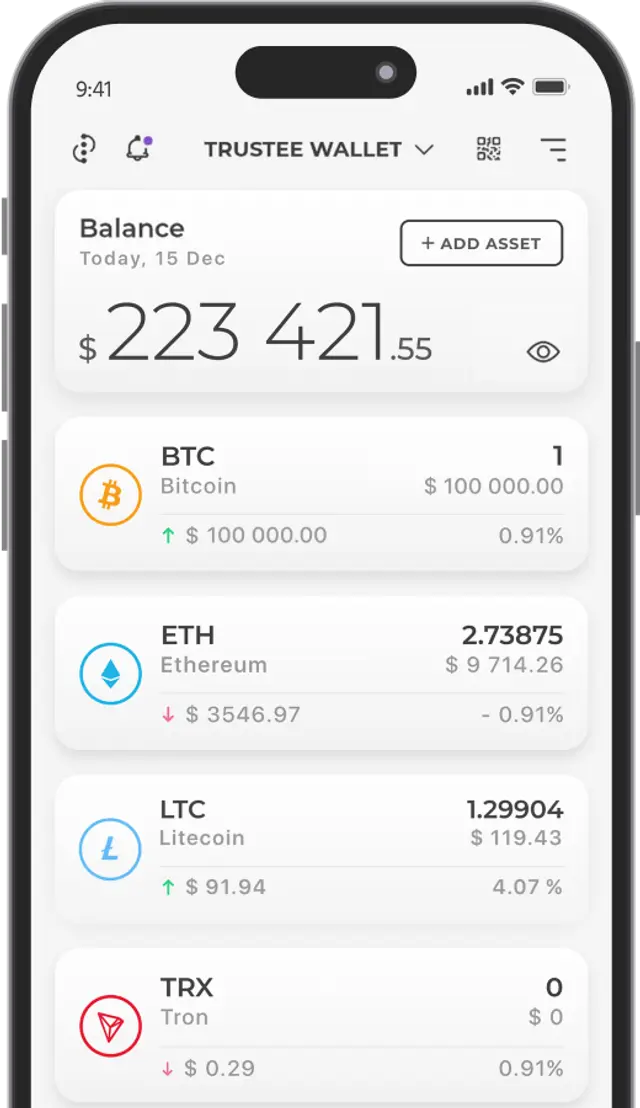
Non-custodial wallets such as Trustee Wallet can be used for the independent storage of cryptocurrencies. In such a wallet, the user rather than a centralised operator controls the private keys. However, non-custodial storage does not necessarily provide anonymity: the network, device, third-party purchase or exchange services and the owner’s behaviour may reveal additional information.
Trustee Wallet supports Monero storage and gives users access to their address, private view key and private spend key. Purchases or exchanges conducted within the application may be processed through external providers with their own rules, fees and identity-verification requirements. Before conducting an operation, users must check the network being used, the service terms and the security of their backup.
The Future of Anonymous Cryptocurrencies
Regulators and financial institutions continue to strengthen controls over tools that make transactions more difficult to trace. This does not amount to a universal prohibition of privacy coins, but centralised platforms may restrict their listing, withdrawals and the use of shielded addresses.
As early as 2018, registered cryptocurrency platforms in Japan began delisting several assets with enhanced-anonymity features, including Monero, Zcash and Dash. Other jurisdictions use different approaches, ranging from risk-based supervision to prohibiting service providers from maintaining anonymous accounts.
The blockchain-analytics industry is developing at the same time. Companies examine public ledgers, cross-chain interactions and the points at which assets enter and leave centralised services. Analysing Monero and other privacy protocols is more difficult than analysing Bitcoin, but it would be incorrect to claim that investigations are completely impossible.
FATF and national regulators focus primarily on service providers, including exchanges, conversion services, custodial wallets and other intermediaries. Such companies are subject to KYC, AML, Travel Rule, source-of-funds verification and suspicious-transaction monitoring requirements.
New rules may prohibit providers from maintaining anonymous cryptocurrency accounts, but these restrictions do not always extend to developers of non-custodial software who do not have access to user keys and do not control the wallet. The particular legal regime must be checked in the place where the service is used.
In the original version of the article, thefuzzstone suggested that Monero might eventually be delisted from every centralised exchange and move primarily to P2P trading. This was the opinion of a community member rather than an established fact. Some platforms have indeed discontinued XMR support, while others continue trading it subject to local requirements.
The Monero community developed Haveno, an open, non-custodial P2P platform built on Tor and Monero. The project reached Mainnet readiness in 2024, but actual trading takes place through independent third-party networks that are not necessarily verified or recommended by the official repository. Users must assess the reputation of the particular network, its arbitration rules, software builds and counterparty risk.
Restrictions on access to centralised exchanges may affect the liquidity and price of XMR or another asset, but the direction and duration of this effect cannot be predicted reliably. The development of P2P marketplaces, atomic swaps and non-custodial infrastructure creates alternative channels but does not eliminate technical or legal risks.
Monero has repeatedly introduced new technologies for protecting financial privacy and remains an example of an open project offering privacy by default. However, protection should not be limited to the blockchain: users must employ free and verifiable software, keep devices updated, protect the seed phrase, control network metadata and avoid disclosing personal information unnecessarily.
Remember that every coin uses its own privacy model. Before purchasing or transferring an asset, it is important to determine which data is concealed, whether protection is mandatory or optional, which wallets support it and which information remains visible on the blockchain.
Frequently Asked Questions About Anonymous Cryptocurrencies
Can Privacy Coins Guarantee Complete Anonymity?
No. They can conceal data directly on the blockchain, but they do not control every external source of information. An IP address, device, centralised exchange, malicious software, publicly disclosed address or user error may associate a transaction with a particular person.
How Does Monero Differ from Zcash?
Standard Monero transactions are private by default: the protocol conceals the sender, recipient and amount. Zcash supports both transparent and shielded transactions. To obtain full ZEC privacy, users must use a wallet and address that support a shielded pool such as Orchard.
Can Bitcoin Transactions Be Made Anonymous?
Bitcoin remains a transparent blockchain. CoinJoin, new addresses, a personal node and protection of the network connection can improve privacy, but they do not turn Bitcoin into a completely anonymous cryptocurrency. The result depends on how outputs are subsequently used and how resistant the transaction is to blockchain analysis.
Is It Legal to Buy and Hold Privacy Coins?
The legal status depends on the user’s place of residence, the selected platform and the nature of the transaction. Holding a privacy coin is not prohibited in every jurisdiction, but a regulated service may not support it, may require verification or may restrict shielded withdrawals. Using cryptocurrency does not remove tax or other legal obligations.
How Can Monero and Other Privacy Coins Be Stored Safely?
Use an official or verified non-custodial wallet, store the seed phrase offline, check the file hashes of downloaded software, never provide private keys to customer support and conduct a small test transfer first. To improve network privacy, users can operate their own node and use connection-protection tools supported by the wallet.