




























Every new cryptocurrency user, after gaining a basic understanding of the technology, asks the question of how to store cryptocurrency and which crypto wallet to choose for working with Bitcoin and other coins. In addition, more experienced users often return to the same question when searching for new solutions — more practical, reliable, and secure. Trustee Wallet experts explain what a Bitcoin wallet is, what types of crypto wallets exist, and what the key selection criteria are.
Not sure which crypto wallet to choose in 2026? Read our article!
Bitcoin wallet: what it is
A Bitcoin wallet is software for managing the Bitcoin cryptocurrency with the following functions:
- storing addresses and keys;
- transfers between addresses — sending and receiving bitcoin;
- displaying information about balances, transactions, and more.
In simple terms, a bitcoin wallet is software for storing bitcoin and carrying out transactions with it.
Key terms
- Crypto wallet address — a unique identifier for sending or receiving crypto transactions, consisting of a set of letters and numbers.
- Seed phrase — a mnemonic passphrase of 12/24 words that allows you to restore or move your bitcoin wallet to another device.
- Backup — a file that contains a copy of your wallet data and helps restore access if the owner forgets the password, loses control of the device the wallet is installed on, or if the device is damaged.
- Public key — the equivalent of a bank account — an address used for sending and receiving coins.
- Private key — the equivalent of a password, required to access funds and authorise transfers.
- Transactions — transfers between addresses, the information about which is recorded on the blockchain. Each transaction has its own identifier — a Tx ID, which can be used, for example, to confirm that funds have been sent.
How to choose a Bitcoin wallet
Several types of wallets are used for storing cryptocurrency — from a sheet of paper to a smartphone app — and they differ in their approaches to security, privacy, practicality, and ease of use.

To a large extent, the safety of your coins depends on which wallet you choose.
-
Reliability level
This factor determines whether attackers can hack a crypto wallet and steal funds. Security characteristics include control over private keys, methods of synchronising with the blockchain, and protection against hacks and cyberattacks.
-
Fees
Make sure you understand what fees are charged when using a crypto wallet: for top-ups, transfers, or withdrawals, and whether there are any additional fees. Read the service terms carefully.
-
Transaction control method
There are three ways to control transactions:
- partial — the user has access to funds, but the service is responsible for security;
- shared — a third-party confirmation is required to complete a transaction;
- full — the user bears full responsibility for keeping funds safe.
-
Code transparency
Basic code transparency does not guarantee a wallet is 100% secure. With full transparency, any user or developer has access to the open-source code and can check it for vulnerabilities and security “holes”. There are also remote apps whose security depends on the service from which data is loaded.
-
Anonymity
Confidentiality is determined by how much personal data a crypto wallet requests to create and use it. Privacy depends not only on software developers but also on users’ own vigilance. Beware of phishing attacks, viruses, and other malicious software to maintain anonymity and avoid losing your funds.
-
Custody
The difference between custodial and non-custodial wallets is where private keys are stored. Custodial projects keep them on their own infrastructure, while in non-custodial wallets they are stored on users’ own devices. The keys and funds of non-custodial wallet users are fully under the users’ control and responsibility and cannot be blocked or stolen.
Types of crypto wallets
You should choose a Bitcoin wallet based on its features and your personal needs. To start, decide how large the amount you will store in the wallet is likely to be, what matters more to you — convenience or security — and whether you are ready to take responsibility for keeping your keys safe or prefer to entrust them to a project team.
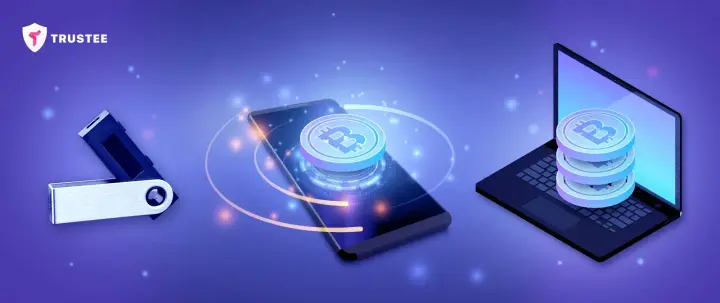
The purpose of use also matters — storing investments or making frequent transactions. Different types of crypto wallets suit different needs.
Hardware wallets — cold
These are devices for offline storage of cryptocurrency that connect to the network only when in use. They are also called cold wallets. They may look like a USB stick, a plastic card, or a standalone device, and can be managed independently or via a computer or smartphone. Among the most popular are:
- Trezor;
- Ledger;
- Cool Wallet;
- KeepKey.
Online wallets
These are browser-based wallets that can be accessed from any device with internet and a browser. They also exist as browser extensions. They are convenient in terms of speed of access to transactions, but less reliable due to exposure to malware attacks, data interception, and phishing. Storing large amounts in such wallets is not recommended, but they are handy for microtransactions.
Exchange wallets
These are customer accounts on crypto exchanges. Such wallets are suitable for those who want to trade crypto assets and profit from price fluctuations. However, you need to understand that exchanges store your keys, and in the event of a leak you may not get your funds back.
Desktop wallets
These are programs for various operating systems that are installed on the user’s computer. There are light and heavy (thin and full) desktop wallets. Heavy wallets download the entire transaction history to the computer’s local drive, take up a lot of device memory, and take a long time to sync. Light wallets allow only part of the blockchain to be downloaded, while the rest is stored on full nodes. In this case, you have to trust the servers the program connects to.
Mobile wallets
These are apps, which are best suited for Android or iOS smartphones, providing access to your wallet from anywhere at any time, as long as you have internet. They are safer than online wallets because they are less exposed to attacks via malicious software or, for example, phishing. Such wallets are best for crypto beginners because they are always “to hand” and often have an intuitive user interface; many support NFC and access via Face ID or Touch ID. Added convenience includes notifications about incoming funds, price changes, trade completion, and app updates.
Paper wallets
A simple sheet of paper with keys printed or written on it. Stealing private keys without stealing the sheet itself is impossible, but if you lose it, you lose your funds along with it. You must store the paper with fire safety in mind, away from moisture, children, and pets. To use the funds in the wallet, you need to import the keys into any other wallet — software or hardware.
Which mobile Bitcoin wallet is best to choose
When choosing a mobile crypto wallet, pay attention to the main criteria — security, a user-friendly interface, multi-currency support, and any additional fees. Also, when comparing different Bitcoin wallets and wondering which one to choose, opt for options with no extra fees.
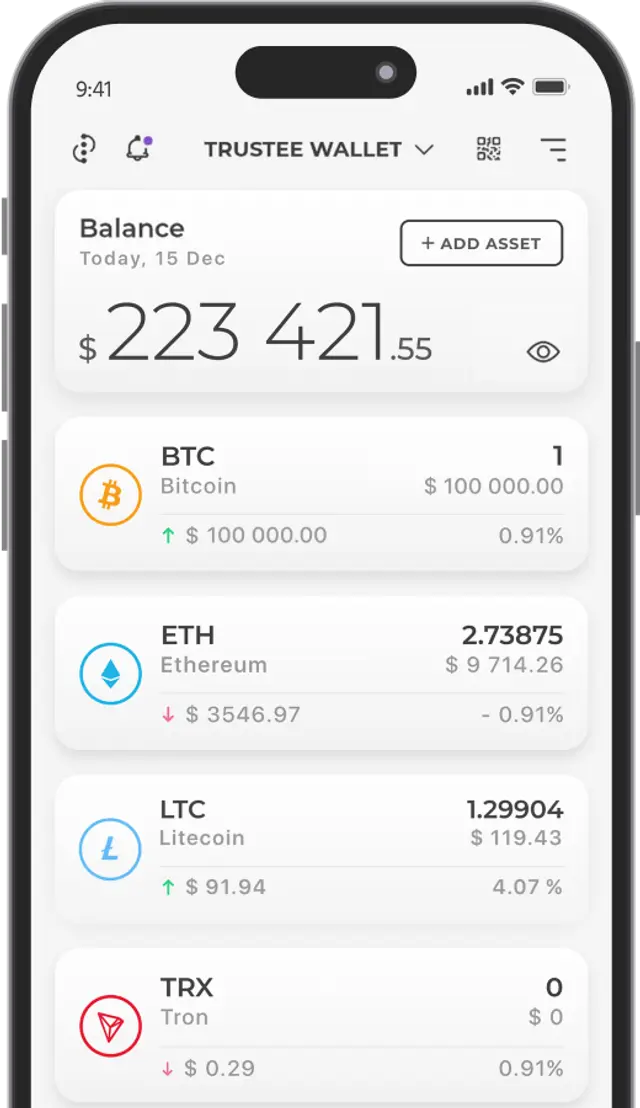
Trustee Wallet — a multi-currency wallet that allows you to store and transact in bitcoin and other cryptocurrencies, while adhering to one of the core principles of the crypto industry — decentralisation. A non-custodial wallet does not store your data; it is stored on users’ own devices.
Trustee Wallet is one of the most optimal wallets for storing bitcoin that iPhone and Android users can choose from the App Store and Play Market respectively.
How to use the wallet: instructions for beginners
Another important Bitcoin wallet criterion to consider when deciding which one to choose is the availability of instructions.
How to withdraw funds from the Trustee crypto wallet to a bank card:
- Tap the ‘Exchange’ button on the main screen of the app.
- Select the cryptocurrency you want to sell in the tab that opens in the ‘You give’ field, and the currency you want to receive in the ‘You get’ field in the FIAT section.
- Select Card in the ‘Method’ field.
- Tap the magnifying-glass icon in the bottom-right corner of the screen and enter the desired amount.
- Tap ‘Add card’ and fill in your bank details.
- Tap ‘Find the best offer’, after which the best terms among exchange services will be offered to you via the Smart Swap system.
- After choosing the most suitable option, tap the relevant button.
- Check the automatically generated pre-check of the exchange transaction — rate, amount, fees. Tap ‘Accept and prepare transaction’.
- The system will generate a receipt. Tap ‘Send’.
- Once the exchange is completed, the funds will be credited to the specified card.
How to keep your crypto wallet secure
To protect your funds from scammers, take a few useful steps:
- make a backup copy of your Bitcoin wallet;
- store your mnemonic phrase in a safe place;
- set a strong password, but do not save it in a keychain or on the device — memorise it or store it in a trusted password manager;
- keep the software updated;
- follow updates from the project team and the crypto industry as a whole;
- use all available wallet protection tools — two-factor authentication, IP management, anti-phishing, and so on.
When choosing a crypto wallet, consider all criteria and features, and also carefully review user feedback and the project team’s reputation. Remember: the safety of your funds and data depends on your choice.