


























The crypto market includes thousands of assets, but much of its value is concentrated among a small group of leaders. Bitcoin holds the top position, Ethereum remains a key platform for smart contracts, while USDT, BNB, USDC and other major assets dominate the upper ranks. However, their positions can change quickly as market prices fluctuate.
In this article, we explore the current top 10 cryptocurrencies by market cap, highlight what makes each asset different, and explain what a high position in the ranking actually means.
What is cryptocurrency market capitalisation and why does it matter?
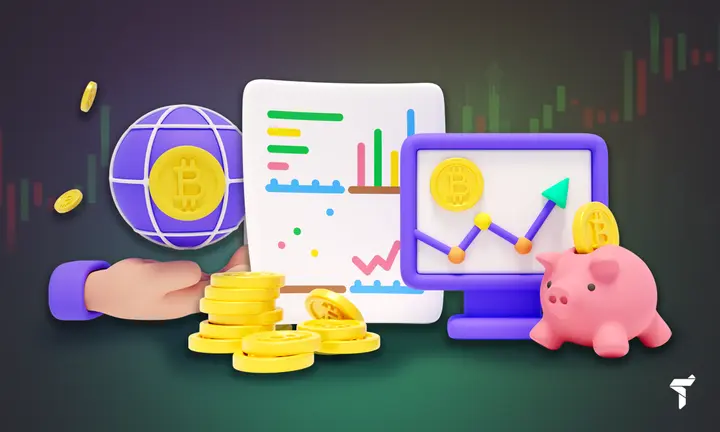
Cryptocurrency market capitalisation is the total value of all coins issued by a particular project, calculated using the formula: price per coin × circulating supply. For example, if 19 million BTC are in circulation and each costs $100,000, the market capitalisation would be $1.9 trillion. This metric helps you quickly assess a cryptocurrency’s “weight” in the market.
Market cap matters because it reflects investors’ confidence in an asset. A higher market capitalisation usually means higher liquidity (it’s easier to buy or sell the coin without affecting the price) and lower risks.
Top cryptocurrencies by market capitalisation
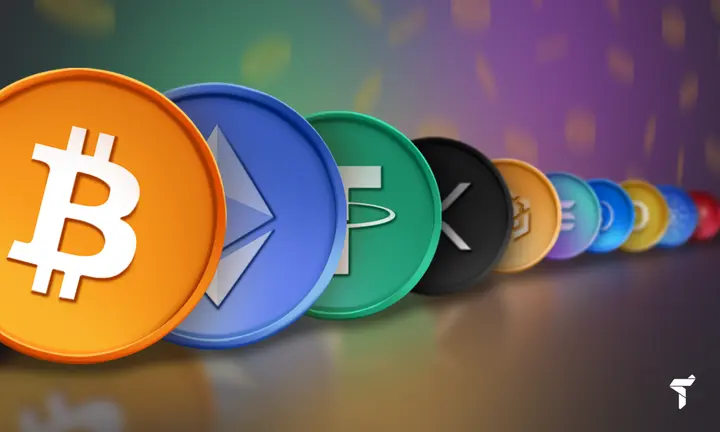
Here is the updated top list of cryptocurrencies by market cap as of January 2026:
1. Bitcoin (BTC)
Bitcoin is the most expensive cryptocurrency in the world, launched in 2009 by an unknown developer under the pseudonym Satoshi Nakamoto. Built on Proof-of-Work, Bitcoin has a limited supply — only 21 million coins — which gives the asset a deflationary nature. Its blockchain operates without a central authority, and transactions are recorded every 10 minutes.
-
Market capitalisation: $1.26 trillion
2. Ethereum (ETH)
Ethereum is a second-generation platform created by Vitalik Buterin in 2015. Its key strength is smart contracts, which make it possible to build decentralised applications (dApps), NFTs and DeFi platforms. In 2022–2023, Ethereum transitioned to Proof-of-Stake, significantly reducing energy consumption and improving scalability.
-
Market capitalisation: $219 billion
3. Tether (USDT)
USDT is the oldest and most popular stablecoin, pegged to the US dollar at a 1:1 ratio. It is issued by Tether Limited and runs on several blockchains: Ethereum (ERC20), Tron (TRC20), Solana and others. It is used as a “digital dollar” for trading, hedging and transfers.
-
Market capitalisation: $184 billion
4. Binance Coin (BNB)
BNB is the utility token of the Binance ecosystem. Initially created as an ERC20 token, it moved to its own blockchain in 2019 — BNB Chain (previously Binance Smart Chain). BNB is used to pay exchange fees, participate in token sales (Launchpad), and across Binance’s DeFi and NFT services.
-
Market capitalisation: $74.6 billion
5. USD Coin (USDC)
USDC is a stablecoin issued by Circle in partnership with Coinbase. It is fully backed by US dollars held in bank accounts in the United States. It runs on multiple blockchains, including Ethereum, Solana, Avalanche and others. It enjoys high trust among institutional investors.
-
Market capitalisation: $73.2 billion
6. XRP (Ripple)
XRP is a cryptocurrency designed for fast international bank transfers. It runs on its own blockchain, the XRP Ledger, with a consensus algorithm that can process up to 1,500 transactions per second with minimal fees. Ripple Labs actively works with financial institutions, but XRP itself is not a classic decentralised asset.
-
Market capitalisation: $67.2 billion
7. Solana (SOL)
Solana is a blockchain focused on high speed and scalability without sharding. Its key technology is Proof-of-History, which allows transaction times to be verified. In theory, Solana can process up to 65,000 operations per second, making it popular among NFT marketplaces, gaming projects and Web3 applications.
-
Market capitalisation: $43.1 billion
8. TRON (TRX)
TRON is a blockchain platform focused on content, media and Web3. Founded by Justin Sun, it enables developers to create dApps and contracts for distributing content without intermediaries.
The coin is known for low fees and high TPS support. It is also used to pay fees when carrying out transactions with USDT (TRC20).
-
Market capitalisation: $30.6 billion
9. Hyperliquid (HYPE)
Hyperliquid is a layer-1 blockchain focused on onchain trading and financial applications. HyperCore supports order books for spot and perpetual markets, while HyperEVM enables EVM-compatible applications. HYPE is the network’s native token and is used to secure and govern the ecosystem.
-
Market capitalisation: $15.2 billion
10. Dogecoin (DOGE)
Dogecoin is a meme cryptocurrency created in 2013 as a joke, which gained popularity thanks to its community and celebrity support. It runs on a modified Proof-of-Work (Scrypt) similar to Litecoin. It is used for micropayments, tipping and charity.
-
Market capitalisation: $12.3 billion
Selection criteria: how we compiled the market-cap top list
This ranking includes the most popular cryptocurrencies as of January 2026, assessed by market capitalisation (price × circulating supply). It is an objective financial metric that makes it possible to compare assets by the scale of investment attracted.
For example, the most expensive cryptocurrency in the world has a market cap of around $2 trillion, while lower-valued projects may be less stable or newer.
Real-world use (utility)
The broader a token’s use, the higher its demand. ETH is the foundation for DeFi applications, BNB is used for payments within the Binance ecosystem, and USDT is used for stable transactions and preserving capital.
Technology and development
Smart-contract support, scalability, transaction speed and consensus mechanisms — all of this is critical for real-world adoption. For example, Solana processes thousands of transactions per second thanks to Proof-of-History, while Cardano is one of the blockchains developed with a focus on scientific code verification.
Liquidity and accessibility
Even a coin with a large market cap is of little use to people if it’s hard to buy or sell. Top assets such as BTC, ETH and USDT are listed on all major exchanges, traded in key pairs and have significant volumes, helping to avoid large spreads and enabling an easy exit from a position.
Team reputation and transparency
Who is behind the project, how often the code is updated, and what partnerships have been formed — all of this affects trust. For instance, Ripple has contracts with banks, Ethereum is driven by the largest decentralised community, and USDC publishes regular reserve reports.
Stability and volatility
For some investors, low volatility is crucial — which is why the ranking includes some of the most stable cryptocurrencies, such as USDT and USDC. For others, growth potential matters more, as with Solana or Cardano.
Top-10 cryptocurrencies comparison
|
Name |
Technology |
Use case |
Team / infrastructure |
|
BTC |
Proof-of-Work |
Store of value |
Open development, maximum decentralisation |
|
ETH |
Proof-of-Stake + EVM |
DeFi, dApps, NFTs |
Ethereum Foundation, global community |
|
USDT |
ERC20, TRC20, others |
Stablecoin for trading |
Tether Limited, centralised reserves |
|
BNB |
BNB Chain (PoSA, EVM) |
Exchange infrastructure, DeFi |
Binance, centralised control |
|
XRP |
XRP Ledger (consensus) |
International transfers |
Ripple Labs, banking integrations |
|
USDC |
ERC20, multichain |
Stablecoin for payments |
Circle, Coinbase, transparent audits |
|
SOL |
Proof-of-History + PoS |
Fast dApps, NFTs |
Solana Labs, venture backing |
|
TRX |
DPoS, TVM (EVM-compatible) |
Content, Web3, transfers |
Tron Foundation, BitTorrent integration |
|
HYPE |
HyperBFT, HyperCore, HyperEVM |
HyperBFT, HyperCore, HyperEVM |
Hyperliquid ecosystem, network validators |
|
DOGE |
PoW (Scrypt) |
Micropayments, meme culture |
Community, open-source project |
Conclusion
The top 10 cryptocurrencies by market capitalisation show just how diverse and multi-layered today’s crypto market has become.
This list of leading coins is not universal investment advice, but it clearly demonstrates that you should look beyond market-cap rankings alone — and consider use cases, technology, liquidity and the team behind the project.