


























Ethereum, or as it’s often called, Ether, is the second most popular cryptocurrency built on blockchain technology, generating significant interest among users.
In this article, we’ll cover the history of the coin’s origin, explain what Ethereum is, how it differs from Bitcoin and Ether, touch on the topic of Ethereum mining, and explore smart contracts.
We'll also help you choose the right service to buy Ethereum, make transactions, and discover different use cases. Let’s dive in.
How and why was Ethereum created?

Ethereum was developed to address the limitations of Bitcoin. As Bitcoin—the world's first cryptocurrency—gained popularity, its transactions became increasingly slow. Deploying smart contracts on the Bitcoin blockchain became inconvenient and inefficient. This created a need for a new platform specifically designed for smart contracts—Ethereum.
The story of Ethereum began in 2013 with an idea by Vitalik Buterin. To bring his project to life, Buterin initiated a crowdsale in July 2014, raising 25,000 Bitcoins (BTC) with a market value of $17 million at the time. These funds enabled the 2015 launch of Ethereum, a global open-source platform.
What is Ethereum?
Imagine Ethereum as a smart, decentralized computer made up of numerous independent systems. These private computers form a decentralized network where no third party is required to exchange information—users themselves control the system.
You can be located anywhere in the world; all you need is access to the Ethereum platform. Information flows directly from one person to another without involving companies or intermediaries. This method of communication is known as a peer-to-peer (P2P) network—no central authority exists.
To interact on Ethereum, there's no need to know or meet the other users personally. The entire process operates through smart contracts.
Why are smart contracts necessary?

Smart contracts are automated computer algorithms that outline the terms of a “deal” and enforce them automatically—without needing a bank, notary, government body, or any other third party.
Thanks to Ethereum’s smart contract system, intermediaries are eliminated. For instance, to send a payment, you don't need to go to a bank. Just select the address of the Ethereum contract wallet and transfer funds. Ethereum then executes a smart contract like a vending machine—automatically ensuring all conditions are met.
Example: A concert organizer could embed a rule in a smart contract that automatically refunds ticket holders if the show is canceled due to illness. The automated algorithm guarantees the enforcement of this rule.
Important! Once a smart contract is agreed upon and signed by the parties involved, it is verified by Ethereum nodes for consensus compliance. The contract is then automatically executed and recorded on the blockchain, making it immutable and tamper-resistant.
Smart contracts can be used for:
-
Internet domain registration
-
Trading on financial markets
-
Crowdfunding (raising capital for a project)
-
Various other purposes
To create, record, and execute a smart contract, a transaction fee is required. This fee is measured in units called “gas” on the Ethereum network.
What’s the difference between Ethereum and Ether?
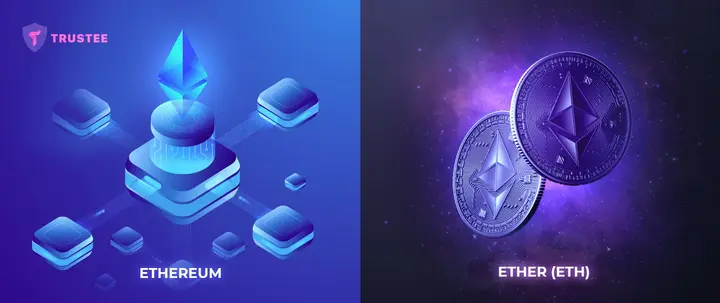
Ether and Ethereum are often used interchangeably, but they are fundamentally different.
Ethereum
Ethereum is a decentralized global platform that allows developers to write code for managing digital assets and create applications accessible from anywhere in the world. With the advent of Ethereum, developers gained the ability to build and deploy decentralized apps.
Ether
Ether (ETH) is the native currency of the Ethereum platform. It acts like a bearer instrument, similar to securities or bonds, and is used as the “currency” within the system. Ether functions like cash—it doesn’t require a third party to validate or authorize transactions.
How do Ethereum and Ether work together?
When digital assets are transferred via Ethereum smart contracts, the transaction requires Ether.
Unlike fiat currencies like the dollar or euro, Ether is 100% digital. It can be stored within the code of a smart contract, which then automatically sends and receives funds. Besides smart contracts, Ether also serves as “fuel” for executing them.
Ether as a Security Layer
Another critical function of Ether is ensuring the security of the Ethereum network. Every time decentralized applications interact with the network, they pay a small fee in Ether. This fee is referred to as “gas” because Ether fuels the platform.
Gas fees prevent harmful applications from slowing down the network through infinite loops. Since launching such apps would be prohibitively expensive, malicious actors are discouraged.
Key Differences Between Ethereum and Ether
| Ethereum | Ether |
|---|---|
| Blockchain-based programmable platform | Cryptocurrency managed by the Ethereum network |
| Cannot be bought or sold | Can be used as payment, bought, and sold |
| Supports multiple decentralized applications | Serves as the primary means for transactions and operations on the blockchain |
How does the Ethereum platform work?
As previously discussed, Ethereum is a public open-source blockchain-based platform that allows developers to create and deploy decentralized applications.
The entire Ethereum system is supported by a global network of nodes. Anyone can download the full Ethereum blockchain to their computer. By becoming a node owner and adhering to the system rules, you can help maintain decentralization and verify consensus within the network.
A node is any computer that has special software installed to access the blockchain network. All nodes exchange information about changes in the network and ongoing transactions.
Ethereum mining

New Ether cryptocurrency coins are created through a process called mining. With the Ethereum 2.0 upgrade, the platform is gradually transitioning from the proof-of-work (PoW) consensus mechanism, used by most cryptocurrencies including Bitcoin, to a proof-of-stake (PoS) algorithm. This method consumes significantly less electricity, making it far more energy-efficient for the planet.
In PoS, users holding larger amounts of Ether are randomly selected to validate transactions. This form of mining — known as forging (or minting) — earns a commission instead of new coins and requires far less power.
Ethereum network difficulty
Each cryptocurrency has a preset average block discovery time managed by the network. As the number of miners increases, the network's hash rate (a unit measuring mining equipment power) also rises, causing the network to gradually increase its difficulty.
How long does it take to mine Ether?
Successful mining in the Ethereum network yields 3 Ether, in addition to all fees from transactions and code execution. On average, mining Ether takes about 12 seconds, compared to approximately 10 minutes for mining a Bitcoin transaction block.
Ethereum Pros and Cons
| Pros | Cons |
|---|---|
| High security and privacy | High volatility |
| Faster than Bitcoin | Expensive transactions |
| Strong development team actively improving stability, security, and scalability | — |
| The only fee charged is blockchain maintenance | — |
| Saves time, money, and effort — no need to develop your own blockchain, just synchronize with Ethereum | — |
How is Ethereum different from Bitcoin and which is better?

Ethereum has established itself as the second-largest cryptocurrency in the world by market capitalization, after Bitcoin.
The blockchain technologies behind Ethereum and Bitcoin are similar. However, while Bitcoin is mainly used for payments, Ethereum is also designed for running smart contracts.
Ethereum’s blockchain not only tracks the ownership of digital currency but also executes program code for various decentralized applications.
- Ethereum enables developers to raise funds for their applications.
- The issuance limit of Ethereum is slightly different from Bitcoin. Ether’s annual release is capped at 18 million coins, which is 25% of the initial supply.
- Transaction valuation in Ethereum is referred to as "gas." The cost of transactions depends on bandwidth use, storage requirements, and complexity. In Bitcoin, transactions compete on equal footing and are limited by block size.
New use cases for Ethereum emerge every day — there are already over 1,000 decentralized applications and many more are expected to be developed, touching all aspects of human activity.
How can Ethereum be used?

Ethereum is not only a platform for deploying smart contracts and supporting DeFi infrastructure. It is also a valuable crypto asset with multiple use cases. How to use Ether is entirely up to you — we’ll explain the most common ones.
As an investment
Ethereum is the second-largest cryptocurrency by market cap, and its price continues to grow, following Bitcoin. Experts believe that the transition to Ethereum 2.0 will further accelerate this growth.
As a payment and settlement system
As Bitcoin's popularity and transaction fees rise while speed decreases, Ethereum becomes a viable alternative for payments. Many goods and services can now be purchased using Ether.
How to earn with Ethereum
Passive income is the dream of every crypto enthusiast. That’s why the developers’ plan to implement staking was widely welcomed.
Ethereum's role as "fuel" for smart contracts and its application in the DeFi ecosystem only strengthen its position and make it even more appealing.
No one knows exactly what lies ahead for Ethereum in 2022, but getting to know this cryptocurrency is certainly worth it.
How to get started with Ethereum
To use this cryptocurrency comfortably, you need a reliable and secure Ethereum Wallet.
Crypto platforms can be divided into centralized and decentralized services.
Centralized services require users to hand over their cryptocurrency to intermediaries. The user transfers private keys and transaction authority to the platform. As a result, assets are no longer under the owner's control.
Drawbacks of exchanges:
-
Complicated user interfaces
-
Mandatory identity verification
-
Risk of hacking and unethical behavior from exchange staff
On decentralized services, users store and manage their cryptocurrency independently, without intermediaries. Key features of such platforms:
-
Users do not transfer keys to the platform, which has no access to their assets
-
Users are not subject to verification and fully control their funds
-
No intermediaries involved
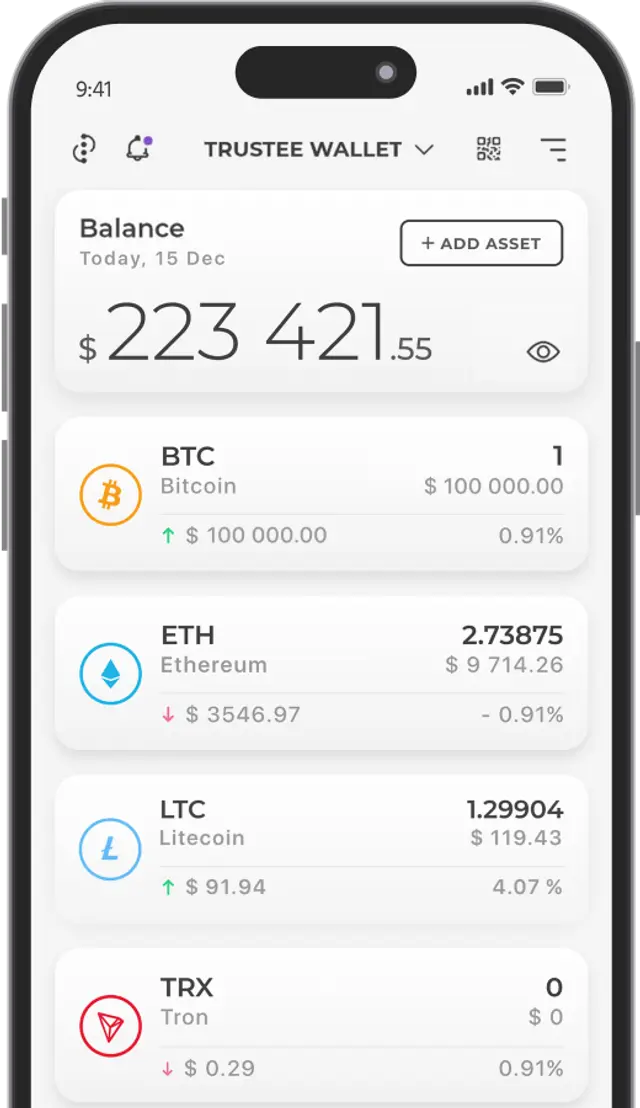
Trustee is the best Ethereum wallet, a decentralized app with cutting-edge technology in this field. It’s an innovative open-source multi-currency crypto wallet that lets you instantly send and receive digital assets using Visa, MasterCard, and payment systems.
How to install an Ethereum wallet
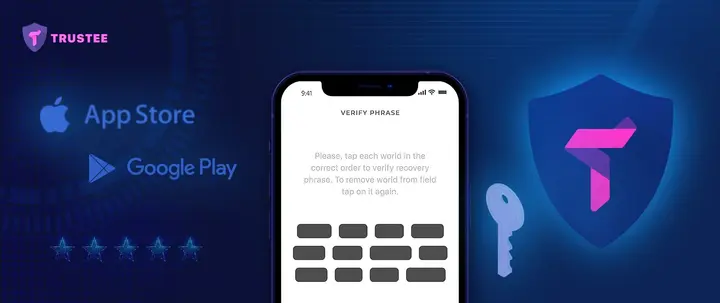
Visit the App Store or Play Market depending on your operating system, download and install the Trustee Wallet app. Creating an Ethereum wallet takes no more than 2 minutes!
How to launch the Ethereum wallet
Upon first launch, Trustee Wallet generates a unique 12/24-word seed phrase. Be sure to write it down and store it securely — this is the only way to restore access to your cryptocurrencies if your phone is lost.
How to buy Ethereum
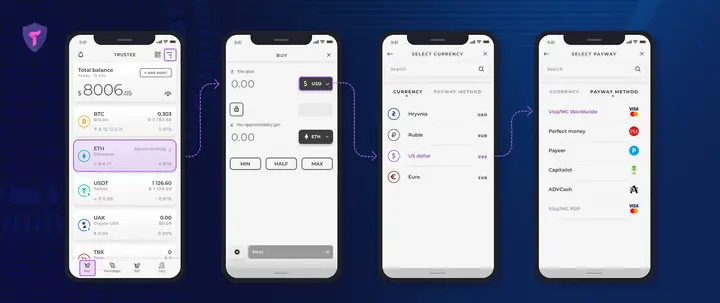
You can fund your Ethereum wallet using a Visa/MasterCard or payment system. To buy Ethereum with a card, just follow these steps:
-
Tap the coin ticker (ETH); the service will redirect you to the "Buy" tab. Alternatively, press the "Buy" button in the bottom left corner of the main screen.
-
Next, select the fiat currency you’re paying with, then specify the amount and choose Ethereum as the cryptocurrency to purchase. The wallet will generate the transaction details.
-
Choose your payment method — your country’s bank card. If this is your first purchase, use the “Add Card” button and enter the required details. Your card will be saved for future transactions.