





























As a cryptocurrency or blockchain network develops, it may become necessary to introduce major changes affecting the rules of the protocol. Depending on the nature of the upgrade, implementing it may require a hard fork.
In this article, we explain what a cryptocurrency hard fork is and why it is needed, how a hard fork differs from a soft fork, and which opportunities and risks such an upgrade may create for a blockchain network and its users.
Key Takeaways
- A hard fork is a change to the consensus rules that is incompatible with the previous version of the protocol. Nodes that have not updated their software may stop accepting blocks produced by the new version of the network.
- A hard fork does not always mean that the blockchain will split or that a new cryptocurrency will be created. When participants upgrade in a coordinated manner, the network may continue operating on a single chain without a lasting division.
- A soft fork tightens the rules in such a way that older nodes continue to consider new blocks valid, even though they do not verify all the additional conditions.
- Hard forks are used to change consensus rules, correct critical errors, introduce new features, alter an economic model or substantially redesign a protocol.
- A contentious hard fork may result in two independent networks, a divided community, increased volatility, replay attacks and fraudulent schemes.


What Is a Cryptocurrency Hard Fork?
Unlike an ordinary centralised application, a blockchain network cannot be fully upgraded by pressing a single button. A decentralised cryptocurrency network is maintained by various participants. Full nodes independently verify blocks and transactions according to the protocol rules, while miners or validators create new blocks and may receive rewards. A coordinated upgrade does not require the literal unanimous agreement of every node, but it does require sufficient support from developers, node operators, miners or validators, wallets, exchanges, payment services and users.
Such changes are known as forks in the cryptocurrency industry. The word fork refers to a point at which something divides into separate paths. The term may be used in several different ways. A source-code fork is a separate software project created from open-source code. A blockchain fork may refer to a temporary or permanent divergence between chains. A protocol fork is a change to the rules of a network. Therefore, a fork is not necessarily a complete copy of a coin and does not always create a new cryptocurrency.
How a Blockchain Hard Fork Works
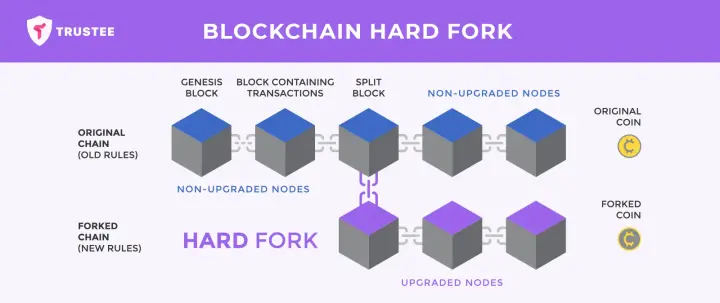
An upgrade is usually activated at a predetermined block height, time or another condition specified by the protocol. Before activation, upgraded nodes continue to operate under the previous rules; after activation, they begin applying the new ones. The relevant block does not necessarily become the “first block of a new blockchain”: when all the principal participants move to the upgraded version, the existing chain simply continues under the new rules.
A contentious hard fork may produce two independent chains with a shared history up to the point of separation. One network continues operating under the previous rules, while the other follows the updated rules. Participants in the old network do not necessarily have to leave it completely. If the old version retains miners or validators, nodes, developers, infrastructure and economic demand, it may continue to exist independently.
A similar situation occurred after the contentious Ethereum hard fork, which divided the network into Ethereum and Ethereum Classic.
What Is the Difference Between a Hard Fork and a Soft Fork?
There are two main types of protocol upgrade — hard forks and soft forks. They are sometimes described as “hard” and “soft” changes, but the principal distinction concerns compatibility with the previous consensus rules rather than the scale of the upgrade.
A soft fork introduces stricter protocol rules under which some blocks or transactions that were previously permitted become invalid. Older nodes do not verify the new restrictions but continue to regard blocks produced by the upgraded network as valid because those blocks comply with the previous, broader set of rules.
A hard fork expands or changes the rules in such a way that blocks produced by the new version may be considered invalid by older nodes. It does not have to be supported by absolutely every participant, but without sufficient technical and economic support, the new version may not become the principal network. If both sides retain support, a hard fork may lead to the creation of two cryptocurrencies. A soft fork may also cause disagreements or temporary divergences, but its backward-compatible structure generally reduces the likelihood of a lasting network split.
Planned and Contentious Hard Forks
Hard forks may be planned, emergency or contentious upgrades.
For a planned upgrade, participants receive the new software version in advance and prepare to activate it at the announced time. If a sufficient number of infrastructure operators support the new rules, the network continues operating without a lasting split. On Proof-of-Work networks, hash rate and economic support are important to the viability of a separate branch. On Proof-of-Stake networks, the validator share, finality rules, liquidity and support from users and services are significant.
Contentious or emergency hard forks, such as the upgrade introduced after the attack on The DAO, may divide the community. This can produce two functioning networks, each developing under its own rules and supported by its own group of users, developers and infrastructure companies.
Why Is a Hard Fork Needed?
A cryptocurrency hard fork is primarily a method of introducing non-backward-compatible changes required for development, restoring security or altering the operating principles of a blockchain network.
A hard fork may be used for the following purposes:
- Correcting network errors — a critical vulnerability or consensus error may require a rule change that older nodes cannot process correctly. In such a case, the developers and community may agree to conduct a hard fork.
- Adding new features — for example, introducing new smart-contract capabilities, changing the transaction format, replacing the consensus algorithm, modifying the economic model or altering block-production rules.
Who Can Initiate a Fork?
Many cryptocurrencies, including Bitcoin, have open-source code, so any developer can examine it, modify it and create a new software version or separate network. However, copying the code is considerably easier than establishing a secure, decentralised and economically sustainable cryptocurrency with users, miners or validators and the necessary infrastructure.
Well-known projects created from or using Bitcoin’s code include Litecoin and Dash. Litecoin was created as a separate project based on the Bitcoin codebase without splitting its active chain, while Dash was originally derived from the Litecoin codebase. It is therefore more technically accurate to describe them as source-code forks or derivative projects rather than coins created by a hard fork of the Bitcoin blockchain. Their rankings, market capitalisations and prices change continuously, so current figures should be checked directly through market-data services.
Initiating a Hard Fork
Any developer or community member may propose a hard fork or soft fork. In practice, initiators are often development teams, researchers, foundations, mining pools, validators, companies or groups of users. However, initiating a discussion is not sufficient: for an upgrade to become part of the network in use, its code must be prepared and tested, and the support of a substantial part of the ecosystem must be secured.
To conduct a hard fork successfully, a sufficient number of participants must be convinced of the necessity and safety of the changes. The history of cryptocurrency shows that disagreements over scalability, governance, economic models or responses to emergencies have frequently led to contentious hard forks and the emergence of new networks.
The best-known cryptocurrencies created as a result of a split in the Bitcoin blockchain are Bitcoin Cash and Bitcoin Gold. Each of them is an independent network rather than an upgraded version of BTC.
How Does a Hard Fork Affect a Cryptocurrency’s Price?
There is no clear and consistently recurring relationship between a hard fork and a change in the price of a cryptocurrency. The market’s response depends on the reasons for the upgrade, its technical quality, the level of community support, the behaviour of exchanges, liquidity, general market conditions and investor expectations.
A positive response from participants and important changes that improve a network’s security or utility may support demand for the asset. However, price growth is not guaranteed. Uncertainty before the upgrade, the division of liquidity and disagreements over which chain should be regarded as the principal one may cause increased volatility both before and after the hard fork.
Advantages and Disadvantages of a Cryptocurrency Hard Fork
The consequences of a hard fork may improve a cryptocurrency’s security, performance and functionality, but they may also cause technical failures, divide the community, create market instability and introduce additional risks for users.
Advantages of Hard Forks
- Fundamental changes to the network protocol that are required for the cryptoasset’s development. During a coordinated upgrade, users, validators, miners and services move to the new version, while the previous version is no longer supported and stops producing blocks.
- Improved network performance and changes to its operating conditions — increased throughput, revised reward rules and optimised transaction verification and node interaction.
- Correction of critical errors, changes to consensus rules and stronger security mechanisms.
- Some users regard a contentious hard fork as an opportunity to receive assets on both networks. When chains split and both survive, the ledger state before the fork is copied to both versions. The owner of the private keys may be able to control the corresponding coins on each network. However, this does not double their value: the new assets may have no liquidity or market value, and claiming them may involve replay attacks, compromised keys and fraud.
Disadvantages of Hard Forks
- When non-backward-compatible changes are introduced, it is difficult to predict in advance how the upgrade will affect the network and which branch will receive the greatest technical and economic support. Critical errors may be discovered in the new code. A blockchain cannot simply be restored to a previous state by the decision of a single administrator, although the community may agree to an additional upgrade or emergency fork to correct the problem.
- A hard fork may divide the community into supporters and opponents of the changes. Even when the upgrade is supported by most participants, the old network may continue to exist if it retains a sufficient number of operators, developers and users. Dividing the hash rate, stake, liquidity and infrastructure may reduce the security of both chains.
- A hard fork may cause volatility in the asset, potentially resulting in financial losses for market participants.
Popular Cryptocurrency Hard Forks
During a contentious hard fork, a blockchain may divide into two versions operating under the old and new rules. If both branches receive sufficient technical and economic support, they continue to exist as independent networks. During a coordinated planned upgrade, a separate chain does not usually survive.
Bitcoin Hard Forks
Throughout the history of Bitcoin, numerous alternative implementations and contentious upgrades have been proposed and launched. Bitcoin XT, which appeared in 2015, was an alternative software version proposing an increase in the maximum block size. The project did not receive sufficient support to create a lasting split in the main network and did not become the first successful Bitcoin hard fork with its own viable coin.
-
Bitcoin Cash (BCH) is the best-known cryptocurrency to have emerged from the Bitcoin hard fork on 1 August 2017. The split followed prolonged disagreements over scalability, block size and the role of SegWit. Bitcoin Cash supporters increased the permitted block size and continued operating on a separate network.
In November 2018, the Bitcoin Cash network itself divided into two principal branches — Bitcoin Cash and Bitcoin SV. In November 2020, another contentious hard fork took place between the Bitcoin Cash Node and Bitcoin ABC software implementations. The Bitcoin Cash Node chain retained the principal Bitcoin Cash name and BCH ticker, while the separated Bitcoin ABC network was subsequently renamed eCash and uses the XEC ticker. The price, market capitalisation and position of BCH in cryptocurrency rankings change in real time, so fixed figures quickly become outdated and should be checked through market-data services.
- Bitcoin Gold (BTG) is a cryptocurrency that emerged from a Bitcoin hard fork in October 2017. The project aimed to make mining more accessible to owners of graphics processing units and reduce dependence on specialised hardware, initially using the Equihash algorithm. The project’s slogan was “make Bitcoin decentralised again”. The market price and position of BTG in rankings change continuously.
- Bitcoin Diamond (BCD) is a separate network that appeared after a Bitcoin hard fork in November 2017. The project claimed to offer greater throughput, an expanded supply and additional data-protection mechanisms. However, these features do not provide complete transaction anonymity. The price, market capitalisation and ranking of BCD are dynamic figures and should be checked at the time of publication.
Ethereum Hard Forks
Numerous hard forks and network upgrades have taken place during the development of Ethereum. One of the first major planned hard forks was Homestead, which was activated in March 2016, less than a year after the launch of the main network. The upgrade moved Ethereum from the experimental Frontier stage to a more stable version, introduced protocol changes and removed the canary contracts mechanism, which had allowed a limited group of developers to signal an emergency.
Ethereum Classic
One of the most contentious events in Ethereum’s history occurred in 2016. The DAO was a decentralised investment organisation operating through Ethereum smart contracts. A vulnerability in its code allowed an attacker to transfer more than 3.6 million ETH, which was valued at approximately 50-60 million US dollars at the time.
The transferred assets were held in a child DAO and could not be spent immediately because of a waiting period specified by the contract. This gave the community time to discuss possible action. A contentious Ethereum hard fork was introduced to recover the funds, changing the network state and moving the assets into a recovery contract. Some participants refused to accept this intervention and continued supporting the previous chain.
The network that accepted the state change retained the Ethereum name and ETH ticker, while the chain that continued operating under the previous rules became known as Ethereum Classic and uses the ETC ticker. Ethereum Classic therefore preserves the history of the original chain without applying the DAO fork, but the two networks share a common history up to the point of separation and have developed independently ever since.
Byzantium, Constantinople, London and The Merge
Unlike contentious Bitcoin hard forks that resulted in separate coins, many Ethereum upgrades were implemented as planned and did not create a lasting competing chain because they received broad support from the ecosystem.
Several important planned Ethereum hard forks have been conducted during the network’s history:
- Byzantium was an upgrade activated in October 2017. It introduced new cryptographic capabilities, including precompiled contracts for zk-SNARK proofs, reduced the block reward from 5 to 3 ETH and delayed the “difficulty bomb” — a mechanism designed to make Proof-of-Work mining progressively more difficult.
- Constantinople was activated together with St Petersburg on 28 February 2019 after being postponed because of a discovered vulnerability. It optimised the execution of certain Ethereum Virtual Machine operations, improved smart-contract capabilities, reduced the block reward from 3 to 2 ETH and postponed the difficulty bomb again.
- London was an Ethereum upgrade activated on 5 August 2021. It introduced EIP-1559: the protocol began calculating a base fee for every block, which is automatically burned, while users may add a priority fee for the validator, or at that time the miner, where necessary. The upgrade changed the fee market and the economics of ETH issuance but did not make the cost of every transaction fixed.
These hard forks, together with consensus-layer upgrades including Altair, prepared Ethereum for its transition to Proof-of-Stake. The term Ethereum 2.0 was previously used to refer to a collection of future changes, but the community later adopted the concepts of the execution layer and consensus layer because the upgraded network remained the same Ethereum.
- On 15 September 2022, the relevant part of the Paris upgrade, known as The Merge, was activated. Ethereum discontinued Proof-of-Work mining on the main network and moved to Proof-of-Stake by combining the existing execution layer with the Beacon Chain. The transition did not create a new ETH coin for users and did not require existing assets to be exchanged.
Cardano Hard Forks
Cardano is positioned as a blockchain platform with a staged roadmap and a formalised approach to upgrades. Through its Hard Fork Combinator mechanism, the network can move between protocol versions without creating a separate chain or new coin. The old and new rules are incorporated sequentially into the history of a single network, provided that the upgrade is supported by the necessary infrastructure.
- Shelley was a major Cardano upgrade activated in July 2020. It began the transition towards more decentralised block production, expanded staking functionality and moved the network from the Ouroboros Classic protocol of the Byron era to Ouroboros Praos.
- Mary was a Cardano hard fork activated on 1 March 2021. It introduced support for native assets and allowed users to create their own tokens directly at ledger level without necessarily using smart contracts.
- Alonzo was an upgrade activated on 12 September 2021 as part of the Goguen era. It introduced support for Plutus smart contracts and made it possible to build decentralised applications on the network.
- Vasil was a protocol upgrade activated on 22 September 2022. It introduced the CIP-31, CIP-32, CIP-33 and CIP-40 mechanisms, improved the operation of Plutus scripts, collateral processing and node synchronisation, and prepared throughput optimisations through diffusion pipelining.
- Chang was a hard fork activated on 1 September 2024. It launched the Conway era and the first part of the CIP-1694 governance system, expanding the participation of ADA holders in decision-making.
- Plomin was an upgrade activated on 29 January 2025. It enabled the remaining decentralised governance mechanisms, including the role of delegated representatives and the full set of specified governance actions.
Cardano’s upgrades have simplified the development and deployment of dApps, expanded the capabilities of Plutus, improved the use of data and scripts in transactions and established network-governance mechanisms. However, the actual performance of an application depends not only on the protocol version but also on the quality of its smart contracts, its dApp architecture and the current network load.
Conclusion
A hard fork may have unexpected consequences for a cryptocurrency, including a divided community, the emergence of a competing network, technical errors and volatility. However, its principal purpose is to develop the protocol, correct critical problems and introduce capabilities that cannot be made compatible with the previous rules. The outcome of a hard fork therefore depends not on the fact that an upgrade has taken place, but on the quality of its development, testing, participant coordination and practical benefits.
Frequently Asked Questions About Hard Forks
Does a Hard Fork Always Create a New Cryptocurrency?
No. If the principal participants move to the new version in a coordinated manner, the blockchain continues operating as a single chain and the old version stops producing blocks. A new cryptocurrency appears only when a lasting split occurs and part of the community continues supporting the previous rules.
What Happens to a User’s Coins During a Hard Fork?
During a coordinated upgrade, a user’s balance does not usually change. If two independent chains emerge, the ledger state before the point of separation exists on both networks. The owner of the private keys may potentially gain access to the corresponding assets on each chain but must consider wallet support, replay protection and the risk of fraud.
Does a User Need to Do Anything Before a Hard Fork?
This depends on the particular upgrade and the way in which the assets are stored. Users should check official announcements from their wallet or exchange, ensure that they have a backup of their seed phrase and temporarily avoid transfers during a contentious split. A private key or seed phrase must never be entered on an unknown website to claim new coins.
Can a Hard Fork Reverse or Change Previous Transactions?
An ordinary planned hard fork changes the rules applied after the activation point and does not rewrite the previous history. However, an emergency upgrade could theoretically include a special state change, as occurred after the attack on The DAO. Such a decision requires extensive coordination and may cause serious disagreement.
Which Is Safer — a Hard Fork or a Soft Fork?
Neither type of upgrade can be considered unconditionally safer. A soft fork preserves backward compatibility, but errors in the new rules can still affect the network. A hard fork requires more complex coordination and carries the risk of a split, but it may be necessary for changes that cannot be implemented through a soft fork. Safety depends on code quality, testing, support and the activation plan.