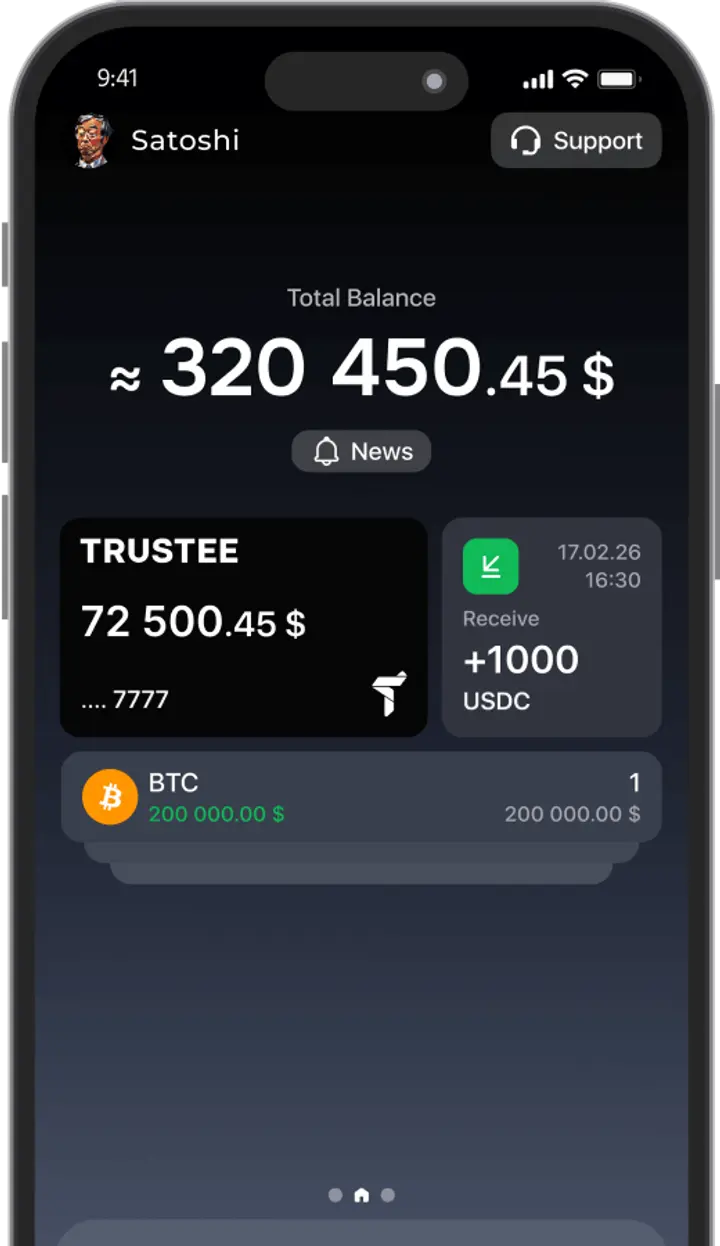






























Choosing a wallet isn’t just about convenience — it’s a critical decision that affects the security of your assets. Should you entrust your private keys to a third-party service, or is it better to have full control over your funds?
Cryptocurrency wallets come in two main types: custodial and non-custodial.
In this article, we’ll explore the key differences, advantages, and risks of both wallet types, as well as compare the features of Trustee Plus and Trustee Wallet. This will help you make the right choice.
Key Takeaways
- The main difference between a custodial and a non-custodial wallet is who controls the private keys: the service provider controls them in a custodial wallet, while the user controls them in a non-custodial wallet.
- Custodial wallets are generally easier for beginners, may provide account recovery and are convenient for regular transactions, but users depend on the platform, its rules and its security.
- Non-custodial wallets provide full control over cryptocurrency and independence from intermediaries, but the user is personally responsible for protecting the seed phrase, private keys and device.
- Access to a custodial wallet may sometimes be restored through support and identity verification, whereas a lost seed phrase for a non-custodial wallet usually cannot be recovered.
- The right choice depends on experience, intended use and willingness to accept responsibility: Trustee Plus is suitable for users who value convenience and account recovery, while Trustee Wallet is designed for those who want independent control of their assets.


Key Differences Between Custodial and Non-Custodial Wallets
Level of Control Over Private Keys
A private key is the core element of cryptocurrency management. In custodial wallets, users don’t have access to it because the keys are stored with the provider, which controls access to the assets. This simplifies account recovery in case of lost access but also creates dependence on the service.
In non-custodial wallets, private keys are generated on the user’s device and never leave it. The owner receives a seed phrase (BIP-39) or a key file, which they must store themselves. Losing this data means irreversible loss of funds, as there’s no backup mechanism from the provider.
Security Level
Custodial wallets are protected by multi-layered security mechanisms, including cold storage, two-factor authentication (2FA), and suspicious transaction detection systems. However, these services are centralized, making them potential targets for hacker attacks. If an exchange or platform is compromised, users may lose access to their funds.
Non-custodial wallets, on the other hand, eliminate centralized attacks since private keys are stored only by the user. However, security depends entirely on the protection of the device where the wallet is stored.
Ease of Use
Custodial wallets are often integrated with crypto exchanges and financial platforms, enabling quick trading, exchanging, and withdrawing funds. Not having to manage private keys simplifies usage for beginners, and account recovery support enhances convenience.
Non-custodial wallets provide autonomy but require more responsibility from the user. They must understand blockchain and token rules and be able to resolve transaction issues independently. This complicates the process, especially for frequent transactions.
Risks of Custodial Wallets
- Platform compromise – Hacker attacks on exchanges or services can lead to loss of user funds.
- Regulatory restrictions – Authorities may freeze accounts or require verification, limiting access to funds.
- Bankruptcy or fraud – If the service shuts down or turns out to be dishonest, funds may be lost.
- Limited control – Users don’t have access to private keys and fully depend on the platform.
Risks of Non-Custodial Wallets
- Loss of private key or seed phrase – If recovery data is lost, access to funds cannot be restored.
- Phishing attacks and malware – Fraudsters can steal private keys through fake websites or viruses.
- User errors – Incorrect address input or signing a suspicious transaction may result in asset loss.
- Device hacking – If a computer or smartphone is compromised, attackers may gain access to the wallet.
Custodial Wallet: Trustee Plus
Trustee Plus is a custodial cryptocurrency wallet that allows users to store, buy, and exchange crypto without managing private keys themselves.
Technical Features and Operation
Trustee Plus operates on a centralized storage principle: all funds are held by the service, and users access them via a mobile app. If account access is lost, it can be restored through verification, significantly reducing the risk of fund loss.
The platform uses multi-layered protection, including 2FA, transaction monitoring, and cold storage for most assets. This ensures that even in case of potential threats, the majority of funds remain inaccessible to attackers.
Non-Custodial Wallet: Trustee Wallet
Trustee Wallet is a cryptocurrency wallet for those who want full control over their assets without intermediaries. Unlike the custodial Trustee Plus, it doesn’t store user private keys — they remain solely with the owner.
How Trustee Wallet Works
When you create a wallet, the system generates a seed phrase (BIP-39) — the only key to your funds. It cannot be recovered through support or the platform, so all responsibility lies with the user. The wallet interacts directly with the blockchain, without intermediary services, enhancing independence, privacy, and personal accountability.
Conclusion
The choice between the custodial Trustee Plus and the non-custodial Trustee Wallet depends on your needs, technical expertise, and approach to security.
If convenience, quick access recovery, and minimal risk of losing funds due to errors are important to you, then Trustee Plus is the optimal choice. It’s ideal for those who want to securely store crypto without managing private keys and for users who frequently conduct financial operations or value integration with bank cards.
If full autonomy, independence from services, and control over your assets are your priorities, then Trustee Wallet is the better option. It’s perfect for experienced users and those willing to responsibly store their seed phrase without relying on third-party services.
Frequently Asked Questions About Custodial and Non-Custodial Wallets
What is the difference between a custodial and a non-custodial wallet?
In a custodial wallet, the service provider stores and controls the private keys, while the user accesses the assets through an account. In a non-custodial wallet, the private keys are created and stored on the owner’s device, so only the owner controls the cryptocurrency and is responsible for restoring access.
Which type of crypto wallet is safer?
Both types of wallet involve different risks. The security of a custodial wallet depends on the platform’s protection, the way it stores reserves and the security of the user’s account. A non-custodial wallet has no single platform controlling the private keys, but funds may still be lost through phishing, malware, a compromised device or exposure of the seed phrase.
Can access to a crypto wallet be recovered?
Access to a custodial wallet can often be restored through customer support, identity verification or another recovery procedure offered by the service. A non-custodial wallet requires a seed phrase, private key or another supported backup file. If these details are lost and the active wallet is no longer accessible, recovering the funds is usually impossible.
Who should use a custodial wallet?
A custodial wallet may be suitable for beginners and users who value a simple interface, account recovery, cryptocurrency purchases, exchanges and regular transactions within one application. Users should nevertheless consider their dependence on the service’s rules, possible identity verification, transaction restrictions and the platform’s security.
Who should use a non-custodial wallet?
A non-custodial wallet is suitable for users who want to control their private keys independently and avoid relying on a third-party service to hold their assets. This option requires an understanding of blockchain transactions, caution when signing operations and secure offline storage of the seed phrase.