

























While the whole world eagerly follows Bitcoin’s rises and falls or tries to guess which investment fund will launch the next crypto ETF, many strong and mature projects remain in the shadow of all this noise. Tabloids do not write about them every day and social media does not constantly hype them up — they simply keep doing their job year after year. One such project is Litecoin: quiet, reliable, and time-tested, like a Swiss watch.
Let’s look at the history of Litecoin, its technical features, real-world use of the LTC cryptocurrency, and a comparison with Bitcoin.
Key Takeaways
- Digital silver with real value: Litecoin is not just another Bitcoin fork, but a clearly positioned asset (“digital silver”) that has served as a fast and low-cost payment method for more than 14 years, complementing Bitcoin’s “digital gold” role.
- Speed, cost, and reliability: the key technical advantages of LTC are a 2.5-minute block time (4× faster than BTC) and very low fees (< $0.10). This makes it ideal for everyday payments and international transfers. The network has never been hacked throughout its entire history.
- Functional evolution: the project does not stand still. SegWit, Lightning Network support, and optional MWEB privacy expand the network’s capabilities, and the LitVM announcement (2026) promises to turn it into a platform for DeFi and NFT.
- The key 2026 catalyst: the most anticipated event is the launch of LitVM (Litecoin Virtual Machine) in the first half of 2026, which is expected to add smart contract functionality to LTC. Although historically the market does not always react strongly to upgrades, this update could become a key growth driver.
- An asset for a conservative portfolio: Litecoin is a choice for those looking for a time-tested, liquid, and relatively stable crypto asset without expecting an instant “10x” — unlike high-risk meme tokens.
History of Litecoin (LTC)
The idea
Litecoin appeared in September 2011. It was created by former Google engineer Charlie Lee, who was inspired by the potential of the crypto industry. The goal was to create a cryptocurrency that would become “digital silver” as a counterbalance to Bitcoin’s “digital gold”.
Genesis block
On 7 October 2011, Charlie Lee created the litecoin-project/litecoin repository on GitHub and published the Litecoin source code (version 0.1.0) — one of the earliest Bitcoin forks. On the same day, the Litecoin genesis block was generated, although the public network launch was still a few days away.
Bitcointalk
On 9 October 2011, on the legendary Bitcointalk forum, Charlie Lee published the announcement of Litecoin and posted a “technical manifesto”, presenting the project’s idea to everyone interested: Bitcoin is a store of value for long-term investment, while Litecoin is a fast and low-cost tool for everyday payments and transfers. To improve on BTC, Charlie Lee introduced a number of changes — a block every 2.5 minutes (vs 10 minutes), the Scrypt algorithm (vs SHA-256), and a maximum supply of 84 million (vs 21 million).
Mining
On 13 October 2011, the Litecoin client v0.8.7 became publicly available, marking the official start of the network. The initial block reward was 50 LTC.
In turn, Litecoin’s Scrypt algorithm was optimised for RAM, which made it possible to mine even on home PCs and laptops — and made network participation more accessible to ordinary users.
Listing
On 9 November 2011, Litecoin first appeared on the BTC-e exchange, where the starting price was $0.03 per coin. For comparison, Bitcoin at that time cost around $3 — meaning you could buy roughly 100 LTC for 1 BTC.
Since then, Litecoin has established itself as one of the most reliable cryptocurrencies. Over more than 14 years of operation, the network has not experienced outages, serious delays, or hacks. This stability has ensured LTC a steady presence near the top of the CoinMarketCap rankings. Today, Litecoin ranks 21st by market capitalisation among thousands of other crypto assets.
Technical features and the Litecoin blockchain
Consensus algorithm
Litecoin, like Bitcoin, runs on Proof-of-Work (PoW), but has one key difference — it uses a different hashing mechanism. Bitcoin uses SHA-256, while Litecoin uses Scrypt.
ASIC resistance
The choice of Scrypt was not accidental: Charlie Lee wanted to make mining accessible to ordinary users with graphics cards, not only to owners of expensive ASIC hardware. Over time, Scrypt ASICs emerged, so “everyday” mining stopped being relevant. However, the algorithm difference remained, allowing miners to combine mining of LTC + Dogecoin, where one ASIC mines both coins at the same time.
Transaction speed
One of Litecoin’s key advantages is faster and cheaper transactions compared with Bitcoin.
Litecoin vs Bitcoin
|
Parameter |
Bitcoin |
Litecoin |
|
Block time |
~10 minutes |
~2.5 minutes |
|
Confirmation speed |
10–60 minutes |
2.5–15 minutes |
|
Average fee |
$1–5 |
$0.01–0.10 |
|
Maximum supply |
21m BTC |
84m LTC |
- Speed: Litecoin processes transactions four times faster than Bitcoin — sometimes almost instantly. It is an ideal solution for paying, for example, for a coffee.
- Cost: Litecoin transaction fees are minimal. A great option for small payments, transfers, and everyday spending.
- Supply: 84 million Litecoin coins in circulation versus 21 million Bitcoin makes LTC more appealing to beginners. Because of its lower price, Litecoin can feel more accessible, although what really matters is market capitalisation.
Security and decentralisation
- Network hashrate: ~2.84 PH/s (peta-hashes per second) as of 2026. This is enough to protect against 51 % attacks, but far lower than Bitcoin (~875.96 EH/s).
- Decentralisation: Litecoin has more than 10,000 active nodes, providing censorship resistance and network resilience.
- Stability: over 14+ years, the Litecoin blockchain has operated without serious outages or attacks. It is one of the most reliable projects in the industry.
Major upgrades (forks)
2017 — SegWit (Segregated Witness)
Litecoin was the first top cryptocurrency to activate SegWit — even before Bitcoin.
This upgrade:
-
- increased network throughput
- reduced fees
- fixed transaction malleability
- laid the foundation for the Lightning Network
2018 — Lightning Network
Lightning Network support made it possible to run near-instant Litecoin microtransactions with minimal fees via second-layer (Layer 2) payment channels.
2022 — MWEB (MimbleWimble Extension Blocks)
Many people do not realise this, but in 2022 developers added optional transaction privacy to Litecoin. This most recent major upgrade allowed users to send LTC via MWEB blocks, hiding amounts and addresses from third-party observers.
The key difference from Bitcoin
Bitcoin is positioned as “digital gold” — a store of value, inflation hedge, and long-term investment.
Litecoin is “digital silver” and a payment coin for everyday use.
Focus on:
-
- fast transactions
- low fees
- practical use in payments
LTC cryptocurrency: use cases and economics
Where Litecoin is used:
-
Payments. Thousands of online and offline shops accept Litecoin cryptocurrency for payments:
-
-
- Newegg (electronics)
- Travala (hotel bookings)
- CheapAir (air tickets)
- Bitrefill (mobile top-ups, gift cards)
-
-
Transfers. Thanks to low fees and speed, LTC is often used for international transfers, especially when you need to send funds without banking delays.
-
Trading. LTC is one of the most liquid cryptocurrencies. It is available on all major exchanges with popular pairs:
-
-
- LTC/BTC
- LTC/USDT
- LTC/USDC
-
How to buy and store Litecoin
You can buy Litecoin cryptocurrency via crypto exchanges (both CEX and DEX), exchange services, or crypto wallets with a built-in purchase function. For secure storage, it is best to use non-custodial wallets or hardware solutions with full control over private keys.
- Buying:
Centralised exchanges (CEX): Binance, Bybit, Coinbase, Kraken
Decentralised exchanges (DEX): Uniswap, PancakeSwap. It is important to understand that this will be wrapped wLTC.
Exchange services: Changelly, Changenow, Crypto.com.
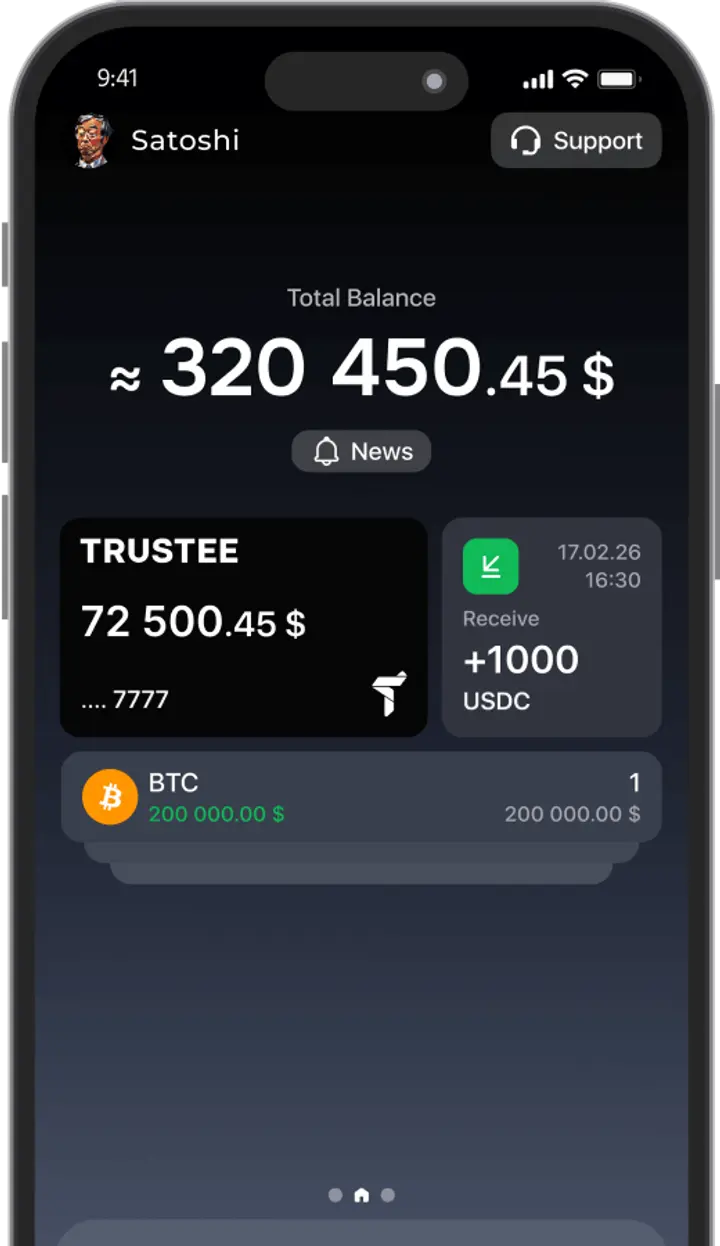
Crypto wallets: the non-custodial wallet Trustee Wallet — via Smart Swap in the “Swap” menu, or Trustee Plus — a licensed custodial wallet with a built-in exchange for convenient LTC↔EUR conversion.
- Storage:
Hardware wallets:
-
- Ledger Nano S/X
- Trezor Model One/T
- SafePal S1
Mobile wallets:
-
- Trustee Wallet — a non-custodial wallet with LTC support, a user-friendly interface, and full key control
- Exodus
- Atomic Wallet
Desktop wallets:
-
- Litecoin Core — official, full node
- Electrum-LTC — lightweight wallet
Custodial solutions:
-
-
Trustee Plus — for convenient storage with fast conversion and payments
-
Litecoin tokenomics
-
- Total supply: 84,000,000 LTC
- In circulation (as of 2026): ~76.8–76.9m LTC (~91 % of max supply)
- Block reward (current): 6.25 LTC
- Halving: every ~4 years (840,000 blocks)
Inflation model:
Like Bitcoin, Litecoin has a deflationary model — the number of new coins decreases with each halving. Inflation gradually approaches zero, and all LTC will be mined roughly by 2142.
After the maximum supply is reached, miners will earn income only from Litecoin transaction fees.
Halving schedule:
-
- 2015: 50 → 25 LTC
- 2019: 25 → 12.5 LTC
- 2023: 12.5 → 6.25 LTC
- 2027: 6.25 → 3.125 LTC
Pros and cons of Litecoin
|
Pros |
Cons |
|
High speed — confirmations in 2.5 minutes |
Lower popularity compared with Bitcoin |
|
Low fees — $0.01–0.10 per transaction |
Strong correlation with BTC — price often moves in line with Bitcoin |
|
Reliability — 14+ years without major disruptions |
Trust issue around the creator — Charlie Lee sold all his LTC in 2017, which drew criticism |
|
High liquidity — available on all major exchanges |
Competition — many other “payment” coins (XRP, XLM, BCH) |
|
Strong community — active developers and community |
Limited functionality — no smart contracts, DeFi, NFT |
|
Proven technology — a Bitcoin fork with tested code |
Mining centralisation — dominance of large pools |
|
Lightning Network support — instant microtransactions |
Lack of headline-grabbing innovation — conservative development |
|
MWEB (MimbleWimble Extension Blocks) for privacy — optional anonymity |
Blurred positioning — created as a “fast payment method”, but now loses on speed and fee costs to modern L1 networks (Solana, SUI) |
Litecoin outlook and development
Roadmap and current work
Since launch, the Litecoin network has gone through 3 major upgrades (forks), the latest of which took place in 2022 and was called MWEB (MimbleWimble Extension Blocks). This upgrade added the ability to make private transactions to LTC functionality, which drew criticism from some market participants who saw risks of breaching anti-money laundering (AML) requirements.
After the 2022 launch, the team continues to optimise MWEB, increasing its relevance in today’s crypto environment:
-
- improving UX for users
- integration into popular wallets
- growing adoption among exchanges
However, any discussion of Litecoin’s prospects would be incomplete without mentioning LitVM (Litecoin Virtual Machine) — the largest technological upgrade in Litecoin’s history, scheduled for the first half of 2026. It turns “digital silver” from a simple payment network into a full smart-contract platform.
As a result, very soon we may see financial tools on the Litecoin blockchain such as DeFi, NFT, RWA, and support for AI integration.
Integration with payment systems
LTC was created as a payment instrument from the start, so the Litecoin Foundation actively develops this direction:
-
- partnerships with payment processors
- integration into POS terminals
- support for crypto cards
Litecoin’s vision of the future is fast and low-cost transactions, deep integration with payment infrastructure, business support, and expanding real-world use cases.
Lightning Network
A significant contribution to popularising Litecoin as a payment method comes from the development of the Lightning Network. That is why increasing the number of nodes and payment channels to scale micropayments is one of the key tasks for developers and community enthusiasts. The more nodes and channels — the faster, cheaper, and more stable payments become.
The Litecoin Foundation wants LTC to be accepted everywhere it is technically possible, so the team consistently:
-
- builds cooperation with payment services
- integrates LTC into POS terminals for offline payments
- works on developing crypto cards for everyday use.
This forms Litecoin’s applied philosophy — not “revolution for revolution’s sake”, but creating a digital asset and consistently integrating it into real payment infrastructure.
Analytical view: what affects the LTC price?
Typically, Litecoin follows Bitcoin’s movements: when BTC rises, LTC follows; when BTC falls, LTC also falls. However, if we exclude simply mirroring BTC market dynamics, historically Litecoin’s price has tended to rise 6–12 months before a halving due to expectations of reduced supply.
In addition, announcements about collaborations with other crypto projects or integrating LTC into new payment systems or major retailers can have a positive impact on Litecoin’s price.
Other factors that affect Litecoin’s price include planned upgrades (forks), although, unfortunately, they do not always trigger the market reaction people expect. For example, in 2022, when the Litecoin team launched the long-awaited MWEB upgrade, the LTC price did not increase significantly — at that time, the market was dominated by bearish sentiment and an overall downturn.
We are now awaiting the largest technological upgrade in Litecoin’s history — LitVM (Litecoin Virtual Machine), planned for the first half of 2026. It is reasonable to assume it could trigger a local price pump for LTC, but current sentiment in the crypto community looks very similar to what it was in 2022. Therefore, unfortunately, a repeat of the negative scenario cannot be ruled out.
Conclusion
Litecoin is a time-tested, reliable crypto asset for fast and low-cost transactions. The project does not (yet) aim for mega-functionality or radical innovation, but it has been consistently fulfilling its purpose for more than 14 years.
Who may find LTC useful:
-
- Investors — who want conservative assets in their portfolio;
- Users — for fast payments with minimal fees;
- Beginners — easy to understand and start a crypto journey;
- Merchants — to accept online and offline payments via POS terminals.
When choosing Litecoin for investment, you should not expect it to make you a millionaire overnight. This is not a meme token that “does a 10x” and then disappears from the radar in an instant. It is a classic, reliable, old-school crypto asset that has earned the title of “silver” in the world of virtual assets over decades.
FAQ (frequently asked questions)
- What is the key difference between Bitcoin and Litecoin?
Bitcoin is positioned as “digital gold” — a tool for saving and inflation protection. Litecoin, as “digital silver”, is designed for everyday use: it has a block time 4× faster (2.5 minutes vs 10 minutes) and significantly lower transaction fees.
- What can Litecoin (LTC) be used for today?
LTC is ideal for fast, low-cost international transfers, paying for goods (for example, at Newegg or Travala) and services (mobile top-ups via Bitrefill). It is a convenient payment method for everyday spending.
- Does Litecoin have anonymous transactions?
Yes. Since the MWEB (MimbleWimble Extension Blocks) upgrade in 2022, Litecoin has optional privacy. Users can send transactions that hide the amount and addresses from third-party observers, but it is not a mandatory mode for all operations.
- What is LitVM and why does it matter?
LitVM (Litecoin Virtual Machine) is the largest technological upgrade for Litecoin, planned for 2026. It will add smart contract support, opening up DeFi (decentralised finance), NFT, and other advanced financial tools, turning Litecoin from a payment system into a full blockchain platform.
- Is it worth investing in Litecoin ahead of the halving?
Historically, Litecoin’s price has often risen 6–12 months before a halving (the next one is in 2027) due to expectations of reduced new-coin supply. However, it is important to remember that LTC strongly correlates with Bitcoin, so its price depends not only on its own fundamentals, but also on the broader market.