


























“Blockchain is dead. Long live blockchain!”
This phrase echoes the famous French expression “The King is dead. Long live the King!”, which symbolised not the end of the monarchy, but the beginning of a new stage in its existence.
But each time, history repeats itself. After another round of “funerals”, a new growth stage begins. It is not only the value of digital assets that increases, but also public interest, the number of users, investment in infrastructure and the real adoption of blockchain technology in finance, logistics, digital identity, government services and other sectors.
However, this time the changes are much deeper. If the crypto industry used to fight for users’ attention, it is now gradually giving up its own visibility. Blockchain is not dying. What is dying is the need to know that it exists at all.
This is exactly what the next stage of internet evolution is about: the transition from Web2 to Web3.
Key Takeaways
-
- Blockchain is not dying — it is becoming invisible. The next stage of Web3 development is not about users seeing the word “blockchain” more often, but about the technology working in the background as naturally as internet protocols or electricity.
- Mass adoption of cryptocurrencies requires simplicity. As long as users have to understand gas fees, networks, bridges, token standards and transaction errors, crypto remains difficult for a broad audience.
- Gas Fee must disappear from the user experience. Fees should be built into the service, paid with any convenient asset or charged invisibly, without alarming warnings and technical details.
- Crypto bridges and network complexity are moving into the background. The user should not have to choose between Ethereum, Solana, Tron, Base or Arbitrum. Ideally, they should simply specify the recipient, while the system selects the fastest, cheapest and safest route.
- Account Abstraction, Smart Accounts and Intents are changing the logic of Web3. Wallets are gradually turning into smart interfaces that independently handle fees, routes, networks and intermediate operations.
- The future of Web3 is Web2 convenience without losing control. The user should get a familiar interface, fast payments and a clear balance, while retaining blockchain’s advantages: independence, transparency, security and control over assets.
- The main sign of blockchain’s victory is its invisibility. When people stop thinking about which protocol, network or token standard stands behind their transfer, cryptocurrency will be able to become a truly mass-market technology.


What is under the bonnet?
Try explaining to your grandmother how TCP/IP works. Or DNS. Or the fibre optic cable that brings the internet to your home. It is unlikely to work — and, honestly, she does not need to know. She simply presses “Play” on the remote and watches a series. If, every time she wanted to watch something, she had to choose between HTTP and HTTPS, pay separately for each data packet and manually reconfigure the router between episodes, the internet as a mass phenomenon simply would not exist.
And that is normal.
Right now, users are forced to think about “gas”, “bridges” and other confusing crypto terms. But all they want is to buy coffee with cryptocurrency or send money to their parents. That is all.
Most people do not want to understand the infrastructure, know what a Gas Fee is, which network their tokens are on, how bridges between blockchains work or why a transaction suddenly failed because there was not enough fee to cover it.
Until developers find effective ways to hide all the technical nuances of Web3 “under the bonnet”, mass adoption of cryptocurrencies can be forgotten, leaving this technology to crypto enthusiasts.
But everything is changing.
A new generation of crypto products is gradually hiding all this complexity inside the interface. Just as a modern car hides the work of its engine, and a smartphone hides the billions of calculations performed every second.
In this article, we will explore why the future of cryptocurrencies is their complete disappearance from the user’s field of view.
The death of “gas”: when fees stop being scary
The term “Gas Fee” is a technical crutch that, for some reason, all blockchain applications still drag around with them. The user does not care at all how much the computing power of some miner or validator somewhere on the other side of the planet costs. One thing matters to them: that the money arrives, and that the amount charged does not come as a surprise.
Meanwhile, today everything works the other way around. A person is just about to send a transfer — and suddenly a red warning pops up in front of them: network fee, gas estimate, recalculation due to network congestion. It is frightening. It is off-putting. And, let’s be honest, it looks unserious for a financial instrument that crypto is trying to become.
Absurd. But this is exactly what most crypto payment services look like today.
The future belongs to Account Abstraction, a technology that allows fees to be paid with any token or even fiat directly from a bank card. The fee should either be built into the price of the product or charged invisibly in the background, without dramatic warnings. Just as you do not see how much traffic costs during a call through a messenger app.
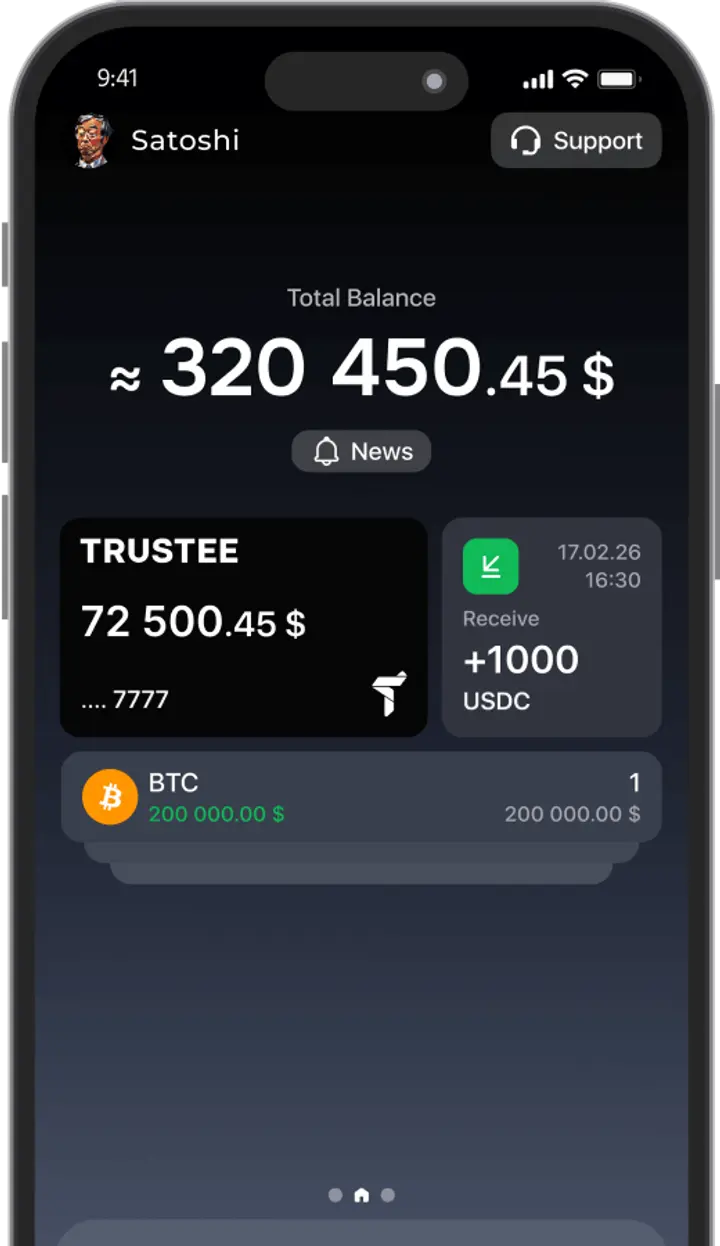
By the way, part of this journey has already been completed — and not somewhere in theory, but in applications people use every day. The same Trustee Plus, for example, removed this issue from the agenda long ago: the user simply converts cryptocurrency into USDC and spends it with a card, without diving into how much gas costs on the network or whether there are enough tokens to pay for the transaction. The fee for internal exchange is fixed, transparent and does not appear as an unpleasant surprise in the middle of a payment.
For the user, everything will look as simple as possible. Why? Because the technology has remained “under the bonnet”.
Gasless experience — a half-measure or a new network trend?
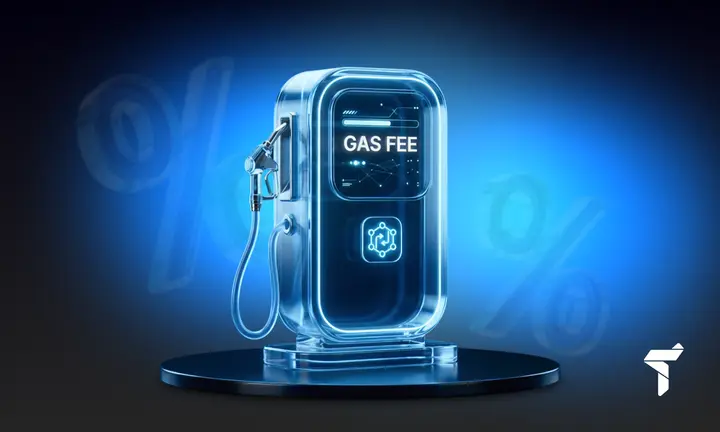
Did you know that Gas Fee is one of the strangest and most confusing concepts for newcomers to cryptocurrency? Yes, really. For us, these things are obvious, but people cannot understand why, in order to send a couple of dollars in USDT on the Tron network, they need to have some obscure cryptocurrency called TRX. Some crypto companies, understanding this user pain point, have taken the path of introducing fee-free transactions for stablecoin operations.
For example, Mysten Labs, the team behind the Sui blockchain network, made a major infrastructure breakthrough for stablecoins. In May 2026, they updated the Sui mainnet by introducing free transfer functionality for a whole list of stablecoins ($USDC, $FDUSD, $AUSD, $suiUSDe and so on).
A similar solution was proposed by Coinbase, the company behind the Base blockchain network, which, together with Circle — the issuer of the USDC stablecoin — introduced new smart wallet standards (Smart Wallets) and gas payments through special contracts (paymasters), which provide a gasless experience for stablecoin operations by default.
The death of “bridges”: an archipelago without ferries
Today, the blockchain industry resembles an archipelago of dozens of islands:
-
- Ethereum
- Solana
- BSC
- Tron
- Base
- Hyperliquid
- Arbitrum
- Polygon
- and many smaller ones.
Most likely not. But this is exactly what crypto bridges look like today. These bridges have become a connecting link that significantly helps develop cross-chain infrastructure, but at the same time they are one of the most vulnerable parts of the crypto industry. Just think how many high-profile bridge hacks have happened in recent years: the losses there are measured in billions of dollars.
Add to this the fact that the average user does not even suspect that their USDC on Ethereum and their USDC on Polygon are technically different tokens, even though they have the same name and price. For a person, they should be one and the same. Just money. Just a balance. Please keep all these confusing technical characteristics such as TRC-20 or ERC-20 to yourselves.
That is why the industry is moving towards full cross-chain interoperability. The relevant technical solutions are already taking shape: cross-chain compatibility and protocols such as Chainlink CCIP.
Blockchains are gradually turning into something like a single global database. You do not choose a network when making a transfer — you simply enter the recipient’s address or nickname, and the system itself decides which route will send the funds faster and cheaper.
The death of “network complexity”: why should you know about L2?
What are Rollups? What is Sharding? Why should an ordinary person understand these terms? These are technical engine details, not something you think about when getting behind the wheel of a car.
Applications (dApps) are gradually learning to hide under the bonnet which specific blockchain they run on. For the user, there should be only one interface and one balance — without being tied to a particular network.
A convenient analogy is Gmail. You do not think about which server in the US physically stores your email. It simply exists; it is simply available. Money should work the same way: it should sit “in a wallet”, not “on the Arbitrum network” or “on the Solana network”. Ultimately, this is exactly the logic custodial services such as Trustee Plus are moving towards, where the user simply sees a balance in cryptocurrency or euros, not confusion with networks, addresses and token formats specific to one blockchain ecosystem or another.
Which specific blockchain is currently carrying out the operation is now a software issue, not the user’s concern. A person should see one balance, one wallet and a familiar interface.
How does it work technically?
Let’s be honest: the main things the end user needs are a predictable result, speed and security.
People turn to a service to solve their tasks, not for a tour of code architecture. They do not care at all which blockchain a smart contract is deployed on, how many validators provide consensus or which cryptographic protocols are running “under the bonnet”. An investor, trader or ordinary buyer needs an intuitive interface where a transaction happens in a second and fees do not eat up half the profit.
But despite all the simplicity for the user, a rather complex infrastructure will be working behind the scenes. Although understanding it in detail will no longer be necessary.
What will make all this possible?
-
- Smart Accounts. Wallets are turning into full-fledged programs that search on their own for where to conduct a transaction more cheaply and quickly. This is no longer a static address, but an active participant in the process.
- Intents. The user simply states an intention: “I want to send 100 dollars to John.” That is all. The system itself finds the optimal route: it exchanges tokens, routes through a bridge if needed and returns the finished result. The person does not need to understand any of the intermediate steps.
This is not a futuristic fantasy, but the direction in which the industry is already moving — step by step, year after year.
Web3 = Web2, only without censorship

The ultimate goal of this entire evolution is to turn blockchain into an invisible backend. Simply a technology that works somewhere in the background and does not require any special knowledge from a person.
- We do not think about electricity every time we turn on a light.
- We do not analyse packet routing when opening a website.
The same will happen with blockchain.
- You will open an app.
- You will see your balance in a familiar currency: dollars or euros.
- You will press the “Send” button.
No 0x-addresses — or they will be hidden behind a QR code or a clear nickname, no gas confirmations, no mysterious errors like “Out of Gas” that scare even experienced users.
We are confident that in the near future people will use blockchain everywhere not because they are fascinated by networks and protocols or understand them, but because it is simply an ideal solution for storing assets, property rights or money transfers. Blockchain has entered our lives for the long term, if not forever.
The most successful technologies are almost invisible. This is the main goal of Web3 development. Not to make the technology more complex, but to make it so natural that the user applies it in everyday life and does not even think about how it all works.
Instead of a conclusion
People once said that the internet was too complicated. You had to configure modems, enter connection settings and understand dozens of technical terms.
This is exactly the future the entire blockchain industry is moving towards. Even today, many modern crypto services build their products around this idea: the user does not need to study the technical nuances of blockchain in order to store assets safely, make transfers or interact with digital finance. In particular, Trustee Plus also follows this principle, gradually removing unnecessary complexity and bringing cryptocurrency closer to familiar digital banking, while preserving the main advantage of Web3 — user control over their own assets.
Comparing cryptocurrency with banks is already a worn-out record that no longer surprises anyone. A much more accurate analogy is electricity. Most people do not know exactly how a generator at a power plant works, have no idea how current is transmitted between cities or why transformer substations are installed outside the window, but without electricity, life instantly stops.
The same will happen with blockchain. One day, we will simply stop noticing that we use it, just as we now do not notice internet protocols when using social networks or watching YouTube.
It is likely that words such as “blockchain” and “cryptocurrency” will be the first to disappear from everyday usage, because they will simply become part of everyday life. And perhaps it is at that moment that cryptocurrency will finally become truly mainstream.
FAQ — answers to common questions
Why does the article say that blockchain should “disappear”?
This is not about the death of the technology, but about it disappearing from the user’s field of view. Blockchain should work “under the bonnet”, just like internet protocols, banking processing or electrical networks do today. What matters to the user is the result: a fast transfer, a clear balance, security and control over assets, not the technical details of how the network works.
What is preventing mass adoption of cryptocurrencies today?
The main obstacle is the complexity of the user experience. Newcomers have to understand gas fees, networks, bridges, addresses, token standards, fees and transaction errors. As long as cryptocurrency requires too much technical knowledge, it remains a tool for enthusiasts rather than a mass-market financial service.
What are gasless transactions?
Gasless transactions are an approach in which the user does not see or pay the network fee separately. The fee may be built into the service, covered by the app, paid with another token or charged in the background. This format makes crypto payments simpler and closer to familiar bank card payments.
Why are crypto bridges considered a problem for Web3?
Crypto bridges help transfer assets between different blockchains, but they are often complex for ordinary users and remain one of the most vulnerable parts of crypto infrastructure. Because of bridge hacks, users lose not only funds, but also trust in the industry. That is why the future of Web3 is linked to cross-chain compatibility, where the system itself chooses a safe and cost-effective transfer route.
What are Account Abstraction, Smart Accounts and Intents?
Account Abstraction is an approach that makes crypto wallets more flexible and convenient. Smart Accounts turn a wallet into a smart program capable of independently choosing the network, fee and route for an operation. Intents allow the user to formulate only the end goal, for example “send 100 dollars”, while the system performs all the technical steps itself.
What will Web3 look like for an ordinary user?
The ideal Web3 will resemble the convenience of Web2, but with the advantages of blockchain: control over assets, transparency, security and less dependence on intermediaries. The user will see a clear interface, a familiar balance currency and simple action buttons, while networks, fees, bridges and protocols remain an invisible technical part of the service.